On January 13, 2077, the government signed a memorandum of understanding through the Investment Board Office to prepare a detailed feasibility study report for Risen Energy JVSAG of Singapore, but since then, although the necessary process has progressed, the project construction has not yet started.
We use Google Cloud Translation Services. Google requires we provide the following disclaimer relating to use of this service:
This service may contain translations powered by Google. Google disclaims all warranties related to the translations, expressed or implied, including any warranties of accuracy, reliability, and any implied warranties of merchantability, fitness for a particular purpose, and noninfringement.
Even after five years, the 250 MW solar power project to be built at Kohalpur in Banke and Wanganga in Kapilvastu is still confined to paper. Although the Detailed Feasibility Study Report (DFSR) of the project has been prepared, the project has not taken off.
On January 13, 2077, the government through the Board of Investment office signed a memorandum of understanding with Risen Energy JV of Singapore to prepare a detailed feasibility study report. But since then, although the necessary process has progressed, the project construction has not yet started.
There is a plan to build 78.16 megawatt solar projects in Banke's Kohalpur and 171.9 megawatts in Wanganga in Kapilvastu with a total capacity of 250 megawatts. Battery storage plants of 12.5 and 27.5 MW capacities are also said to be in place at Kohalpur in Banke and Wanganga in Kapilvastu. According to the MoU, Risen Energy had to submit DFSR within 12 months.
The 44th meeting of the Investment Board held on 5 June 2077 allowed the company to prepare DFSR. The board said that the project will be the largest solar energy project in Nepal so far. The company prepared the feasibility study report of the project on 20 July 2079 and submitted it to the Investment Board office. After immediate feedback, the company submitted the revised feasibility study report to the Board of Investment office on 19 July 2080.
The DFSR prepared by Risen Energy was formally submitted at the 55th meeting of the Investment Board held on 8 August 2080. But the said meeting took 'information' of the feasibility study report to complete the environmental impact assessment. But the board has not approved the DFSR.
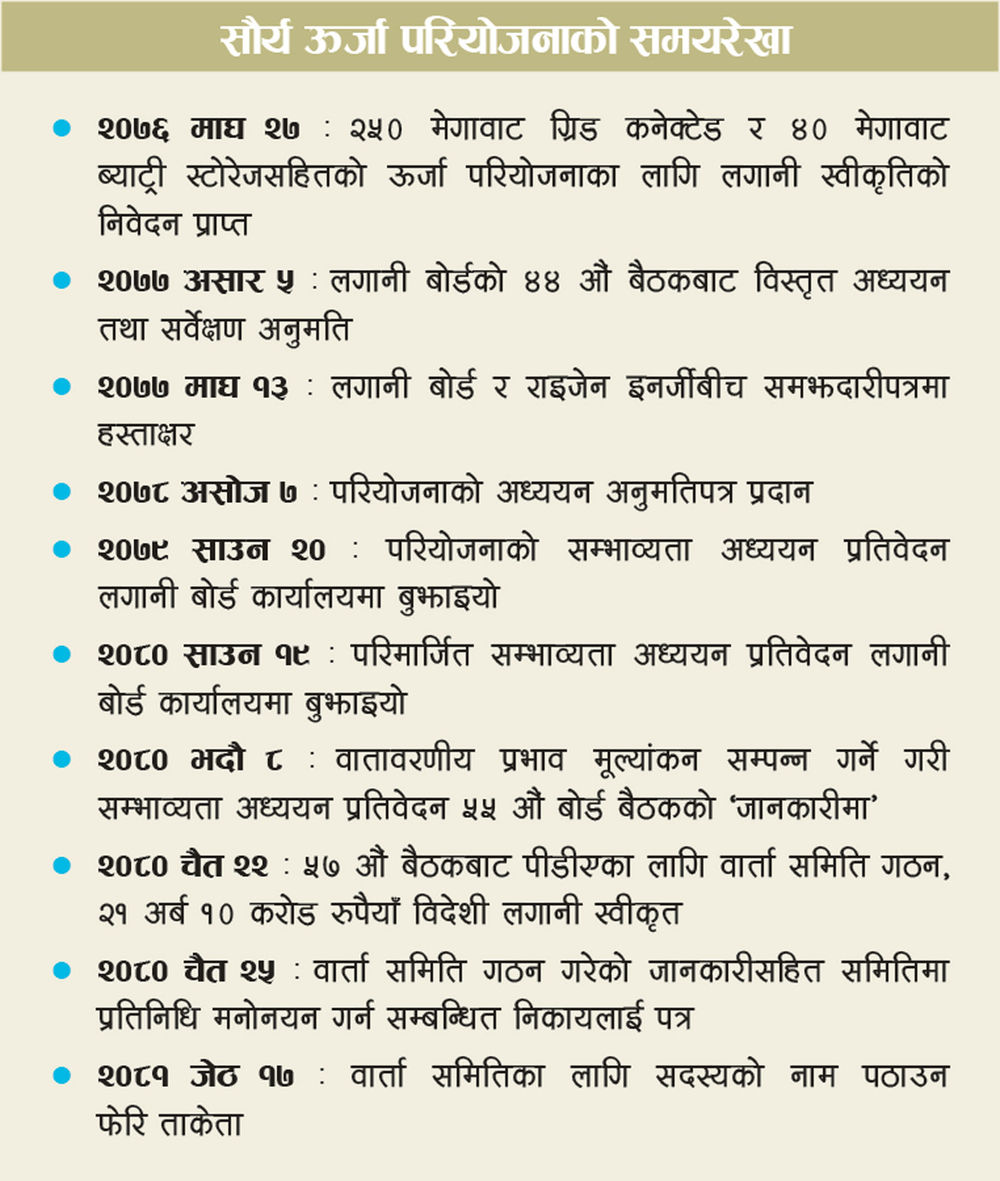
The 57th meeting of the Board of Investment held on 22 Chait 2080 approved foreign investment of 21 billion 10 million rupees for the project. The project, which is supposed to be built with 100 percent foreign investment, is still in confusion. In the same meeting, it was decided to form a committee under the chairmanship of the Chief Executive Officer (CEO) to negotiate with the developer company to enter into a Project Development Agreement (PDA). At that time the CEO of the board was Sushil Bhatt, now it is Sushil Gyawali. But due to the delay in appointing the representatives of various concerned ministries in the said committee, the negotiations could not proceed.
The investment board office sent a letter to the concerned body to nominate a representative for the committee with the information that the negotiation committee has been formed on 25 March 2080. Since then, even on 17th June 2081, the board has informed that the names of the members for the negotiation committee should be sent. But so far, only the law ministry has sent the name of the representative, said Pradyumna Upadhyay, spokesperson of the Board of Investment office. He says that the relevant ministries including energy, forest and environment have not sent the names of the members of the negotiation committee.
Due to administrative delay and lack of priority, the project to bring in 100% foreign investment has not been able to gain momentum, according to the concerned bodies. According to the Investment Board Office, the Environmental Impact Assessment (EIA) report of the solar project has been prepared. But the report is yet to be sent to the Ministry of Forests and Environment for approval. The total estimated cost of the project will be around USD 158.5 million (roughly over Rs. 21 billion). Electricity generated in Kohalpur and Wanganga is envisioned to be directly connected to the national transmission line.
The government has adopted a policy of energy mix to solve the energy crisis. The government has adopted a policy of energy mix by releasing the concept paper 2072 on the prevention of national energy crisis and electricity development decade. It is mentioned in the concept paper that the production mix of the project will be determined according to the type of hydropower project with the aim of ending load shedding from Nepal's production in the long term.
According to the concept paper, the electricity generated from reservoir projects will be 40 to 50 percent, 15 to 20 percent from semi-reservoir projects, 5 to 10 percent from run-of-river (ROR) and other alternative sources. But till now the total connected electricity capacity is 3591 megawatts, solar energy is only 116.94 megawatts. Alternative sources such as solar power are said to be brought into the mix along with hydroelectric power, but the policy taken by the government has been limited to paper because it could not be implemented.

