The study committee chaired by the then director of the board, Phaninder Gautam, concluded that most of the founder shares of the listed companies in the sector, except for banks and financial institutions and insurance, were converted into public shares after the end of the 'lock-in' period, which caused problems in the company's operations.
We use Google Cloud Translation Services. Google requires we provide the following disclaimer relating to use of this service:
This service may contain translations powered by Google. Google disclaims all warranties related to the translations, expressed or implied, including any warranties of accuracy, reliability, and any implied warranties of merchantability, fitness for a particular purpose, and noninfringement.
A study report of the Nepal Securities Board has pointed out that when the founder shares of listed companies are changed to common people all at once, there will be problems in the overall operation of the company. The study committee chaired by the then director of the board, Phaninder Gautam, concluded that most of the founder shares of the listed companies in the sector, except for banks and financial institutions and insurance, were converted into public shares after the end of the 'lock-in' period, which caused problems in the company's operations.
The report, titled 'Study on the current state of the share structure of the listed companies of the hydropower group and its impact', has suggested that a maximum of 19 percent can be given at a time when the securities board approves the change of the founder's shares to common shares. The report suggests that this arrangement should be made in the case of listed companies in all sectors that do not have direct regulatory bodies except for banks and financial institutions and insurance. In the
report, it is mentioned that in the case of hydropower group companies, approval should be given to change from founder shares to public in accordance with the percentage that will be proportionately based on the period (pay-back period) that the related company promised to return money to the public when issuing the IPO.
Especially the founding shareholders of hydropower companies have increased tendency to sell many shares at once after the 'lock-in' period and this has started causing distortions, the board formed a study committee with experts under the coordination of Gautam. The report submitted by the committee was approved by the board of directors of the Securities Board and decided to implement it. However, even though it has been almost 2 years since the report was submitted, neither the board has implemented the recommendations nor has the report been made public.
Since the Securities Board could not make a concrete decision regarding the system of converting the founder shares to the general public, now the dispute regarding the 'International Securities Identification Number' (IZIN) is intensifying. Experts say that if the report was implemented on time and a solid policy arrangement could be made regarding the conversion of the founder's shares to the general public, there would not be any dispute in relation to Aizen.
Although the recommendations of the report have been gradually implemented, officials of the Securities Board claim. "The study reports made by the board have been implemented in a timely manner, this report is also being implemented in the same order," said Niranjay Ghimire, the spokesperson of the Securities Board. The
report has shown that most of the founder shareholders of the hydropower projects are exiting the secondary market by selling their shares after the end of the 'lock-in' period. The report points out that the founding shareholders themselves do not believe that the hydropower project they have established will give good returns in the long run. "When studying the details and documents of 43 companies listed in NEPSE at that time, it was seen that the founders of 20 hydropower companies sold their shares after the 'lock-in' period was over," the report said.
The coordinator of the study report and the current secretary of the government, Fanindra Gautam, says that the founder shareholders of Jalvidyut should not be allowed to sell their shares at once. "Currently, in the hydropower sector, the founders sell their shares quickly, so the company is like an abandoned asset," he said, "hydropower companies are more sensitive than other companies." Therefore, we asked them to make the criteria for sale of shares according to the conditions. Do not sell all the shares at once. We have said that we should not give IPO and FPO at the same time, we will give it only after commercial production starts.
While studying and analyzing the share structure of listed hydropower sector companies, the report also showed that there was no change in the ownership of the companies by the government and subordinate bodies. "When the founding shareholders sell their shares at once, the construction and operation of the company is disrupted, the general public loses confidence in this sector, so there is a lack of capital," the report says. It is mentioned in the report to investors.
Neeraj Giri, ex-executive director of the Securities Board, is of the opinion that it is not right for a major shareholder of any company to exit the company soon, not only hydropower. Who are the main founding investors when the general public invests shares in the IPO? What will happen to the corporate governance of the company when they are the ones who are going to invest based on that? Does it have a problem with the company? He says that questions will arise.
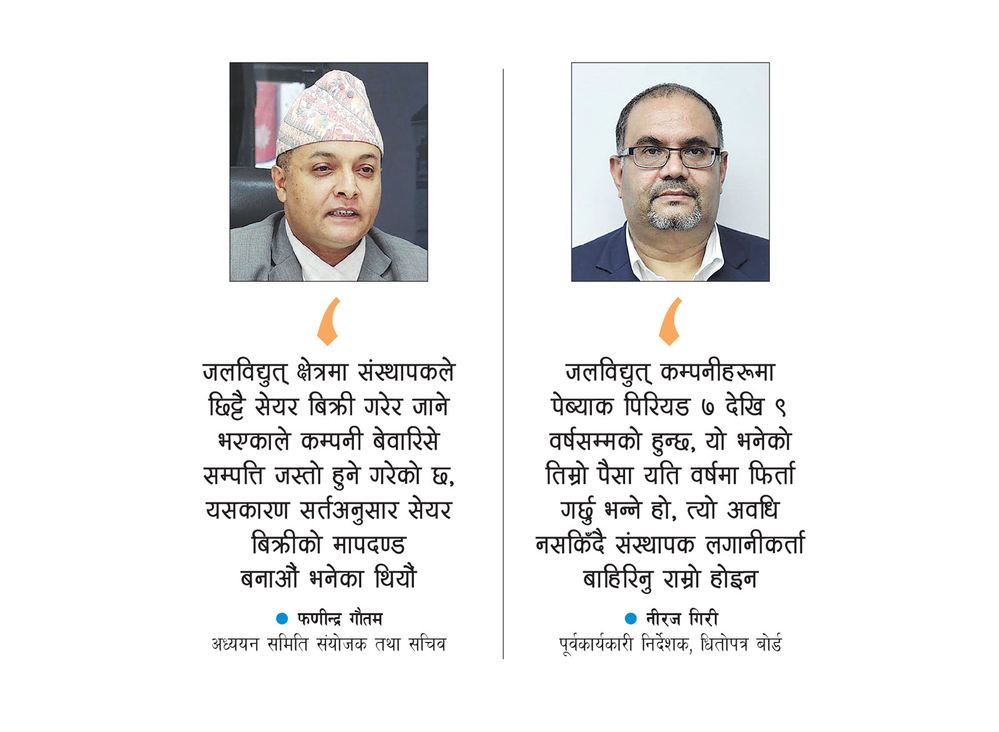
The exit of the main shareholder of a running company is also a sensitive information that affects the price. Because they know all the inside information of the company," he said. "Generally, the payback period in hydropower companies is 7 to 9 years. This means that you will get your money back in so many years. It is not good for the founder investor to leave before the end of that period.'' "For this reason, even when I was still in the securities board, efforts were made to increase the pay back period, but it was not possible," he says.
As of Friday, 91 companies in the hydropower sector have been listed on the Nepal Stock Exchange (NEPSE). The number of companies that have received approval from the board for public issue and are in the pipeline is constantly increasing. Out of the total number of companies listed in NEPSE, the sector with the largest number of companies listed is hydropower.
There are four types of shareholders among the investors of the organized organization: those who invest in the founding shares of the company establishment, the employees of the organization, the local people of the project-affected areas, and the general investors who invest in the shares when the organization makes a public issue of securities.
Among these, there is a provision of 'lockin period' for the shares purchased by the founders, employees and project-affected people, apart from the shares of the general public. Shareholders in these groups cannot sell their shares for three years after the company sells shares to the public.
After issuing shares to the general public, they have to start expanding their business more aggressively, and selling all the shares themselves, the experts say, is a confirmation that the builder himself does not have faith in the company. Analyzing the capital structure and cost situation of some of the listed companies of the hydropower group, the report showed that most of the hydropower companies have borrowed more than their equity capital.
Some projects have also been shown to inflate costs unnaturally. In this way, the report mentions that even the hydropower companies which cannot give returns to the investors due to high costs have been listed in the secondary market. "When studying the cost per cubic meter of listed hydropower companies, it was found that the lowest cost per cubic meter was 135 million and the highest cost was 314 million 48 million," said the report.
The report concluded that the interest of investors needs to be protected as there is a high level of debt compared to capital. Since the debt/equity ratio of hydropower companies is very high, the report also suggests that early issuance of hydropower group organizations, rights issuance and share structure should be made more systematic in order to protect the interests of investors. Therefore, it has been emphasized that the legal provisions related to securities should be amended and made necessary.
In order to protect the interests of investors, the committee suggests that the current share structure of the listed companies of hydropower group should be amended as it is not practical. "Since the project period of the hydropower sector companies is for a fixed period, after the transfer of the project to the government, regarding the equity investment and share structure, a high-level mechanism should be developed between the Ministry of Finance, the Ministry of Energy, and the Securities Board, and a solid and clear policy should be made by submitting a proper proposal to the government," the report states. The report also suggests that the founder should retain at least 30 percent of the shares for 7 years, while the board approves the securities, the company's payment period should be based on the proportional percentage to be converted from the founder's shares to the general public. The report also asked for more policy arrangements regarding the fact that hydropower group companies have not completed their projects for three years after their initial listing.
The study committee has also suggested in the report that for the public share issue, the hydropower company must submit a certified statement that at least 50% of the physical infrastructure progress required to function according to its purpose has been completed, and the funds received by the hydropower company from the public issue should only be used for bank loan repayment purposes or the completion of the company's ongoing construction.
The report was submitted by the study committee to the Board of Directors of the Securities Board a year ago (on 080 June 15). Based on the report, the board issued some general instructions but still kept the report confidential. The report has raised some serious questions regarding the listed companies of the hydropower group. Officials of the Independent Power Producers Association (IPPAN) therefore expressed displeasure over the report. After that, a meeting was held between the Securities Board and IPPAN and they agreed on some points.
According to the agreement made on August 24, 2080, it is mentioned that the progress of the physical infrastructure required for the hydropower company to carry out its purpose is at least 50 percent completed, and the application process will be proceeded with the board along with the details certified by the relevant bank from which the company has taken a loan. After the hydropower company submits a certified statement that at least 65 percent of the physical infrastructure has been completed, the board of directors must submit a commitment to provide the final approval from the board, to use the capital obtained from the initial issuance by the hydropower company for bank loan repayment purposes or for the completion of the company's ongoing projects.
Similarly, the investment return of the hydropower company's project should be more than 12 percent, the company's net worth should not be less than the paid-up capital, but this provision will be applied only to companies that will be registered with the board in the future, and it will not be applicable to companies that have already registered with the board.