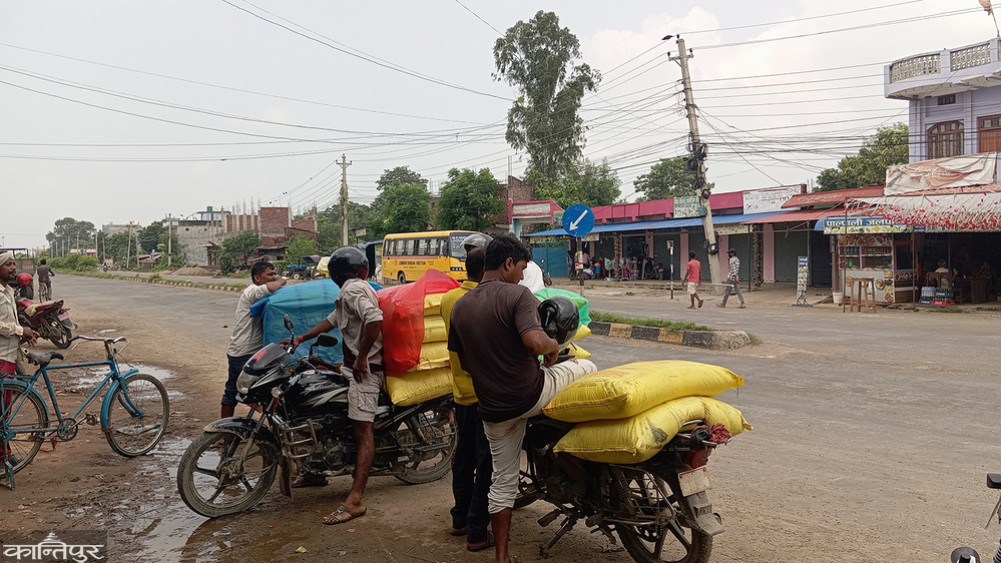
As cooperatives are unable to supply fertilizers to the villages, farmers are buying fertilizers imported from India at high cost.
We use Google Cloud Translation Services. Google requires we provide the following disclaimer relating to use of this service:
This service may contain translations powered by Google. Google disclaims all warranties related to the translations, expressed or implied, including any warranties of accuracy, reliability, and any implied warranties of merchantability, fitness for a particular purpose, and noninfringement.
Farmers of Marchwar area of Rupandehi, who were forced to eat dry food a month ago due to lack of rain, have now become victims of 'black market' of chemical fertilisers. As there is not enough available in the country, they are forced to pay high prices depending on Indian fertilizers.
Urea fertilizer is being distributed in the village at a cost of Rs 900 per bag. However, they are buying Indian urea fertilizer brought to their doorsteps for 2500 to 3500 rupees per bag after not getting it from the local cooperative.
According to common people, the manure brought overnight from India to the border area is delivered to the local market and doorstep by some people. Farmers said that when the green rice in the field did not get fertilizer, they were buying the fertilizer that was transported in this way at a high price. Ramashankar Yadav of Sammarimai-7 Betkuian in Rupandehi said that the price of a 45 kg bag of urea fertilizer is 280 Indian rupees in the Indian market. According to him, the people involved in transportation bring manure from India for a maximum of 600 rupees per bag and store it in the border area towards Nepal. "The price of fertilizer is 2200 rupees per bag as soon as it is brought to the border," he said. For the convenience of the farmers, the Nepali administration has been relaxing the security in the transport of manure as it cannot be supplied as per the requirement within the country. However, farmers are sad after having to pay triple the price of fertilizer which is available at 900 rupees per bag in the local area. Farmers are worried after starting to black market instead of eating proper profit of fertilizers brought from India .
73-year-old Najabuddin Muslim of Sammarimai-7 needs 40 bags of urea fertilizer every year. This time too, rice is flourishing in his field . As the water is sufficient, it is time to spread the fertilizer . "Until now, one bag of fertilizer has not been taken from the cooperative," he said, "We have to purchase 3500 rupees per bag from the fertilizer carrier from India." "Earlier there was a problem due to lack of rain," he said, "now it is sad not to get fertilizer, I will be happy the day I get fertilizer." He said that he has received two sacks of urea from the cooperative so far. "The fertilizer here is not enough," he said, "now I am looking for Indian fertilizer." He has no savings to buy fertilizer. Therefore, every year, he takes a loan from the local Shree Mahalakshmi Swavalamban Savings and Loan Cooperative to buy fertilizer. He said that he has already given a loan of 1 lakh to buy fertilizers and to avoid household debt. "If the paddy grows well, it will fill the stomach," he said, "otherwise, we have to take a loan to buy fertilizer." However, now they are upset after suddenly increasing the price and starting to sell.
According to local leader Ram Vikas Chaudhary, until 2-3 years ago, chemical fertilizers were cheaper in India than in Nepal. Therefore, the border farmers used to supply the shortage by transporting fertilizers from India . Until then, the price of Indian fertilizer was at most 500 to 1000 rupees. "The price has increased due to smugglers," he said, "They bring it from India at night and store it in the border area." He said that smuggling is widespread as urea fertilizers are used in non-agricultural purposes such as plywood and alcohol. "It is being sold at Rs. 22500 per sack," he said.
Fertilizer has been transported through Jhulnipur under the Bhairahawa-Lumbini road section from Tuesday. There are godowns of smuggled manure in Rohini, Marchwari and Lumbini areas of the district. Farmers buy and use from those godowns at a high price. Sammarimai-7 is about 14 km south of the Indian border from Betkuiyan. Shortage in
co-operatives
Co-operatives selected for distribution have not been able to supply fertilizers as per the demand . As a result, farmer-farmer conflicts have increased. According to Mahesh Lodh, manager of Shree Mahalakshmi Swavalamban Savings and Credit Cooperative located at Sammarimai-7 Betkuiyan, the co-operative has been entrusted with distributing fertilizer to 1,100 households in 10 villages. Rice has been planted in more than 800 bighas in that village. One bigha requires one quintal of urea. In this way, he said, 800 quintals of fertilizer are required to be delivered to all farmers.
At least 1,700 sacks of urea are needed to deliver to everyone . So far, 850 sacks of fertilizer have been supplied by agricultural material companies and salt trading. "Fertilizer disappears in the agricultural material company," he said, "here the farmers are forced to buy Indian fertilizer." Lodh said that due to the distribution of less fertilizer, conflict has arisen in the cooperative. According to him, the farmers who have already paid the money ask for the money back after not getting the fertilizer. Farmers queue up in front of the cooperative from midnight on the day of fertilizer distribution. After the cooperative opens at 7 in the morning, the jostling for the mall starts . ``Even if we try to deliver to everyone, we are scolded,'' he said, ``We call the police on the day of manure distribution because of tension.''
According to Ashok Kumar Tiwari, manager of Bhawani Swavalamban Multipurpose Cooperative located in Sammarimai-5, 10,000 sacks of manure are needed for the 1,600 households in the ward. He said that 1000 sacks of fertilizer have not been supplied yet. So far only 340 bags have arrived. Every year, 10,000 sacks of fertilizer are required for 11 villages under the cooperative's working area. Only 2000 sacks are supplied during the year. He said, "The rest of the country has to live by buying fertilizer brought from India. Democracy has not come to the people." He said that it is not easy to take fertilizer from India. According to him, when going to buy fertilizer, Indian security personnel interfere. He said that the farmers are also suffering from the native security personnel after coming to Nepal after suffering mistreatment and bringing manure.
Administration's 'neglect'
In the rural areas, the black market of manure is openly imported from India, but it has been found that the administration has neglected to control it . According to the locals, fertilizers are being sold in the settlements near the border area. Local eyewitnesses say that in the northern part of the district, manure is often transported in the evening, morning and night. Those involved in fertilizer smuggling have been delivering such fertilizer to vacant buildings and agrovets in places. "It is not a big deal for farmers to bring fertilizers from India and sprinkle them on the fields," said Jitendranath Shukla (W), the former chairman of Sammarimai Rural Municipality, "People's representatives and the administration should have at least controlled the black market, they did not see that role."
Deputy Superintendent of Police Suraj Karki, the spokesperson of the District Police Office, said that despite the strictness, the feces may have been introduced through the eyes of the security personnel. "We have not allowed the open import of manure," he said, "If it is smuggled and sold at a high price, it is black market, it will be regulated."
He said that the price of illegally imported fertilizer will not be fixed and action will be taken if it is black marketed. Chief District Officer Tokaraj Pandey said that due to the fact that armed police are doing the work of district border surveillance, necessary action will be taken after receiving information about smuggling of manure and black market in the bordering municipality. "I will get information about what happened in the mall," he said, "if necessary, we will investigate by sending a monitoring team."