Delayed planting and less planting in arable land results in lower yields. Imports also increase naturally.
We use Google Cloud Translation Services. Google requires we provide the following disclaimer relating to use of this service:
This service may contain translations powered by Google. Google disclaims all warranties related to the translations, expressed or implied, including any warranties of accuracy, reliability, and any implied warranties of merchantability, fitness for a particular purpose, and noninfringement.
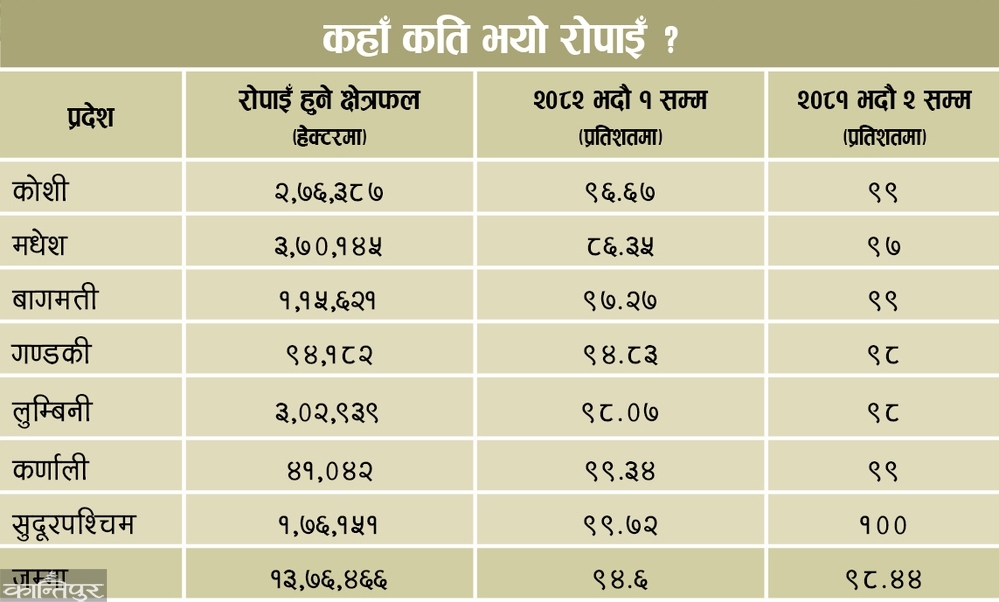
Although the monsoon has been active on time, due to lack of rain in Madhesh, Gandaki and Koshi, about 5 percent of the arable land has not yet been planted this year. According to the Center for Crop Development and Agricultural Biodiversity Conservation, only 94.6 percent of the crops have been planted by August 1.
"Now the data to come is final, planting has been completed in Bagmati, Lumbini, Karnali and Far West," said an official of the Ministry of Agriculture and Livestock Development, "Due to drought, there was no good planting in Madhesh." Same is the case with Koshi and Gandaki. Now the planting is not very important, there will not be a good return.'
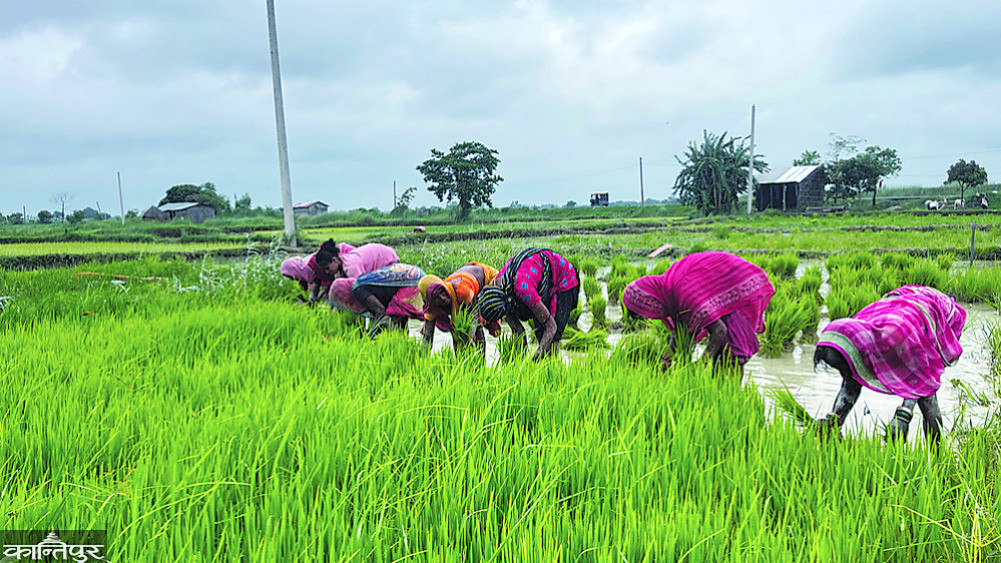
The rice seeds are scattered due to the late planting. Planting has taken place in some areas, albeit later than clearing the land. But the analysis of the ministry is that the production is not as expected. According to the ministry, about 1.2 million tons of rice is insufficient for the country. Delayed planting and less planting in arable land results in lower yields. Imports also increase naturally. According to the customs department, 500,000 tons of rice (including seeds) worth 20.35 billion were imported in the last financial year.
According to the data of the department, 241 thousand tons of rice was imported worth 18 billion 66 million. In the last fiscal year 2081/82, 5955 thousand 476 tons of rice was produced. This amount is 231 thousand 242 tons more than the financial year 2080/81. Even though the production increased by about 200,000 tons, rice worth billions of rupees was imported.
Madhesh, which is considered the capital of rice, has not been planted. The ministry official said, "There is no doubt that the production will decrease. But how much it will decrease, it is not possible to say now. This year till August 1, only 86.35 percent planting has been done in Madhesh. According to the
center, dry paddy is planted on 370 thousand 145 hectares in Madhesh. Out of this, 3 lakh 19 thousand 626.78 hectares have been planted. Last year, at this time, 97 percent of the land had been planted. 276 thousand 386.73 hectares are planted in Koshi. Till August 1 this year, 96.67 percent planting has been done in this province. Last year, 99 percent planting was done.
In Gandaki, only 94.83 percent planting has been done. While last year, 98 percent planting was done in this province. Barkhe paddy is planted in 94 thousand 182 hectares in Gandaki. Keshav Devkota, head of the center, said that although the planting has been completed in four provinces, planting will continue for one more week in other provinces. The center has said that planting has been completed in Bagmati, Lumbini, Karnali, Far West. In these 4 provinces alone, 2 thousand 142.166 hectares of arable land were not planted compared to last year. According to the data of
center, 2 thousand 5.21 hectares of arable land in Bagmati were not planted. Barkhe paddy is planted in 1 lakh 15 thousand 621.25 hectares in Bagmati. This year, 97.27 percent i.e. 1 lakh 12 thousand 459.82 hectares have been planted. While last year, 99 percent i.e. 114 thousand 465.0375 hectares were planted in Bagmati.
In Far West, 499 hectares were not planted. In the Far West, 176,151 hectares of rice are planted. This year only 175 thousand 652 hectares of rice have been planted. This is 99.72 percent. Last year, 100 percent planting was done here.
In Lumbini, planting has increased in 222.78 hectares. 3 lakh 2 thousand 939 hectares are planted in this province. This year, till August 1, 297,133 hectares have been planted. It is 98.07 percent. Last year, only 98 percent planting was done. Plantation has increased in 139.264 hectares in Karnali. 41 thousand 42 hectares of rice are planted in this province. This year, 40 thousand 770.844 hectares have been planted. This is 99.34 percent. Last year, only 99 percent planting was done, the center said.