Nepal Oil Corporation has said that the factory can be opened in collaboration with Indian Oil Corporation (IOC). The representative of Chaudhary Group, who participated on behalf of the private sector, was of the opinion that the factory could be opened in a public-private partnership.
We use Google Cloud Translation Services. Google requires we provide the following disclaimer relating to use of this service:
This service may contain translations powered by Google. Google disclaims all warranties related to the translations, expressed or implied, including any warranties of accuracy, reliability, and any implied warranties of merchantability, fitness for a particular purpose, and noninfringement.
Prime Minister KP Sharma Oli has shown interest in opening a fertilizer factory after the shortage of chemical fertilizers has increased every year. Prime Minister Oli held a discussion with Agriculture and Livestock Development Minister Ramnath Adhikari and Industry, Commerce and Supply Minister Damodar Bhandari last Tuesday after farmers faced shortage of fertilizers.
In the discussion, he has also instructed both the ministers to prepare a blueprint for opening a fertilizer factory.
As a result of this, Industry Minister Bhandari held a discussion with officials from the Department of Industry, Oil Corporation, agricultural materials companies and the private sector on Wednesday. In the discussion, it is said that topics such as fertilizer demand, production, investors, and technology were discussed.
Nepal Oil Corporation has said that the factory can be opened in collaboration with Indian Oil Corporation (IOC). The representative of Chaudhary Group, who participated on behalf of the private sector, was of the opinion that the factory could be opened in a public-private partnership.
'Enough fertilizer can be produced from a factory that will be opened with an investment of more than one billion. If production is based only on the country, the investment will be wasted. Everyone was of the opinion that the factory should be opened with export modality,'' said an officer who participated in the discussion.
This is not the first time Prime Minister Oli has shown interest in opening a fertilizer factory. For many years, the government has been raising the issue of opening a fertilizer factory. But when the demand for fertilizers increases, the idea of opening a factory also disappears.
In 2041, a study was conducted to open a urea fertilizer factory in collaboration with the Japan International Cooperation Agency (JICA). JICA concluded that the cost of running the factory would be high and there would be problems in marketing after production. Government policies and programs and budgets also mention factories.
The report was also prepared by the task force formed under the coordination of the then Agriculture Secretary Rajendra Bhari. The preliminary report submitted to the then Agriculture Minister Ghanshyam Bhusal in October 2077 suggested that it is possible to open a fertilizer factory and to conduct a more detailed technical study.
The cabinet meeting on 24 October 2077 formed a high-level working group under the coordination of then finance minister Bishnu Paudel. The then Industry, Commerce and Supply Minister Lekhraj Bhatt and Agriculture Minister Padmakumari Aryal were in the task force. The high-level task force submitted its report to the then Prime Minister KP Sharma Oli in Chait 2077. The task force suggested that a fertilizer factory based on natural gas can be established and operated. It was concluded that the initial investment would be 1 trillion 3 billion rupees.
The cabinet meeting of Chait 2077 approved the operation of the fertilizer factory. It was decided to entrust the Board of Investment to prepare and implement the procedure for setting up the factory in Public-Private Partnership (PPP) model and to build the infrastructure. In the report prepared by Germany's DIAG Industries GmbH, the board has submitted options including natural gas technology or water electrolysis technology. The
report pointed out that it will cost 1.5 trillion to operate the fertilizer factory. It is mentioned in the report that 7 lakh tons of fertilizer can be produced annually from the factory. Even now, Oli is the prime minister and Paudel is the finance minister. The talk of opening a fertilizer factory has come again after the government's all-round opposition due to lack of fertilizer during rice planting.
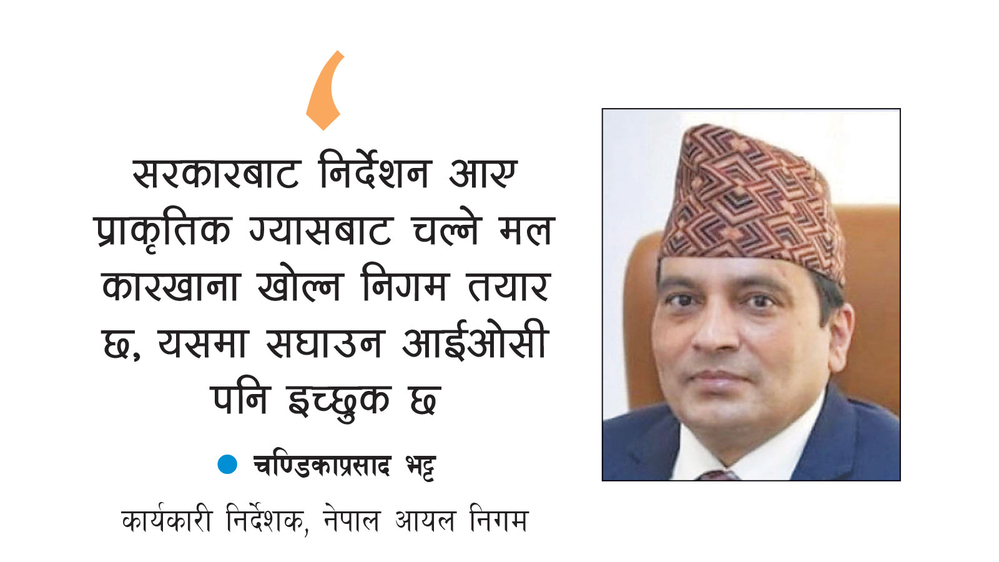
Executive Director of Oil Corporation Chandika Prasad Bhatt said that the corporation is willing to open a fertilizer factory under the government's instructions. Opening a factory is not enough just to look at the market of Nepal, we also need a strategic partner, with the help of which the product can be bought back. For this, the private sector should also come in," Bhatt said, "IOC is ready to invest in fertilizer factories, and if the government goes ahead, the corporation is also ready."
Bhatt said that the factory can be opened using natural gas. Recently, a preliminary study has shown that Dailekh has 112 billion cubic meters of natural gas. The corporation concluded that the said gas can be utilized.
Every year, billions of rupees are spent on fertilizer import. 31 billion 1 crore in 2079/80, 24 billion 34 crore in 2080/81, 27 billion 95 crore in 2081/82 were imported fertilizers. 28 billion 82 crores have been allocated in 2082/83 for the purchase of fertilizers. But farmers have not been able to get fertilizer easily.
According to the Ministry of Agriculture, about 1.3 million tons of fertilizer is needed annually. It is planned to import 6 lakh tonnes of fertilizer in the current year. The ministry says that due to excessive subsidy on fertilizers, the available budget could not meet the demand and bring fertilizers.

