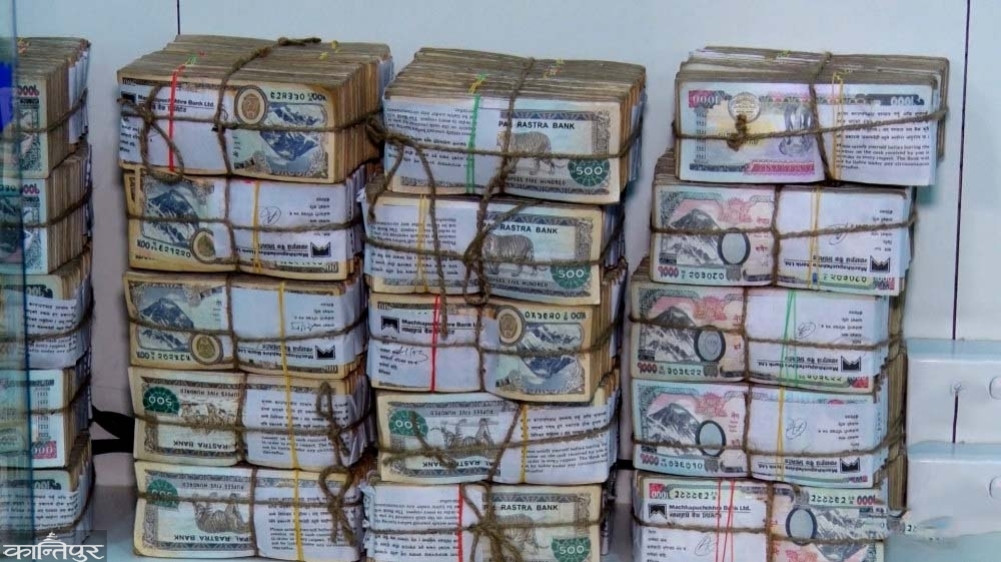
Profit increased due to reduction in loss provision, loan recovery and increase in non-interest income due to loose policy, 16 out of 20 commercial banks increased profit, 4 decreased.
We use Google Cloud Translation Services. Google requires we provide the following disclaimer relating to use of this service:
This service may contain translations powered by Google. Google disclaims all warranties related to the translations, expressed or implied, including any warranties of accuracy, reliability, and any implied warranties of merchantability, fitness for a particular purpose, and noninfringement.
Commercial banks have increased their profits by an average of 43 percent in the financial year 2081/82, when the market demand is not increasing as expected due to the economy not being viable.
Although the target of the National Bank was to increase the credit by 12 percent in the last fiscal year, the credit flow was barely around 8 percent in the last 12 months. Out of the 20 commercial banks operating in the last financial year, 16 have increased their profits while 4 have decreased.
In the last fiscal year, even though there was an average of 6 trillion more liquidity every month, due to the loose policy made through the monetary policy, less amount had to be set aside for losses, the government paid the amount of the builders, their loans were recovered, and the increase in fee income is the reason why the profit of the banks increased on average. According to the financial statements published by the
banks, in the last financial year 2081/82, commercial banks have earned a total net profit of Rs 71 billion 51 crore. This is an increase of about 43 percent over the previous financial year. The unrefined financial statements published by the banks showed that the profit of the banks increased by about 43.39 percent in the fourth quarter of the last financial year. The total profit of 20 commercial banks operating in the financial year 2080/81 was 49 billion 87 crore rupees.
Bhuvan Dahal, the former president of Nepal Bankers Association, said that the profit of many banks has increased due to the decrease in bad loan provisions of banks compared to the previous year. Some banks' operating profits have increased, some have decreased. The fee income (non-interest income) has increased, along with the expenses have also increased," he said. "Overall, the financial situation is improving. Non-performing loans (NPAs) have not decreased compared to the previous year, but have increased. In the previous year, due to bad loans, a lot of provisioning had to be made. Last year, less amount had to be allocated. This has seen an increase in profit.'
Dahal says that the increase in fee income of banks should be understood as an increase in economic activity. He said that although there is some reduction in interest income due to competition, the increase in other charges should be taken as a sign that the LC is open for imports and economic activity is about to start.
Out of the 20 commercial banks in operation, 16 have increased their profit in the fourth quarter, while the remaining 4 have decreased. Even among the banks with increasing profits, the growth rate of some of them seems to be very abnormal (high rate). The growth rate of some of those banks has increased by 100 percent, while some of them have increased by more than that. The reason for this is that banks compare the unrefined data of the fourth quarter of last year with the refined (audited) data of the previous financial year. Always compare with the bank's statement for the same period last year. Compared to the unrefined data of the fourth quarter published by the banks last year, there is a lot of difference between the refined data and it is seen that the profit has increased by a lot compared to that.
In plain language, banks showed much lower profits on refined (audited) statements than they did on unrefined financial statements last year. A banker said that comparing the profit of last year's unrefined statement compared to the same low profit, the profit of those banks has increased by a lot.
Banks with higher profit growth rates include Kumari, Nepal, Rashtriya Komerzi, Prabhu Bank and others. According to Santosh Koirala, president of Nepal Bankers Association, even though a difference of up to 15/20 percent is considered normal in the unrefined and refined data of banks, it is not a good practice to have too much difference. Admitting that there was a big difference between the unrefined and refined statements of some banks, he said, "This is not a good practice." Even if there is something like that, the regulatory body will look into it.
According to the financial statement, Nabil is the most profitable bank in the fourth quarter. NIC Asia Bank has the lowest profit. Nabil Bank earned a profit of Rs 7 billion 12 crore last year. During the same period, the profit of NIC Bank is only 16 crore 15 lakh rupees. Last year, Nepal Investment and Global IME Bank earned a profit of more than 6 billion, while the profit of Prabhu Bank is 5.44 billion rupees.
Everest, Krishi Bikas, Lakshmi Sunrise and Prime Bank have made a profit of 4 to 5 crores. The profit of National Commercial Bank, Nepal, Siddharth, NMB and Standard Chartered Bank is between 3 billion to 4 billion. While the profit of Sanima, Kumari and Machhapuchhre Bank is between 2 to 3 billion, the profit of Nepal SBI, Himalayan and Citizens Bank is between 1 to 2 billion.
Global IME Bank Chief Executive Officer Surendraraj Regmi says that profit has increased in the fourth quarter compared to the third quarter due to improvement in recovery. "In the third quarter of the last financial year, the distributable profit of most commercial banks was negative, in the fourth quarter, their dividend distribution capacity has increased," he said. This has also helped in increasing profits. More than that, because of the improvement in recovery, the profit may have improved.'
Overall, the financial sector appears to be on the road to recovery. While distributable profits of a few banks have declined, most have increased. Banks seem to be able to distribute dividends at an average rate of 12/13 percent. Regmi said that this also confirms that the financial sector is in a state of improvement.
Banks say that the easy arrangements made in the monetary policy of the current financial year have also helped in the increase in the profits of the banks. After the flexible policy regime and improvement in loan recovery, the bad loan loss provision of the banks has also decreased last year. According to this, the total loss provision of banks till last June is 28 and a half billion rupees. While the previous year under this arrangement, banks had allocated 55 billion 98 million rupees.
Net interest income of banks has decreased in the last financial year after the increase in profit. According to this, the total interest income which was Rs 1 trillion 92 billion 64 crore last year is only Rs 1 trillion 90 billion 53 crore last year. Last financial year, the ability of banks to pay dividends (distributable profit) is 21 billion 63 crore rupees. Based on this, banks can give an average of 13.29 percent dividend.
By the end of the last financial year, bad loans of banks have increased by an average of 4.1 percent. In the previous financial year, such loans were 3.74 percent.