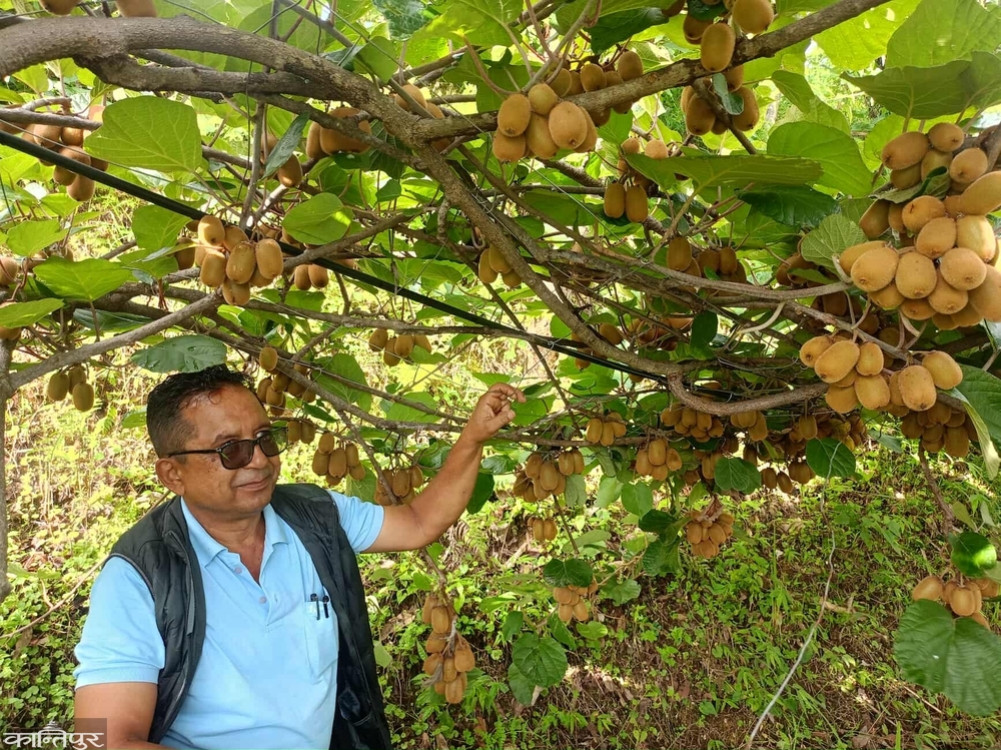
Now that the farmers have started to get good production and income by cultivating kiwi, even the neighbors are not in the mood to leave their birthplace.
We use Google Cloud Translation Services. Google requires we provide the following disclaimer relating to use of this service:
This service may contain translations powered by Google. Google disclaims all warranties related to the translations, expressed or implied, including any warranties of accuracy, reliability, and any implied warranties of merchantability, fitness for a particular purpose, and noninfringement.
Padam Chhetri of Gokhunga, who left his job as a permanent teacher and did some hotel business in Sandhikhark along with politics, bought pakhobari and kharyan of 41 ropani area of Kalukathe village in Malarani rural municipality-9 Gokhunga four years ago.
After reaching Dolakha and studying Kiwi farming, he got training in Kathmandu and thought of Kiwi farming. He made local Saraswati Basic School Principal Krishna Poudel and Jeevlal Poudel partners.
The motor had not reached the remote village of Kalukathe. He dug the road and took the motor to the village. After digging up the barren land, they brought kiwi plants from Dolakha and planted them. Within four years, the kiwi fruit flourished.
"In the beginning, the monkey tried to eat the sprouted grain," said Chhetri, "he could not eat it because he was afraid of the grain." After that we were sure.' Wild animals had previously harassed the villagers by damaging food crops, vegetables and fruits. Because they could not save their crops, some villagers had migrated from here.
Now that Kiwi could not be harmed, the monkey went elsewhere. In his Malarani agriculture and livestock farm, 400 kiwi plants have been produced, including various vegetables, green beans, cucumbers, parsley, ghirula, bodhisimi, kurilo, yam, pidalu, sakhkhar, etc., and spices.
The income is doubled with Kiwi in the same crop. Maize cultivation is also good. Buffaloes, local chickens and goats are also reared in the farm. Kiwi and other crops from livestock have also received income from the sale of manure and meat animals.
Kshetri was a candidate for the chairmanship of Malarani Rural Municipality twice from the Maoist party with the support of Congress, Rashtriya Janamorcha, CPN Integrated Samajwadi and other parties in the local elections of 2074 and 2079. Now he has joined UML. UML district secretariat member Chhetri has taken forward politics, social work and agricultural work together.
'I was a permanent teacher in 2047, I quit my job and joined politics,' he said, 'now my pension is this Kiwi. A plant bears fruit continuously for 60 years. Last year, kiwi was sold at Rs 2 to 300 per kg in Sandhikhark market. Kiwi seeds have grown on the plant. He is not worried that no matter how much he produces, it will not be sold.
Due to the harassment of wild animals, there was a wave of people migrating by selling their houses and leaving them. Now that Chhetri has started cultivating and producing kiwi, even the neighbors are not in the mood to leave their birthplace. They are also thinking of cultivating kiwi.
'Kiwi is a new crop,' said Jeevlal Paudel, 'There was confusion as to what the production would be like. Now it has flourished and there is a lot of demand in the market, we are sure that kiwi will change the future. Villagers are shocked to see that kiwi cultivation is producing good crops after digging barren fields.
According to Chhetri, the goal is to involve the entire village in Kiwi farming not only within his farm and to make the youth self-employed through agricultural enterprise by creating a source of income from house to house.