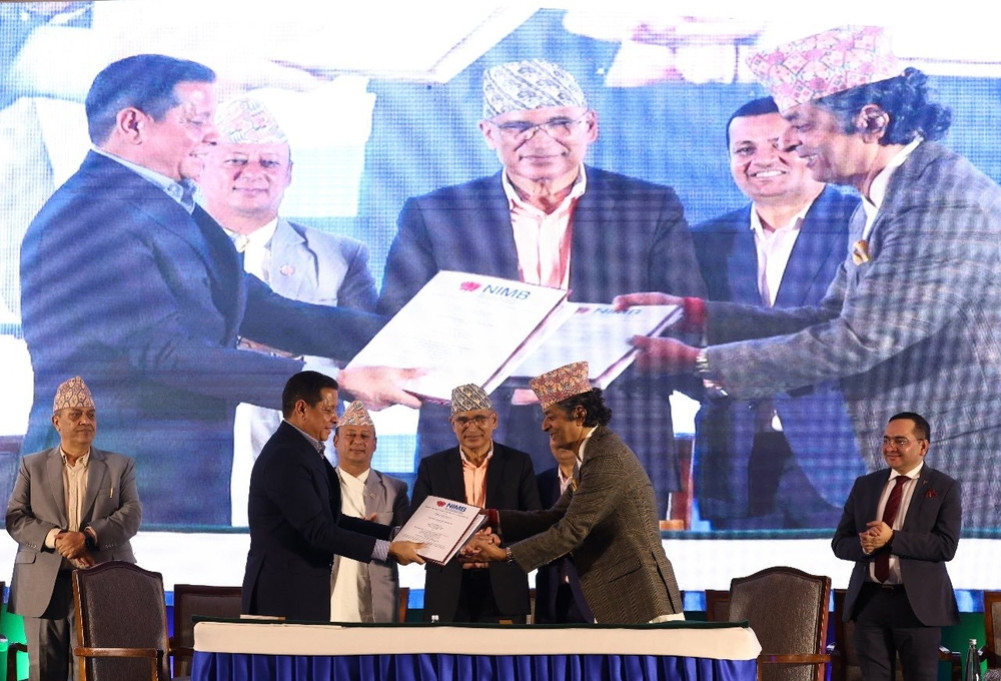
Banks and financial institutions, led by Nepal Investment Mega Bank, will invest Rs 52.5 billion in loans.
We use Google Cloud Translation Services. Google requires we provide the following disclaimer relating to use of this service:
This service may contain translations powered by Google. Google disclaims all warranties related to the translations, expressed or implied, including any warranties of accuracy, reliability, and any implied warranties of merchantability, fitness for a particular purpose, and noninfringement.
Investment has been raised to build the 341 MW Budhi Gandaki Semi-Reservoir Hydropower (PROR) project. The total cost of building the project is estimated at Rs 70 billion.
Times Energy Pvt. Ltd., a subsidiary of Sahas Urja Limited, will build the project. Ten banks and financial institutions led by Nepal Investment Mega Bank are to invest Rs 52.5 billion in the hydropower project under a consortium (joint) model.
A loan investment agreement was signed between the promoter company Times Energy and the banks and financial institutions at a program organized in Kathmandu on Thursday. The agreement was signed by Sushil Thapa, director of Times Energy, and Jyoti Prakash Pandey, CEO of Nepal Investment Mega Bank.
Nepal Investment Mega Bank is to invest Rs 10 billion, Nabil Bank Rs 8 billion, Laxmi Sunrise Bank Rs 8 billion, Global IME Bank Rs 7 billion, Hydro Electricity and Development Company Rs 4 billion, Machhapuchhre Bank Rs 4 billion, Citizen Bank Rs 3 billion, Nepal Infrastructure Bank Rs 3 billion, Prabhu Bank Rs 3 billion and Krishi Bikas Bank Rs 2.5 billion.
The project is being built through 25 percent equity and 75 percent debt. Banks will jointly invest Rs 52.5 billion in debt and the promoter company will invest Rs 17.5 billion.
Sahas Urja owns 51 percent of the shares in Times Energy. Accordingly, Sahas Urja will invest 51 percent of its equity. This is the largest project to be built and financially managed by the private sector so far. Earlier, the 285 MW Upper Tamor Project and the 216 MW Upper Seti Project have been financially managed.
Of the projects that have been commissioned so far, the 86 MW Solukhola Dudhkoshi Hydropower Project is the largest private sector project. This hydropower project has also been built by Sahas Urja. Solukhola Dudhkoshi started commercial production in Magh 079. Sahas Urja bought 51 percent of the shares of Times Energy in Pus 2080.
Times Energy had obtained a permit from the Department of Power Development in December 2007 for the construction of the project and power generation. The company has stated that a Power Purchase Agreement (PPA) has been signed with the Nepal Electricity Authority to sell the project's power.
The Budhi Gandaki Semi-Reservoir Hydropower Project will be constructed in Gorkha, 170 km from Kathmandu. The dam area of the project will be in Ward No. 3 of Chumanubri Rural Municipality of Gorkha and the power house will be in Ward No. 3 of Dharche Rural Municipality. The company has stated that there is a 10 km road between the dam area and the power house. The power house of the project will be underground.
The project will have a 398-meter-long head (water fall height), a 6.9-kilometer-long tunnel, and 6 turbines with a capacity of 56.8 megawatts. The dam will store 1.76 million cubic meters of water. It will be able to generate electricity at full capacity for 6 hours a day. The project will generate an average of 1867.77 gigawatt hours of electricity annually. According to the company, the project will generate 320.30 gigawatt hours of electricity in the main dry season, 243.43 megawatt hours in the normal dry season, and 1304.04 gigawatt hours in the rainy season. The design discharge of the project is 100.25 cubic meters per second. The company says that the physical and financial risks in the project are also low. The company has stated that the cost of the project per megawatt is Rs 205.3 million. The Authority has a PPA of Rs 4.80 per unit in the rainy season, Rs 8.40 in the winter, and Rs 10.55 per unit during peak hours. The project will generate 1304.04 gigawatt hours of electricity in the rainy season, 243.43 megawatt hours in the normal dry season, and 320.30 gigawatt hours in the main dry season. This has also shown a high potential for return on the project.
The generated electricity will be connected to the 400 kV Ratamate substation in Nuwakot, which will be built by the Millennium Challenge Corporation (MCC), through a 220-kilometer transmission line. The return on investment of the project is estimated to be 16.99 percent.
According to the feasibility study, the company has stated that the normal investment can be recovered within 5 and a half years of the project being operational. The net valuation of the project is currently Rs. 23.24 billion. The target is to commercially generate electricity from the Budhigandaki semi-reservoir hydropower project on 17th Poush, 2087.
Deputy Prime Minister and Finance Minister Bishnu Prasad Poude said in the financial management program that Sahaj Urja and the projects it has invested in are a good answer to those who are trying to create a narrative that nothing happens in Nepal. He said that based on past experience, this project is also expected to be completed on time.
Minister for Energy, Water Resources and Irrigation Deepak Khadka said that it is a matter of happiness that the private sector is developing a project of this level by increasing its capacity. He said that the project, which is expected to raise investment within 5 years, is attractive and is expected to be completed on time.
At the program, Ganesh Karki, Chairman of Independent Power Producers Association of Nepal (IPPAN), said that large projects can be built even if the government only facilitates the private sector.
Addressing on behalf of the investor banks, Nepal Investment Mega Bank CEO Pandey said that Sahas Urja had previously completed and commissioned the 86 MW Solu Dudhkoshi on time, and the banks are ready to invest in this project due to the experience and working style of this leadership.
Times Energy Chairman Him Prasad Pathak, giving detailed information about the project, said that it is a matter of happiness and pride in itself to invest in such a large project by the private sector.