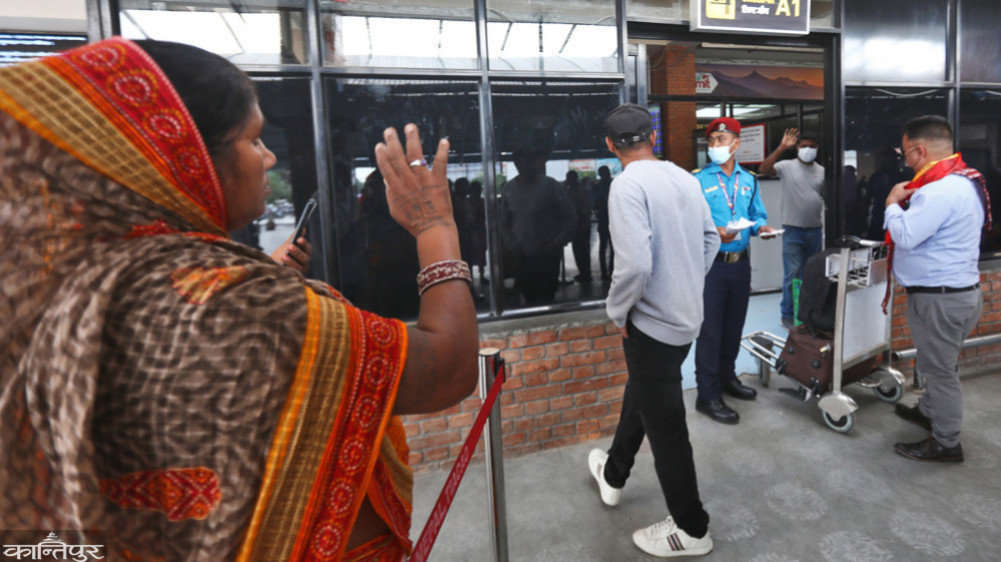
The Ministry of Labor has proposed to remove life insurance in the bill made to amend the Foreign Employment Act-2064.
We use Google Cloud Translation Services. Google requires we provide the following disclaimer relating to use of this service:
This service may contain translations powered by Google. Google disclaims all warranties related to the translations, expressed or implied, including any warranties of accuracy, reliability, and any implied warranties of merchantability, fitness for a particular purpose, and noninfringement.
The government has prepared to remove the provision of term life insurance in order to make the insurance of workers going for foreign employment one door. The Ministry of Labour, Employment and Social Security has proposed to remove life insurance in the bill made to amend the Foreign Employment Act-2064.
The Ministry of Labor has prepared to send this bill to the Ministry of Law in an interim form. If this amendment put forward by the ministry is passed, the compulsory provision of life insurance for workers every two years will be removed.
Labor, Employment and Social Security Minister Sharatsingh Bhandari said that the insurance system is going to be moved to a one-door system so that the welfare services and relief amount received by the workers will not decrease. Workers who go for foreign employment have to pay separately for welfare services. It is going to be organized and the benefits from insurance will be added from the welfare fund," he said. "If it is taken to a one-door system, the funds of the workers can be fully utilized. This amount can be used for the benefit of the workers.'
Currently, workers have to pay 3,500 to 5,500 rupees for term life insurance to get labor approval and re-employment approval. One thousand five hundred to two thousand five hundred rupees should be deposited for workers' welfare fund and two thousand rupees per month for social security fund.
For life insurance, workers must pay for two years and six months. However, as soon as the two-year contract expires, the fee for two years and six months must be paid when re-approving the work. Thus, a worker has to pay an additional fee of 6 months every two years while renewing the contract. Trade unions and non-resident Nepalese associations have been pressuring the government to remove this insurance.
If the worker dies within the period of labor approval, there is a provision to get a relief amount of 14 lakh rupees under life insurance. For this, the workers paid a fee of only 3 thousand 900. However, the workers who paid Rs 1,500 to the welfare fund have been paying Rs 10 lakh relief money, scholarships for the children of the deceased up to class 12, transportation of the body from Tribhuvan Airport to their homes and the treatment of the injured and the family.
According to the Foreign Employment Board, compensation was given to the families of 1,100 deceased people last year alone. 1 thousand 180 dead bodies were brought home. 698 injured and amputated workers were treated. 70 dead bodies stranded abroad were repatriated by the board itself.
According to Labor Minister Bhandari, only if the workers' welfare fund is strengthened, comprehensive protection of workers and their families will be achieved. The plan is to consolidate the separate amounts designated for insurance and welfare funds into a lump sum.
Now we can provide more benefits than what we get from the board and insurance," Minister Bhandari said. Workers do not get more facilities.'
According to the Nepal Insurance Authority, in the financial year 2080/81, private insurance companies earned insurance fees equal to 3.12 billion 68 million by insuring 744 thousand 130 people. It seems that 1 billion 42 crore 11 lakh rupees were paid to 1 thousand 601 people that year.
According to Purnachandra Bhattarai, an expert former secretary of labor administration, although it is necessary to provide welfare facilities with insurance through one door, the legal side of insurance should be looked at.
'Welfare fund is related to the welfare of workers. Insurance deals with compensation. If the Foreign Employment Board is to look at insurance as well, it is necessary to have harmony between the Insurance Act and the Foreign Employment Act," he said. Amending a single act without looking at another act can lead to controversy.
He said that it would be appropriate to look at international practice for the welfare of workers. The best practice for us is the Philippines. "Many of the subjects we adopted are compatible with the Philippines," he said, "It is appropriate to look at the practices of other source countries that send workers."