In April, the price increased up to 140 rupees in Crete, even after a week or two, the government remained silent.
We use Google Cloud Translation Services. Google requires we provide the following disclaimer relating to use of this service:
This service may contain translations powered by Google. Google disclaims all warranties related to the translations, expressed or implied, including any warranties of accuracy, reliability, and any implied warranties of merchantability, fitness for a particular purpose, and noninfringement.
Listening to the government statistics and the speech of the leadership, it seems that the country has become self-sufficient. It was claimed to be self-sufficient in March 2077 by saying that 61 eggs are available per person per year. The then Prime Minister KP Sharma Oli had claimed that he had succeeded in taking a step forward in one area by saying that he was self-sufficient in Anda.
Even now the Prime Minister is KP Sharma Oli. But the price of eggs in the market is attractive. The businessmen have increased the price within a week or two saying that there has been a decrease in production. Since Baisakhi, the price has increased up to 140 rupees per crate.
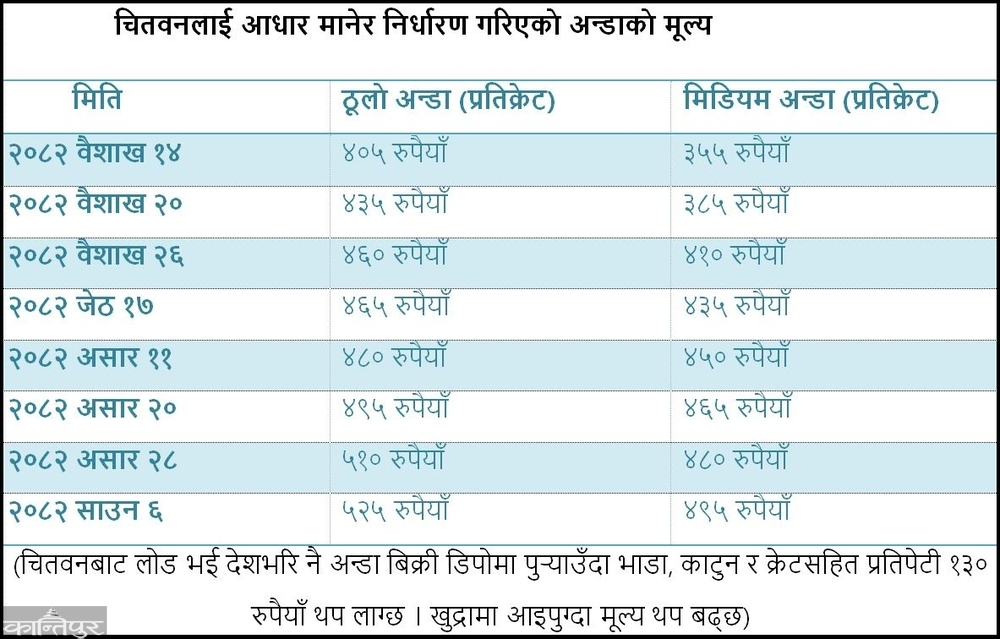
The robbery has started in the market saying that demand and supply determine the price. The gathering of some people has increased the price week after week. When it comes to consumer prices, one egg costs up to 25 rupees. "Crate has reached more than 600 rupees," said Madhav Timilsina, President of Consumer Rights Research Forum, "The number of middlemen in the market has increased. But the government is silent on this issue.' But Timilsina says that the market price of eggs is determined by a gathering of limited traders and middlemen. It seems that some people have increased the prices, but the government has not shown any interest in monitoring and regulating the consumers. "Monitoring has been carried out only in the places that are favorable to us," he said, "The responsibility for the price should be taken by the Ministry of Industry, Commerce and Supply and the Department of Commerce." On April 14, 2082, the price of a large egg per crate was Rs 405. By July 6, 2082, the price has increased to Rs 525 per crate. The price of medium eggs has also increased. On Baisakh 14, per crate was Rs 355. On July 6, the price increased to Rs 495 per crate. This price is determined based on Chitwan. According to the association, it costs Rs 130 per carton including freight, cartons and crates to deliver eggs to the sales depot across the country. According to the association, the price has increased further when it reaches the retail market (to the consumer).
'The main reason for price increase is monopoly. Production has also decreased. Some farmers have reduced the number of chicks. But a strategy has been devised to increase the price by causing more shortage,'' said a Layers poultry farmer, "Big traders and big poultry farmers have a hand in reducing-increasing the price of eggs." Those farmers claim that only the big farmers got the price.
There are also different layers in the egg area. From the farmer to the common man, he has to go through about 6 levels. Producer farmers, suppliers, (Kathmandu, Biratnagar and other big cities) then sub depots, hotels/shops and then finally reaches the consumer," said the farmer, "The price depends on the suppliers. Danapani is provided by suppliers. They pick it up at a low price and sell it at a high price. That is why small farmers do not get the price. Big farmers themselves are suppliers, they get good price.'
According to those farmers, suppliers charge 50 to 100 rupees per crate depending on the place. Those farmers say that if the price is determined by the state, there will be a lot of relief from farmers to consumers.
According to a report released by the Animal Services Department, the contribution of grain to the price of eggs is 75 percent. Labor cost is 7 percent, capital (cage cost) is 2 percent, interest on investment is about 6 percent and chick price is about 3 percent. Big businessmen have reared layer chickens. They also make grains. They also determine the price," said an official of the union, "in a way, arbitrariness has been implemented in the market."
eggs are mainly produced in Chitwan, Dang, Makwanpur, Jhapa, Morang, Sunsari and other districts. Egg prices are determined based on chitwan. In order to control the market price, the Consumer Protection Act 2075 also asked to determine the market level. But the government has not determined the market level yet. Due to that, businessmen have been reducing their favorable prices.
Vinod Pokharel, president of the association, claims that even though the price is the highest so far, the farmers have barely received the price. The farmer's cost price is 16 rupees 57 paise. Now the farmer has received 17 rupees 50 paise. The consumer price is only 22.5 rupees, said Chairman Pokharel, "Farmers who have been in loss for 10 months have received the price for a week." Even though the government declared self-reliance, it was only limited to slogans, there was no support from the government. About 60 to 70 percent of farmers have been displaced during this period,” he said. Seven years ago there were about 800 farmers, now they are limited to about 125. 33 to 34 lakh eggs were produced daily, but now it is limited to 26 lakh to 28 lakh, that's why the price has increased.'
Kumar Dahal, director general of the Department of Commerce, Supply and Consumer Protection, which regulates the market, admitted that the price was obtained by middlemen. Although it is said that cartelization is going on in Anda, there is no monitoring. Farmers did not get the price when looking at the market. The middleman got the price. It appears to be cartelizing. Imports from India have stopped and prices have increased here. Is that why the market price has increased?'' He said, 'But there is also cartelization of traders. Meanwhile, the dealer may also have increased the price. Regarding monitoring, which modality is being studied.'

