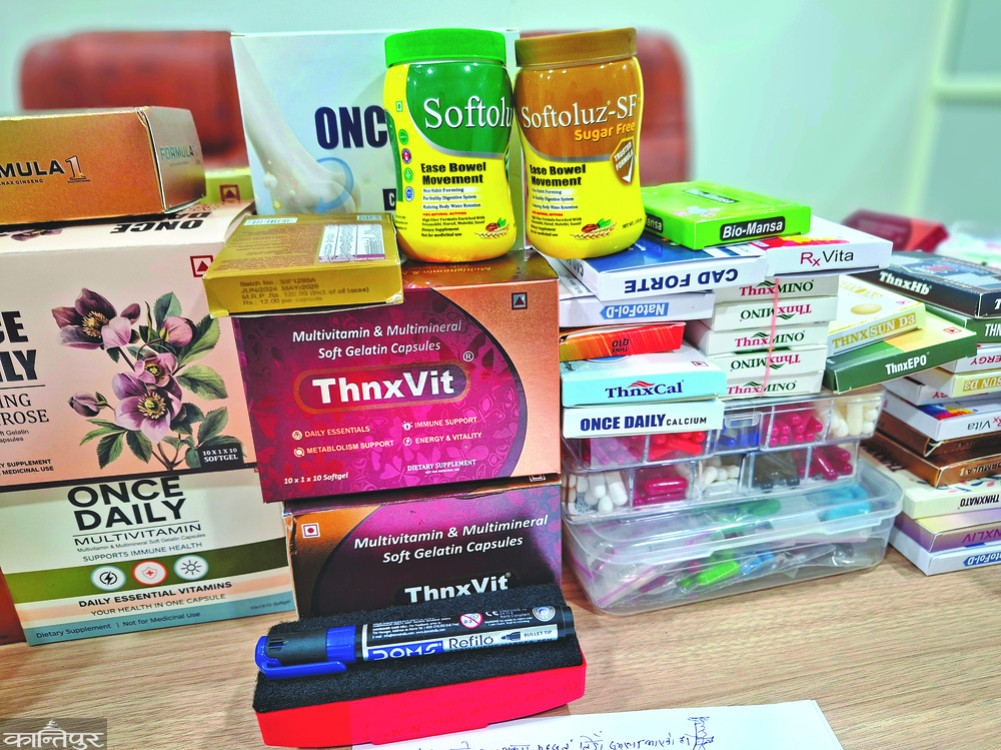
Due to the uninterrupted import of 'dietary supplements' from countries including India, 'Jayshree Healthcare' located in Parwanipur of Parsa-Bara Industrial Corridor is in a sick condition.
We use Google Cloud Translation Services. Google requires we provide the following disclaimer relating to use of this service:
This service may contain translations powered by Google. Google disclaims all warranties related to the translations, expressed or implied, including any warranties of accuracy, reliability, and any implied warranties of merchantability, fitness for a particular purpose, and noninfringement.
The dietary supplement industry is in crisis as it cannot compete with foreign products. Due to the continuous import of dietary supplements from countries including India, the dietary supplement industry 'Jayshree Healthcare' in Parwanipur of Parsa-Bara Industrial Corridor has reached a sick condition.
Industry operator Saket Cal complains that the ``dietary supplements'' imported from India are trying to destroy the domestic industry. He said that due to government policies, the indigenous 'dietary supplement' industry could not compete with imported dietary supplements. Dietary supplements are taken to compensate for the lack of a balanced diet in the human body.
Although the government allowed the pharmaceutical industry to bring in raw materials and packaging materials at a one percent customs duty, Cal says that the industry has become unable to operate because the dietary supplements have been determined by increasing the customs duty and value added by 20 to 40 percent. He said that the government should facilitate the import of raw materials like the raw materials of medicine.
He said that his industry, which was established a year ago with an investment of 40 million rupees, currently sends more than 20 million medicines to the market for distribution, but only 60 million rupees have been sold. The industry is importing raw materials worth Rs 1 crore to Rs 15 crore annually from India. The company currently employs 50 people directly. The industry has been producing 40 types of food supplements.
In the last fiscal year in Nepal, ``dietary supplements'' worth about one and a half billion rupees were brought in from India and third countries, Cal is accused of making the domestic industry sick due to government non-cooperation and complicated laws. He said that due to the lack of necessary cooperation and coordination from the relevant agencies of the state, the problem is to operate the industry. Although there is a high risk that the imported 'food supplement' may be of poor quality and it may have a serious impact on public health, it is alleged that the concerned body is not serious about it.
According to Cal, the regulatory body of 'dietary supplements' is having problems coordinating with the office of the Food Technology and Quality Control Department despite not having enough manpower and technicians. He complains that the Drug Administration Department is also misusing the Drug Act to obstruct the sale and distribution of indigenous food supplements in drug stores. He also said that as foreign 'dietary supplements' are imported without registration and approval, it is necessary to regulate them.