The total deposits accumulated in banks and financial institutions till last week is 72 trillion 45 billion rupees, the total deposits are about 114 percent of the ratio of the gross domestic product of Nepal.
We use Google Cloud Translation Services. Google requires we provide the following disclaimer relating to use of this service:
This service may contain translations powered by Google. Google disclaims all warranties related to the translations, expressed or implied, including any warranties of accuracy, reliability, and any implied warranties of merchantability, fitness for a particular purpose, and noninfringement.
After we meet our needs, we save a lot of money in the bank. Guess how much money you - all of us have deposited in banks and financial institutions?
The answer is being prepared with the National Bank. The total deposits accumulated in banks and financial institutions till last week is 72 trillion 45 billion rupees. This is more than the size of Nepal's economy. As of last week, the total deposit is about 114 percent of Nepal's gross domestic product (GDP).
we know. Banks and financial institutions are financial intermediaries. Banks and financial institutions are called financial intermediaries because they collect scattered savings and give loans to people in need. Therefore, banks and financial institutions can give loans to people who need more than 90 percent of the amount of about 72 billion rupees.
But in recent years, the economy has not improved as expected. Economic activity has not expanded. Therefore, banks and financial institutions have currently provided loans equal to 75.76 percent of the total deposits (55 trillion 63 billion rupees). This is about 91 percent of Nepal's total GDP. Based on this, banks and financial institutions have accumulated about 10.5 billion rupees that can be given loans.
Till last week, 59.4 million deposit accounts have been opened in banks and financial institutions. During the same period, 19 lakh 66 thousand loan accounts were opened. In this way, the savings collected through about 6 crore deposit accounts have been used by about 1.9 and a half lakh borrowers. Looking at the distribution of borrowers, only about 3 percent of borrowers have availed loans of more than 1 crore rupees. Those borrowers are using more than 49 percent of the total loans. The remaining 97 percent of the borrowers have used 51 percent of the loan, according to the data of Rashtra Bank.
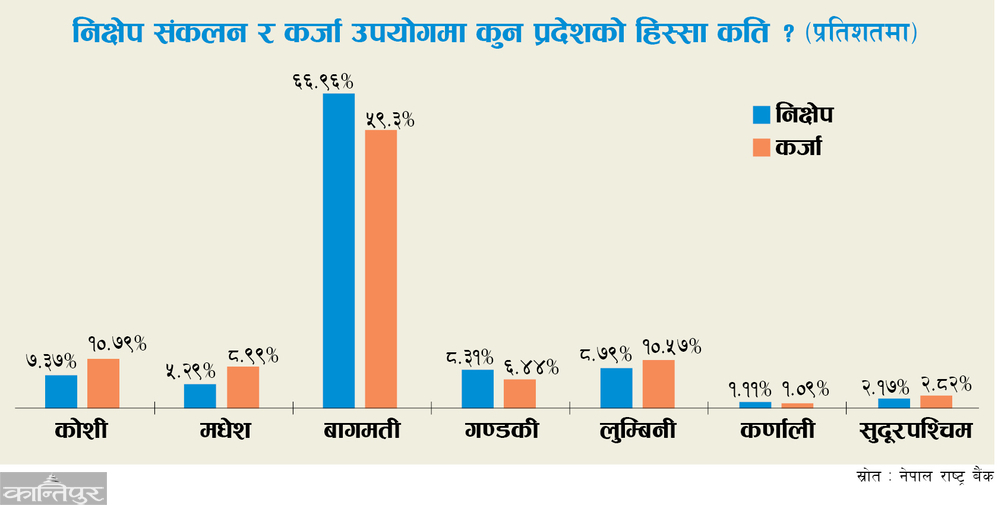
Looking at the use of deposits and loans regionally, the share of Bagmati is the highest. The economic activity study of the National Bank has shown that despite the state's aim to decentralize financial services as the country moved to federalism, it has not been able to work accordingly. The semi-annual economic activity study published by the National Bank of the last financial year has shown that about 67 percent of the total deposits of banks and financial institutions and about 59 percent of the loans are in Bagmati province. According to the
report, the total deposits collected by banks and financial institutions from Bagmati till last December is 44 trillion 74 billion 60 million rupees. This is 66.96 percent compared to the total deposit collection for the same period. Until last December, banks and financial institutions have provided loans of 32 billion 21 billion 38 billion rupees in Bagmati only. This is 59.30 percent of the total loan disbursement of the same period.
'In the total deposits mobilized by banks and financial institutions by the end of December 2081, the share of deposits mobilized from Bagmati is the highest at 66.96 percent, while the lowest is from Karnali at 1.11 percent,' the Rashtra Bank report says, '59.30 percent of the total loans from banks and financial institutions have flowed into Bagmati. The lowest credit has flowed to Karnali at 1.09 percent.' Out of this in Bagmati
has the most 3 thousand 41 branches while Karnali has the least 477 branches in operation.
By the end of last December, the loans provided by banks and financial institutions in the service sector have reached 33 trillion 67 billion 58 million. Compared to the same period last year, such loans have increased by 18.16 percent. In the first 6 months of last year, such loans decreased by 5.66 percent to 28 billion 49 billion 96 billion.
By the end of December 2081, the credit of poor class from banks and financial institutions has decreased by 1.09 percent to 3 trillion 18 billion 75 crores. During the same period last year, such loans increased by 0.5 percent to 3 trillion 22 billion 27 billion. During the review period, the share of loans disbursed to Bagmati is 54.53 percent among the total poor class loans. Karnali province has the lowest share of 1.38 percent.
In Bagmati, the rate of growth of poor class loans is the highest at 14.06 percent, while in Far West, the highest decline in the flow of loans is by 23.36 percent, according to the report of Rashtra Bank.
In the last fiscal year, banks and financial institutions collected 7 trillion 96 billion deposits and 4 trillion 31 billion loans. Thus, as the gap between deposit collection and credit expansion started to widen, the state bank had to withdraw money for a long period of time.
In the last financial year, the National Bank has set a target of expanding loans by 12 and a half percent. To meet this target, banks and financial institutions had to extend loans of 6 trillion 82 billion rupees. But until last June, the loan disbursed by the banks is less than the target by 2 trillion 51 billion rupees.
In the previous financial year 2080/81, when 7 trillion 42 billion deposits were collected, 2 trillion 91 billion rupees were extended. The National Bank, which had set a target of 11.5 percent credit expansion last year, set a target of 12.5 percent for last year, which was itself ambitious. Because even in June of last year, the basis for credit expansion was not well prepared. However, the National Bank has set a target of 12 percent credit expansion for the current financial year.

