Barkhe paddy is planted in 3 lakh 72 thousand 645 hectares in Madhesh, but only 1 lakh 25 thousand 888 hectares are planted till June 29.
We use Google Cloud Translation Services. Google requires we provide the following disclaimer relating to use of this service:
This service may contain translations powered by Google. Google disclaims all warranties related to the translations, expressed or implied, including any warranties of accuracy, reliability, and any implied warranties of merchantability, fitness for a particular purpose, and noninfringement.
Madhesh is called the capital of rice. Because the most plantations are in this province. Along with planting, production is also high in Madhesh. Since the end of June, planting in this province is low.
According to the Crop Development and Agricultural Biodiversity Conservation Center, Madhesh has done the most planting among the seven provinces. According to the center, dry paddy is planted in 372 thousand 645 hectares in Madhesh. But till June 29, only 125,888 hectares or 33.78 percent have been planted.
According to the Center's data, planting has almost doubled in the same period last year. Till June 30, 2081, 66.7 percent planting was done. The main reason for not planting rice in Madhesh is the lack of irrigation. Nepal has a monsoon based farming system. Agricultural Research Council (NARC) has informed that due to lack of irrigation, planting could not be done on time.
'It looks like it's raining on the mountain. But it has not rained in Madhesh. Due to the lack of sufficient water, there has been a decrease in planting," said Sushil Subedi, a scientist at NARC. In the cold weather, not much rice may grow. He said that the planting area in Madhesh will be till July 15, and if water is available, the area to be planted can increase. He says that if planting is delayed, it will affect Hardinath, Savitri and Ram rice.
'No paddy is planted until July 15. Seedlings can grow under rain irrigated conditions. But it didn't rain. Farmers who remain in this situation for 10/15 days may face many problems, said Subedi.
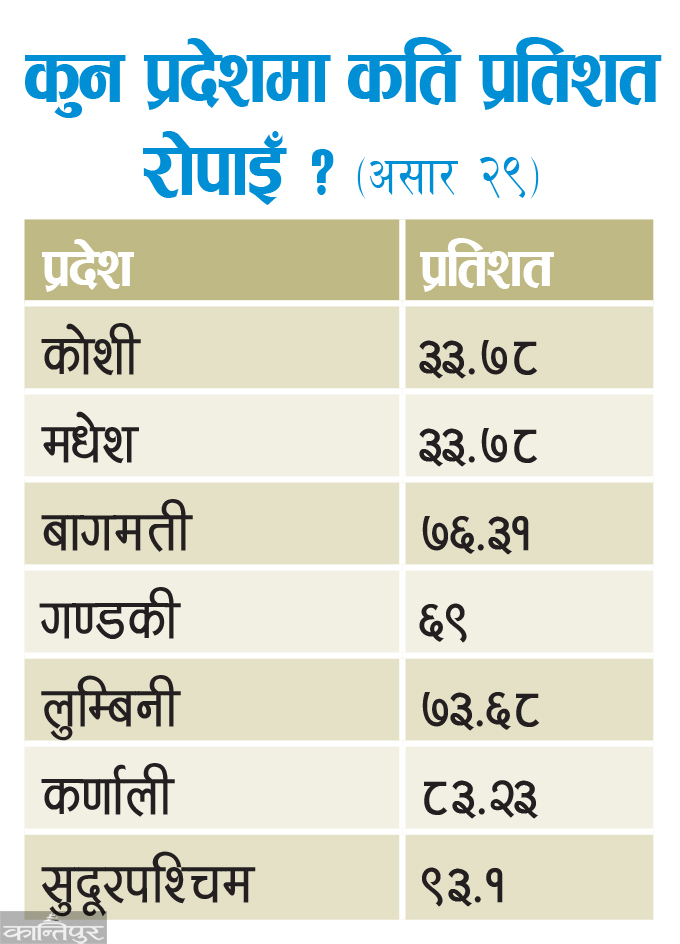
Monsoon has entered Nepal since May 15, but Madhesh has not received significant rainfall. The Madhesh Province Cabinet meeting held last Thursday has also declared the province drought-affected. The state has been declared drought-stricken after no rain even during planting. Madhesh province had to be declared drought-stricken after heavy rains in places. Home, Communications and Law Minister Rajkumar Lekhi, who is also the spokesperson of the Madhesh province government, said that the province has been declared drought-stricken after no rain even during planting.
Experts say that there will be more problems if water is not available. They say that they should focus on rice that can produce even if there is little water. Bhugune 1 and 2 are rice that can withstand both drought and flooding. There are also varieties of rice from dry 1 to 6. Masinoma Sukha 5 and 3 are the most common types of paddy,'' said Subedi. According to the
center, the most rice planting has been done in Far West, 93.1 percent. 176 thousand 151 hectares are planted in this province. Of this, 163 thousand 993 hectares have been planted. Till June 30, 86 percent planting was done in this province.
Second, 83.23 percent planting has been done in Karnali. 40 thousand 884 hectares are planted in this province. Till June 30, 86 percent planting was done in this province. Planting had started from the second week of May towards the hills. Enthusiastic planting has taken place in this area. According to the Centre, 73.68 percent planting has been done in Lumbini. 3 lakh 2 thousand 939 hectares are planted in this province.
According to the Center's data, 69 percent planting has been done in Gandaki province. Last year till June 30 only 67.4 percent planting was done. 94 thousand 182 hectares are planted in Gandaki. In Bagmati too, planting has been done more than last year. Till June 29, 76.31 percent planting has been done. 120 thousand 545 hectares are planted in this province. Last year, till June 30, 71 percent planting was done. According to the center, 41.32 percent planting has taken place in Koshi. 276 thousand 386 hectares are planted in this province.
What percentage was planted in which province? (June 29)
| province | percentage |
Koshi | 33.78 |
Madhesh | 33.78 |
Bagmati | 76.31 |
| Gandaki | 69 |
| Lumbini | 73.68 |
| Karnali | 83.23 |
| Far West | 93.1 |

