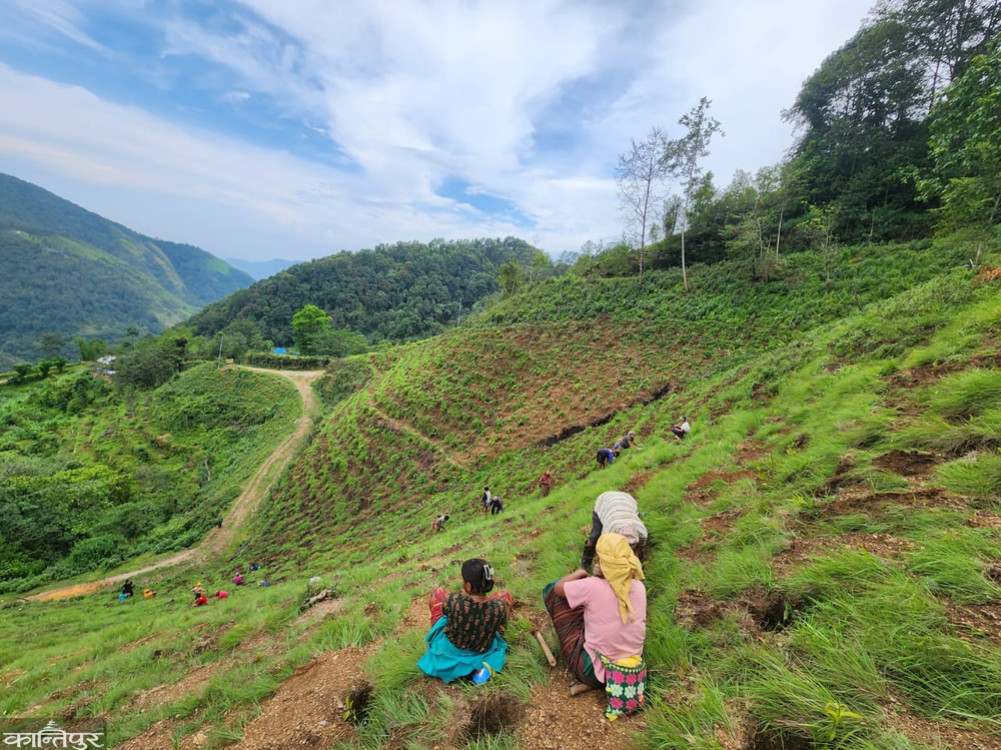
24,000 tea plants in Dhuwaakhola and 1,400 orange plants in Naigaon, more than 25,000 plants in 137 plantations
We use Google Cloud Translation Services. Google requires we provide the following disclaimer relating to use of this service:
This service may contain translations powered by Google. Google disclaims all warranties related to the translations, expressed or implied, including any warranties of accuracy, reliability, and any implied warranties of merchantability, fitness for a particular purpose, and noninfringement.
Cultivation of tea has been started on barren land in Bhurtung Dhuwankhela, rural municipality-7 of Kaligand. Locals have planted tea plants in 37 plantations that are barren. Ashish Gurung, President of Tamu Tol Development Association, said that after 12,000 tea plants of 38 varieties of Ilam planted on 17 ropani land last year grew attractively, 12,000 tea plants of the same variety were planted on 20 ropani land this year.
36 families are active for tea cultivation in Dhuwankhola through local clubs and organizations. Among them are Tamu Entrepreneurial Women's Group, Tamu Toll Development Institution, Tamu Youth Club and Dhuwankhela Drinking Water Consumer and Sanitation Committee. Gurung said that tea cultivation is also envisaged for the purpose of supporting the operation of local homestays.
Dhuwankhela tea garden protection committee is protecting the plants. Dhuwankhola, which is 1,800 meters above sea level, has good potential for tea cultivation. Tea has been cultivated with the slogan 'Dhuwankhola tea garden, promotion of rural tourism: conservation of nature is our mission'.
Also, in Bhurtung Nayagaon, 29 people are preparing to plant orange saplings in more than 100 individual plots. Ward president Ghanshyam Thapa said that final preparations have been made by digging a pit and placing manure. Currently, 1,400 orange trees will be planted on that land. Thapa says that there are preparations to add more plants next year.
Nayagaon, which is 1,500 meters above sea level, has good potential for orange cultivation. 32 workers of the municipality under the Prime Minister's employment program have worked in planting tea and orange plants. They are working in such a way that they get paid at the rate of 340 rupees.
Agricultural Knowledge Center has informed that one lakh rupees has been supported in the purchase of plants through technology demonstration in tea cultivation. The municipality is providing technical assistance including staff deployment. In the case of oranges, the plant municipality has helped.
In order to attract local people into business, the ward said that tea and orange cultivation has been promoted so that the income will be self-sufficient. Tea and orange cultivation has been expanded so that if the production is good, other income will be given to the households that are active in agriculture, apart from the taxation.
Kaligandaki rural municipality chairman Bed Bahadur Thapa says that tea and orange cultivation will help in economic development along with tourism promotion. "Agriculture is the main backbone of our economic earnings," he said, "We have attracted the local people into professionalism so that jobs are also created."