Emphasizing that the process of repatriation of profits by foreign investors should be easy and fast
We use Google Cloud Translation Services. Google requires we provide the following disclaimer relating to use of this service:
This service may contain translations powered by Google. Google disclaims all warranties related to the translations, expressed or implied, including any warranties of accuracy, reliability, and any implied warranties of merchantability, fitness for a particular purpose, and noninfringement.
While there is increasing positive interest in bringing in foreign investment in Nepal's technology sector, the suggestion that the process of repatriation of profits by foreign investors should be easy and fast has also started coming from the diplomatic sector.
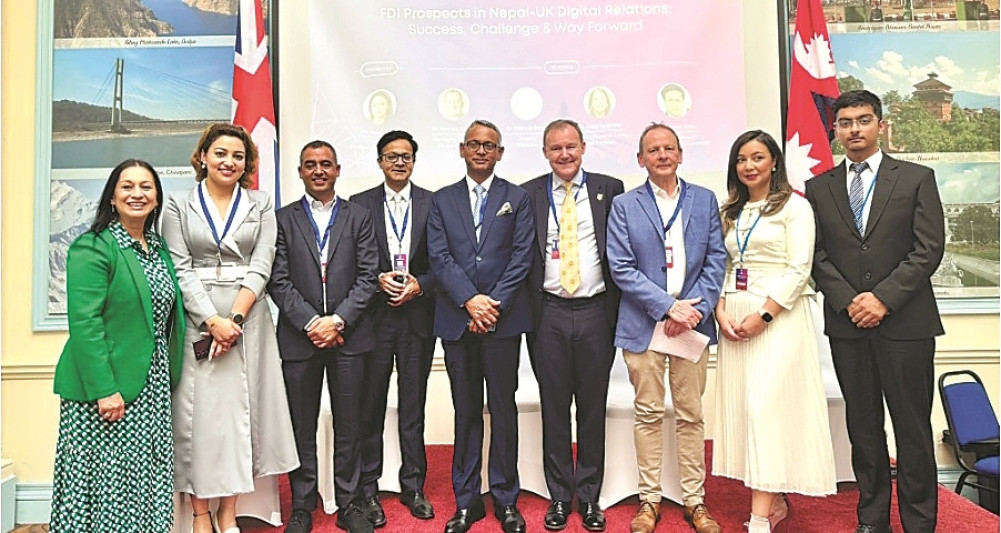
In a program organized by the Nepali Embassy in the UK on Friday, the British Ambassador to Nepal, Rob Fenn, pointed out that the process of returning profits should be easy. To facilitate this topic, 'Nepal-Britain Digital Working Group' will be formed.
In the first edition of the 'Nepal-UK Tech Forum' organized by the embassy, British Ambassador Fen said that Nepal can establish the technology sector in the world market the fastest. He says that to return profits to foreign investors in Nepal, they have to go through a very long and difficult process. The program was organized to discuss the development and investment opportunities of the Nepali Information Technology (IT) sector. The
forum has also decided to form a mechanism called 'Nepal-UK Digital Working Group' consisting of embassy officials and other relevant stakeholders from both countries. Such a mechanism is going to be built to institutionalize and make effective the cooperation between Nepal and Britain in the field of technology. It will have representation from both countries' embassies, policy-makers, industry representatives and technology sector stakeholders. In the
forum, portraying Nepal as an emerging IT destination, British investors were invited to expand the IT industry in Nepal and cooperate in export promotion. Discussing the significant progress seen in Nepal's information technology sector in recent years, Chandrakumar Ghimire, the Nepalese Ambassador to Nepal, urged British investors to invest by taking advantage of Nepal's competitive workforce and favorable policies.
"Though the number of young people migrating to Nepal for foreign employment is large, now tens of thousands of IT graduates are working from home and serving in the international market," Ghimire said, "Nepalese youth have been providing quality services in information technology. After studying and gaining experience in different countries, IT experts are now returning to Nepal and engaged in such services. Sushil Gyawali, Chief Executive Officer (CEO) of the Board of Investment, who arrived in the UK for the
program, presented Nepal as a destination for FDI (Foreign Direct Investment). He presented details of policy, legal, institutional and procedural reforms. Gyawali presented data in favor of investment requirements, adding that Nepal, which is preparing to be upgraded from a least developed country, should achieve the goal of sustainable development by 2030. He also said that efforts are being made to reach an agreement on the Double Taxation Avoidance Agreement between the UK and Nepal. At the
forum, various presentations and discussion sessions were conducted on the experiences of information technology companies, the potential of Nepal-Britain technology trade, the potential of artificial intelligence, digital diplomacy, and the role of the Nepali diaspora community. In the event, Alex Baker, who is a British MP and also the chairperson of the All-Party Parliamentary Group for Nepal, expressed her happiness that the Nepal-UK Tech Forum was organized.
UK-Nepal Chamber of Commerce Chairman Dr. Along with Kapil Rizal, 28 speakers expressed their views on various issues related to increasing investment and trade between Nepal and the UK. Ambassadors, government officials of both countries, professional leaders, technology professionals, professors and more than 100 people participated in the program, according to the Nepali Embassy in the UK.
Nepali information technology service exports to Britain and the role Britain can play in increasing foreign direct investment in Nepal were also discussed, according to the statement issued by the embassy.