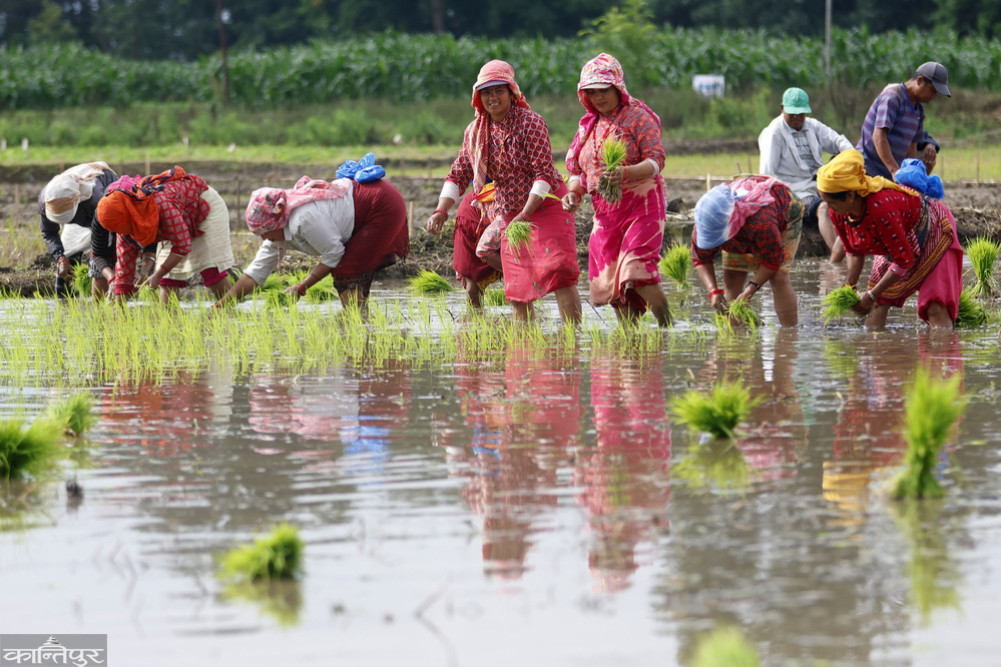
Rice seeds are imported from India and China, with open borders also allowing large numbers of seeds to be imported illegally from India
We use Google Cloud Translation Services. Google requires we provide the following disclaimer relating to use of this service:
This service may contain translations powered by Google. Google disclaims all warranties related to the translations, expressed or implied, including any warranties of accuracy, reliability, and any implied warranties of merchantability, fitness for a particular purpose, and noninfringement.
Import of rice seeds has increased abnormally in recent years. As farmers are attracted to hybrid seeds in the hope of higher yields, seeds worth 1.16 billion have been imported in 11 months of the current financial year.
According to the data of the customs department, rice seeds worth 886.5 million rupees were imported during the same period of the last financial year. Rice seeds are imported from India and China. Open borders also allow a lot of illegal entry of seeds from India.
Hybrid seeds of rice are mostly imported, according to the Seed and Quality Control Center. 54 of the imported hybrid rice seeds have been registered. 148 rice seeds have been registered to be released and imported in Nepal. 94 have been released and registered in the country," said Prakash Acharya, Information Officer of the Centre. "Of the imported seeds, 48 are hybrid and 6 open irrigated varieties. Nepal has released only two varieties of Varnashankar (Hardinath 1 and Hardinath 3).''
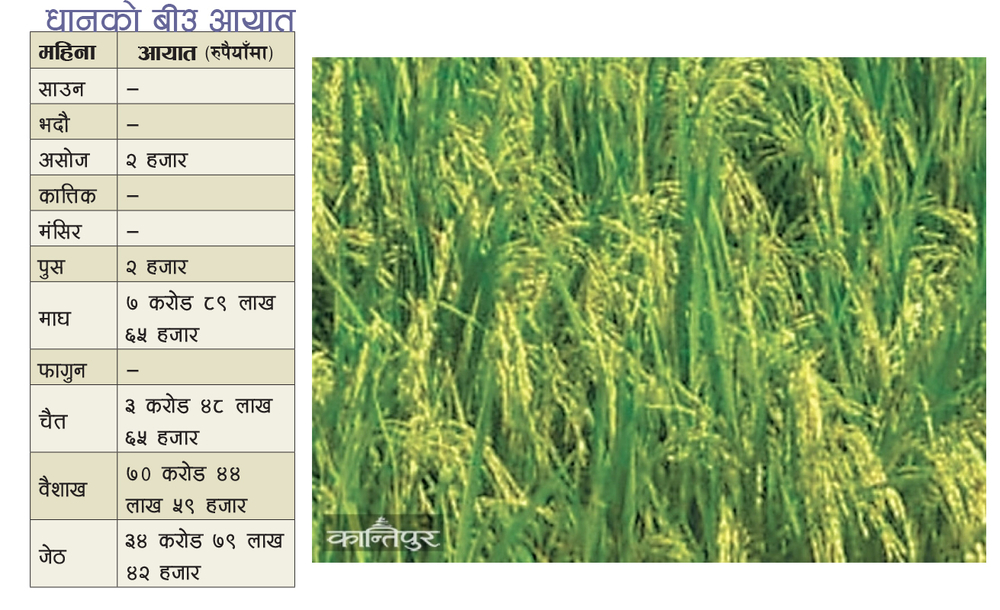 According to the data of the customs department, rice seeds worth 886 million rupees were imported in the last financial year. In 2079/80, seeds worth Rs 75 crore 63 lakh and in 2078/79 Rs 87 crore 5 lakh have been imported. In 2077/78, the import of 2 billion 17 crore 38 lakh rupees was reported by the department.
Indigenous hybrid systems are not robust. Hybrids are more preferred by farmers as they produce more fruits. Acharya said that 90 percent of the imported seeds are hybrids. Hybrids are the ones that bear more fruit, that's why farmers prefer them more. Advanced (improved) varieties are also good," he said. "Our rice seeds are no less than hybrids. But the farmers have chosen hybrids because of more fruits.'
20 thousand tons of seeds are consumed annually. Of this, 2,500 to 3,000 tons are imported. The Center claims that other improved seeds are also consumed. According to Economic Survey 2081/82, the seed replacement rate of food crops in the last financial year is 23.61 percent. Up to February of the current financial year, 528 tons of rice source seeds (original/source and certified/label level) have been produced from government firm centers.
In the financial year 2080/81, 37 lakh 98 thousand tons of rice source seed was produced. In the last financial year, 9 lakh 7 thousand 431 tons of advanced rice seeds were produced. Director General of Agriculture Department Prakash Kumar Sanjel said that hybrid rice varieties are being developed in Nepal itself. To ensure the availability of seeds of developed rice varieties, the seed increase program is being conducted through all three levels of government, he said.