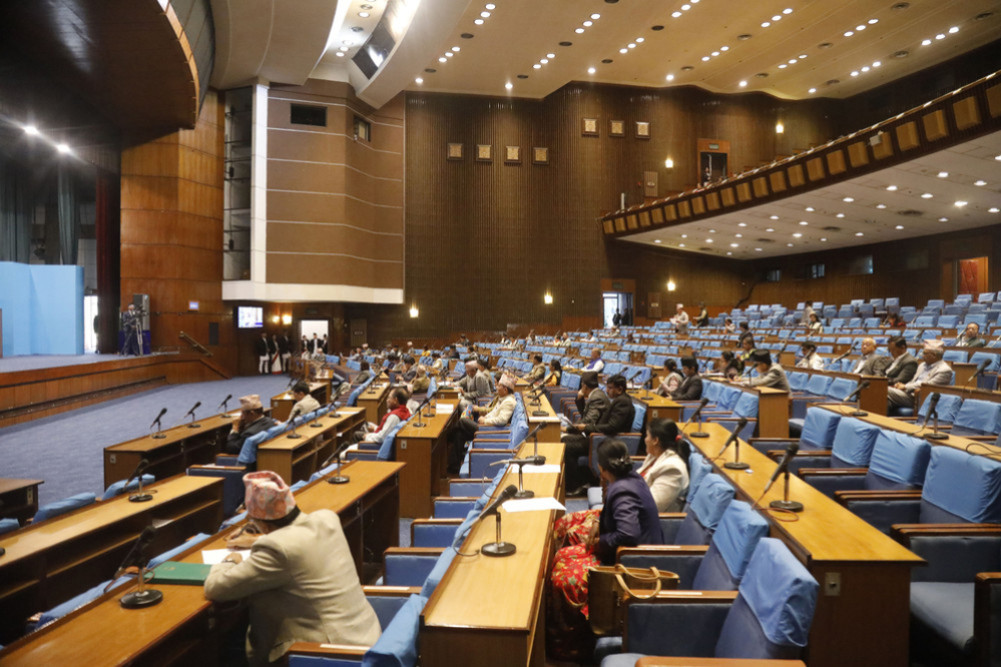
There is a question as to why the provision that should be included in the Electricity Bill was included in the Water Resources Bill. In another Bill, engineering safety is mentioned but there is a technical ambiguity, there is a serious suspicion that it may be misused: Mahesh Bertaula, Chief Whip, UML
We use Google Cloud Translation Services. Google requires we provide the following disclaimer relating to use of this service:
This service may contain translations powered by Google. Google disclaims all warranties related to the translations, expressed or implied, including any warranties of accuracy, reliability, and any implied warranties of merchantability, fitness for a particular purpose, and noninfringement.
The government has backtracked on its decision to withdraw the Water Resources Bill. Although it was informed that the cabinet meeting on June 2 had decided to withdraw the bill, the decision was not formally announced.
The bill will not be withdrawn after Congress leaders and parliamentary committee officials put pressure on the Prime Minister saying that his understanding was wrong.
Prime Minister KP Sharma Oli had said that the bill had to be withdrawn because the provisions related to the safety of dams, which were not included in the bill that the government took to parliament, but included in the report prepared by the Infrastructure Committee of the House of Representatives, had to be amended. The
committee has stipulated in Section 30 that 'the dam operator shall have the primary obligation and responsibility to ensure the safety of the dam for the construction and operation of the dam' and 'the dam operator shall follow the standards of construction, operation and safety of the dam prepared by the commission'. Prime Minister Oli's understanding was that because of these arrangements, foreign troops could open the door to protect projects built by foreigners.
After the decision of the Council of Ministers on June 2, Congress leaders met Prime Minister Oli and drew attention to it. The bill was withdrawn after the Prime Minister raised objections regarding the security provisions of the project. "We did not agree with the decision to take the bill to the parliament after a long discussion and then suddenly withdraw it when it was passed by one assembly and went to another," said a Congress official. "The Committee and the Speaker have not yet been informed about the withdrawal of the bill," said Singh. There is a legal provision that the relevant ministry will inform the parliament secretariat after the cabinet has decided to withdraw the bill.
The Water Resources Bill, which was registered in Parliament on 31st June last year by then Energy Minister Shakti Basnet, was sent to the Infrastructure Development Committee on 25th June for quarterly discussion. According to Singh, the chairman of the committee, during the weekly discussion on the bill, MP Gagan Thapa proposed to add security provisions for the dam. Later, after the members of the committee felt the need for it, provision was made in paragraph-9.
In Singh's statement, Prime Minister Oli's understanding was similar to that of the committee and MPs. But he said that the Prime Minister was 'briefed' by misinterpretation from the staff level. The law secretary said that the bill should be moved forward as proposed, not any more reductions. I said that it is the right of the parliament, not what you say, I got a little bit angry.
This is why the secretary of the Ministry of Law was not present in one of the meetings of the committee. After the bill was amended, the matter reached the Prime Minister.'
President Singh of the Infrastructure Development Committee said that the provisions made in Article 30 are not related to armed security. If the concerned company does not build a quality dam, it may collapse and deteriorate later. Therefore, the provision of the bill is that it should not be taken by the state but by the related company," he said. The
committee passed the report and submitted it to the Parliament on March 18, and on May 5, the House of Representatives passed the bill along with the report. After the bill was tabled in the National Assembly, Prime Minister Oli tried to stop it after receiving information from the staff level about the security arrangements of the dam. Udayaraj Sapkota, who retired from the Ministry of Law just two weeks ago, did not want to say anything more, stating that there was nothing to do with the dam as they only deal with procedural issues.
UML's chief whip Mahesh Bertaula claimed that the decision to withdraw the bill was not from the government, even though interest was expressed in the matter of the dam. He said that there is some technical ambiguity in the provision made in the bill regarding the safety of the dam.
The first thing is the question of why the provision that should be included in the electricity bill was included in the water resource bill. Secondly, the bill talks about engineering security, not arm security, but there is a technical ambiguity in the bill, there is a serious suspicion that it could be misused, he said, "What to do with the bill as it has gone to the National Assembly is a matter of his right." But the current arrangement creates confusion. It needs to be clarified.'