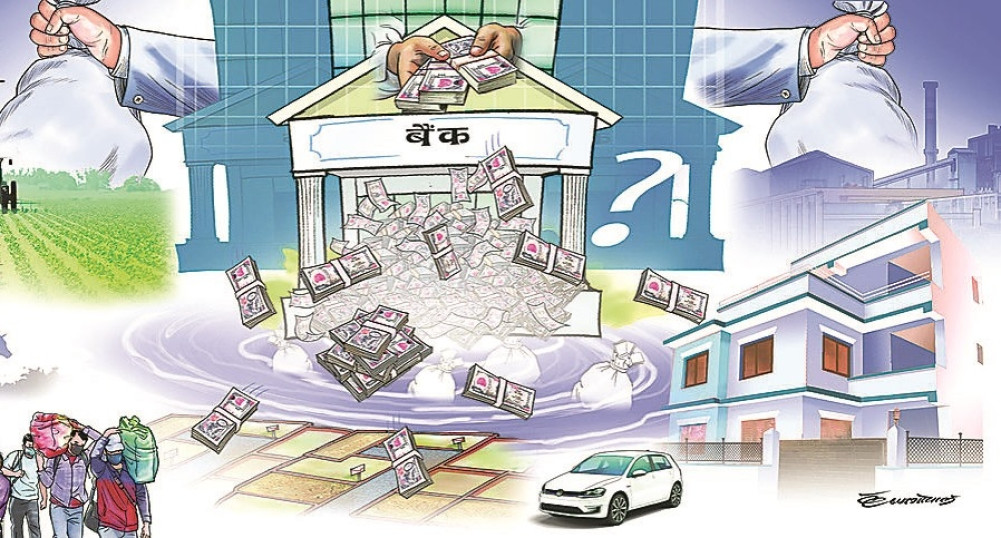
An increase of 8.4 percent in credit disbursement compared to last financial year till April
We use Google Cloud Translation Services. Google requires we provide the following disclaimer relating to use of this service:
This service may contain translations powered by Google. Google disclaims all warranties related to the translations, expressed or implied, including any warranties of accuracy, reliability, and any implied warranties of merchantability, fitness for a particular purpose, and noninfringement.
In the 10 months of the current financial year (from July to April), banks and financial institutions have provided loans of 3 trillion 68 billion 68 crore rupees. This is an increase of 7.3 percent compared to last June and 8.4 percent compared to April of last financial year.
In the current financial year, the National Bank has set a target to expand loans by 12 and a half percent. To meet this target, banks and financial institutions should extend loans of 6 trillion 82 billion rupees this year. But until last May, the loans provided by the banks are 3 trillion 14 billion rupees less than the target. However, in order to achieve the target set by the National Bank, in the remaining 2 months, banks have to extend additional loans of around 3 billion rupees, which is not possible, experts say.
'Last year, the National Bank set a target of 11 and a half percent credit expansion, and set a target of 12 and a half percent for this year, it was ambitious in itself. Because even last June, the basis for credit expansion was not ready," said the chief executive officer of a bank, "the investment environment did not improve this year. However, credit has expanded by 7 percent so far. We should be satisfied with this.' The official said that the credit expansion was not possible as per the target this year because the overall market demand did not improve.
In all months of this year, an average of more than 5 billion investable funds have accumulated in the financial system. Interest rates fell to their lowest level in 47 months. However, experts say that the credit expansion as expected is due to the lack of improvement in overall demand, industries running at less than half of the target capacity, and overall investment environment not being created.
Officials of the National Bank admit that the annual target cannot be achieved as the economic activity has slowed down due to the economy not being viable and the credit demand not being increased due to its effect. They say that although monetary flexibility has been adopted in the recent past with the aim of increasing credit demand and supporting economic activity, the credit expansion has not been according to the target. There is more liquidity in the financial system. Monthly reports have shown that the National Bank has to spend a large amount of money for liquidity management. Santosh Koirala, president of the Bankers Association, said that the loan demand in the market is low and some banks are under the pressure of primary capital (core capital) due to the inability to provide loans. Although the National Bank has set a target of 12.5 percent credit expansion this year, it seems that it will reach around 9 percent by the end of this year. In recent days, it seems that there has been an improvement in the loan recovery of banks. As this process increases, in the coming days, lending may accelerate," he said.
Nepal Rastra Bank Spokesperson Kiran Pandit says that although the credit expansion set by the Rastra Bank has not been achieved, it cannot be said that the credit is not expanding. Even if nothing has happened, the economic growth rate of 4.5 percent has been seen. And accordingly, credit seems to have expanded. However, this is not expected. It cannot be said that economic relaxation has already come," he said. He also said that the latest figures show positive signs in import-export. The interest rate is also at a single point. In this way, we can be optimistic," he said, "so let's be positive, we will definitely see good results."
According to the monthly report of the National Bank, 63.1 percent of the loans from banks and financial institutions to the private sector were transferred to the non-financial institutional sector and 36.9 percent of the loans were transferred to the individual and household sectors. During the same period last year, this share was 63.7 and 36.3 percent respectively.
"In the past 10 months, the credit flow of commercial banks has increased by 7.6 percent, development banks by 4.1 percent, and finance companies by 6.5 percent," the report says, "In the end of May 2082, among the loans invested by banks and financial institutions, 14.6 percent was secured by current assets (agricultural and non-agricultural goods) while 65.1 percent was secured by real estate mortgages." As of April, the share of loans disbursed to such securities was 12.1 and 68.5 percent respectively.
In the 10 months of the financial year 2081/82, among the loans invested by banks and financial institutions, loans to the industrial production sector increased by 9, 12.3 to the construction sector, 4.9 to the wholesale and retail trade sector, 11.9 to the transport, communication and public service sector, 7.9 to the service industry sector and 8.8 percent to the consumer sector, it is mentioned in the report.
From last July to April, out of loans from banks and financial institutions, periodic loans increased by 5.1 percent, margin loans by 39.3 percent, trust receipt (import) loans by 58.1 percent, hire purchase loans by 4.1 percent, cash flow loans by 3.4 percent, and real estate loans (including personal residential house loans) by 5.2 percent. However, during that period, the excess loan has decreased by 12.9 percent.
In the 10 months of the current financial year, banks and financial institutions have collected an additional 3 trillion 99 billion 81 crore rupees in deposits. This is an increase of 6.2 percent compared to the end of last financial year. In 10 months of the last financial year, such deposits increased by 7.8 percent or 4 trillion 43 billion 80 million. According to Rastra Bank, deposits in banks and financial institutions increased by 11.4 percent at the end of May 2018 on an annual point basis.
As of last May, the total deposits of banks and financial institutions are 5.5 percent in current, 35.9 percent in savings and 50.8 percent in term. In the same period last year, such share was 5, 29.1 and 59 percent respectively.
2082 At the end of April, the share of institutional deposits in the total deposits of banks and financial institutions is 35.4 percent. In 2081 Baisakh, the share of such deposits was 35.7 percent.
In the previous two financial years, the growth of the manufacturing industry, construction and wholesale and retail trade sub-sectors was negative, but the growth of these sub-sectors will be positive in the current financial year, the Statistics Office estimates. But this year, there has been an improvement in the arrival of tourists, and there has been an expansion in wholesale and retail trade.
These are the reasons for not increasing the credit flow
Inability to create an investment environment