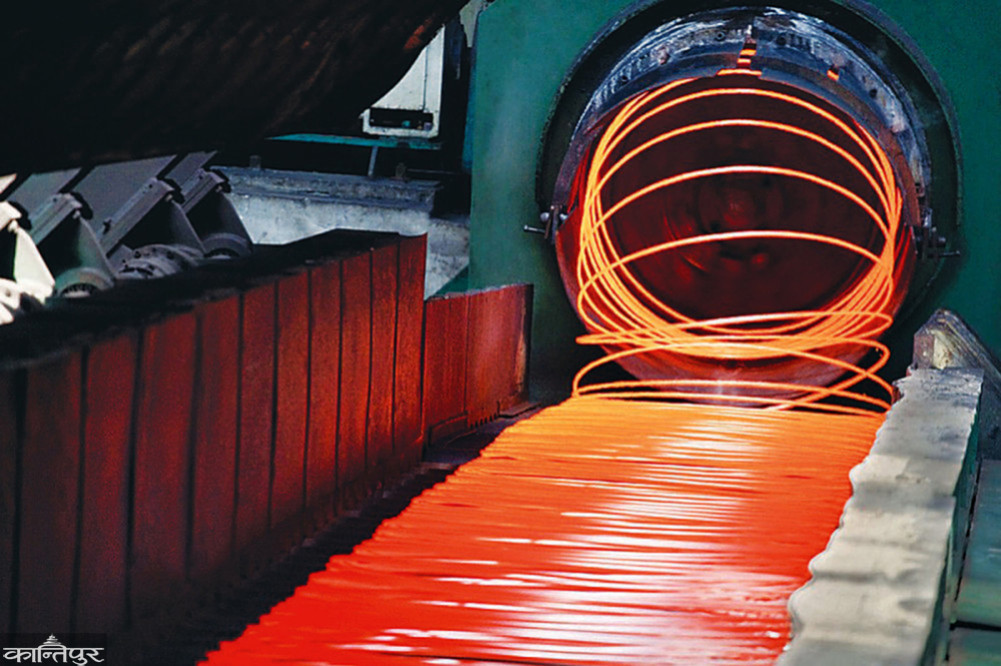
After the 5% customs duty was increased to 10% through the 2082/83 budget, the related industries are in crisis, some are closing down.
We use Google Cloud Translation Services. Google requires we provide the following disclaimer relating to use of this service:
This service may contain translations powered by Google. Google disclaims all warranties related to the translations, expressed or implied, including any warranties of accuracy, reliability, and any implied warranties of merchantability, fitness for a particular purpose, and noninfringement.
The government had imposed a 10 percent customs duty on the import of raw materials required for the production of GI wire through the budget of the financial year 2079/80. At that time, the industrialists demanded that the duty be reduced to 1 percent saying that domestic production would be adversely affected.
But the government was ignoring the demands of the industrialists. The same problem that was seen two years ago has now recurred. Recently, through the public budget, customs duty has again been increased on the import of raw materials required for binding and GI wire. Which has reversed the old problem and made the businessmen suffer again. According to
industrialists, such a policy will destroy the domestic industry. They say that this will increase the cost of production and adversely affect the development projects as well. On Thursday, the businessmen of Virgunj, Parsa, have formally protested against the increased customs duty on raw materials by writing to the Finance Minister of the Federal Government, Vishnu Paudel.
In the letter signed by Madhav Rajpal, Acting President of Birgunj Chamber of Commerce and Industry, it is mentioned that after the previous 5 percent customs duty was increased to 10 percent through the budget of the financial year 2082/83, the related industries are in crisis and some of them are in a state of closure.
While it is natural for raw materials to have lower customs duty compared to prepared goods, on the contrary, 6 percent (with SAFTA discount) on binding wire and GI wire and 10 percent on raw material wire rods have been fixed, indicating that the import-oriented economy will be encouraged, it is mentioned in the letter.
More than two dozen industries across Nepal have been importing iron rods and producing binding wire and supplying them to the domestic market.
It has been warned in the letter that such a provision threatens to jeopardize the investment of billions of rupees and thousands of jobs in these industries. Through the
letter, it has been demanded to protect the indigenous industry that produces binding wire and GI wire by maintaining the existing 5 percent customs duty on wire rods.
On the other hand, industrialists of Biratnagar have also opposed the move of the government. Anupam Rathi, president of Morang Udyog Trade Association, has alleged that the government is trying to impose problems on industrialists by increasing the taxes fixed in the financial year 2079/80.
There are more than a dozen GI wire industries across the country. There is only one wire and rod industry, Jagdamba Steel. "The intention of the government to nurture one industry and kill many other industries is seen," added Rathi, "this is never acceptable." Sunsari-Morang Industrial Corridor has 5 GR wire industries namely Premium, Pioneer, Kamala Rolling Mill, Hulas and Ariant. After the government's policy, there is a warning from industrialists that the problems in that industry may increase.