Mandatory registration of vehicles for rent, transporters are in favor of repealing the regulations
We use Google Cloud Translation Services. Google requires we provide the following disclaimer relating to use of this service:
This service may contain translations powered by Google. Google disclaims all warranties related to the translations, expressed or implied, including any warranties of accuracy, reliability, and any implied warranties of merchantability, fitness for a particular purpose, and noninfringement.
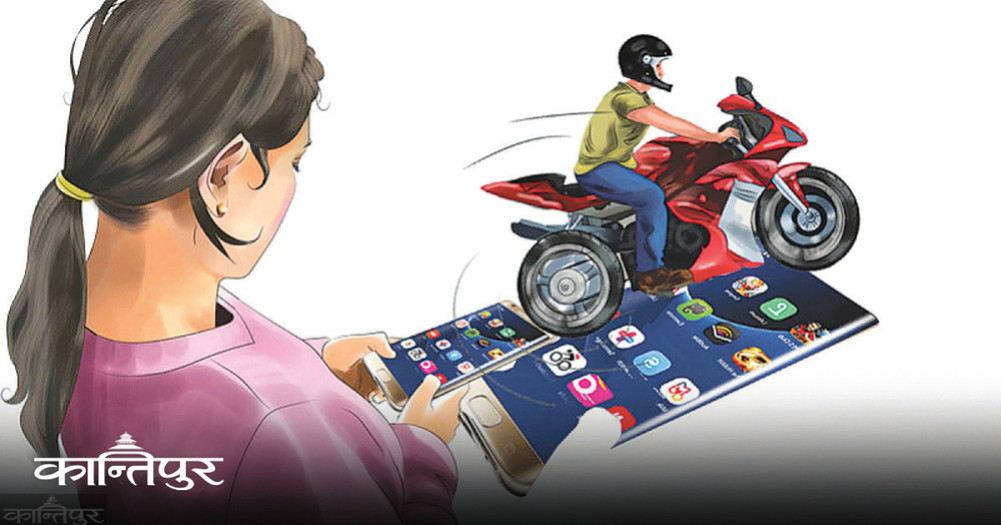
The Gandaki state government has passed regulations related to ride sharing (regulation and management) in order to give legal recognition to ride sharing. The regulations passed by the Provincial Council of Ministers meeting last Tuesday have provided for the registration, renewal, regulation and fines of ride-sharing and rental vehicles (self-drive).
Both types of service providers must be registered with the Transport Office within 30 days of the release of the regulations. A penalty of Rs 1 lakh has been fixed for operating the service without registration.
The organization that operates ride-sharing and self-ride has to pay 25,000 rupees for two-wheeler permit, 12,500 rupees for renewal, 50,000 rupees for four-wheeler permit, 25,000 rupees for renewal, 70,000 rupees for two-wheeler and four-wheeler permit, and 35,000 rupees for renewal. At least 20 to register ride sharing and at least 5 vehicles to register self-drive. When registering for
ride-sharing, two-wheeler owners will have to pay Rs 500 to the service provider and four-wheeler owners will have to pay Rs 2,000. Apart from that, for the number of registered vehicles, the service provider will have to file an annual service fee of 5,000 for two-wheelers and 20,000 for four-wheelers at the Transport Management Office. The service provider will be allowed to charge a maximum of 12 percent service fee from the vehicle owner.
Rule 12 stipulates that vehicles registered for ride-sharing cannot travel more than 20 km and drivers cannot drive for more than 12 hours. The service provider will have to arrange that the 12-hour period starts after opening the app at the beginning of the day and automatically closes or does not run after 12 hours.
Under 10 years old and over 80 years old cannot be made a passenger, there is a provision in the regulation that only one year of license completion is eligible to be registered in ride sharing. In rule 18, the company or organization that provides the service must have vehicle insurance, driver and passenger insurance and third party insurance for each vehicle.
Rule 19 stipulates that drivers of two- and four-wheelers who provide online services must pay a fine of Rs 4,000 and Rs 10,000 respectively. There is a rule that two-wheelers will be fined 5,000 and four-wheelers will be fined 10,000 for violating the rules.
The second time the fine will be doubled. Spokesperson of the government, Takaraj Gurung, said that legalization was given by making regulations to regulate the ride-sharing that is in operation. According to him, since the Supreme Court has decided that private vehicles can run ride sharing under the law, the regulations have been made based on that. Even if it was not legal, it was still going on. As the sporadic incidents increased, the state seemed innocent. Regulations have been made to regulate,' he said.
He said that the government committee will determine and review the fees that ride-sharing and rental vehicles can take from the service users. After the implementation of the regulations, the provincial government estimates that the revenue will be up to 1 crore rupees per month.
The Supreme Court on June 13, 2081 ordered to bring ride sharing to legal standards and organize it. The full text of the decision made by the joint bench of the then Chief Justice Vishwambhar Prasad Shrestha and Judge Tek Prasad Dhungana was published last December. In full, the Union Government was directed to implement the necessary legal provisions for the registration, operation, management and monitoring of transport service businesses such as ride sharing.
In July last year, the state government had prepared to bring a procedure to legalize ride sharing. After learning about this matter, the transport businessmen were on a rampage. After the businessmen protested, on the initiative of Acting Chief Minister Vindukumar Thapa, it was agreed with the transport businessmen not to bring the procedure immediately and to form a technical committee. This time, without the knowledge of the transport businessmen, the provincial government has completed internal preparations and passed the regulations by the Council of Ministers.
Transport professionals are dissatisfied with the government bringing regulations based on the order of the Supreme Court. Secretary of Public Transport Central Federation of Nepal Gandaki Gandhiraj Giri said that the regulations should be abolished. He said that it is not appropriate for the Union Government to rush to legalize ride-sharing without amending the Transport Act.
'The order of the Supreme is to the Union Government. Not to the province. It is under discussion in the union,' said Giri, 'the remaining 6 provinces are not rushed, they were rushed here.' He warned the government that the agitation program will be continued if the regulations are not repealed.