Pressure from industrialists not to implement
We use Google Cloud Translation Services. Google requires we provide the following disclaimer relating to use of this service:
This service may contain translations powered by Google. Google disclaims all warranties related to the translations, expressed or implied, including any warranties of accuracy, reliability, and any implied warranties of merchantability, fitness for a particular purpose, and noninfringement.
The government-affiliated body is trying to make the maximum retail price (MRP) mandatory for goods available from retail shops to luxury places. The Department of Commercial Supplies and Consumer Protection has begun to fine the businessmen who do business without keeping price labels. Industrialists have increased pressure to stop it saying that it is not practical. They have started 'lobbying' not to implement MRP saying that the maximum selling price has spoiled the market and the fine has discouraged the businessmen.
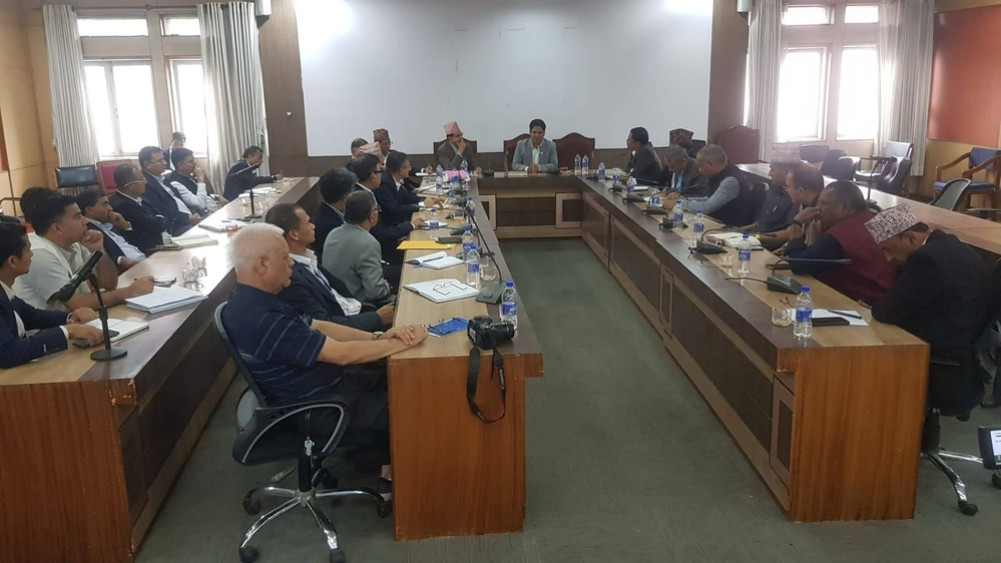
At the request of industrialists, MRP was also discussed in the Ministry of Industry, Commerce and Supply last Tuesday. In the discussion chaired by Industry Minister Damodar Bhandari, umbrella organizations of the private sector (Nepal Federation of Industries, Confederation of Nepal Industry and Nepal Chamber of Commerce), Nepal Rastra Bank, Customs Department, Agriculture Department, Internal Revenue Department, Commercial Supply and Consumer Protection Department, Statistics Office, Consumer Rights Workers and others participated in the discussion. At that time, the businessman said that the implementation of MRP was not possible immediately. They say that businessmen should not be fined on the pretext of not implementing MRP.
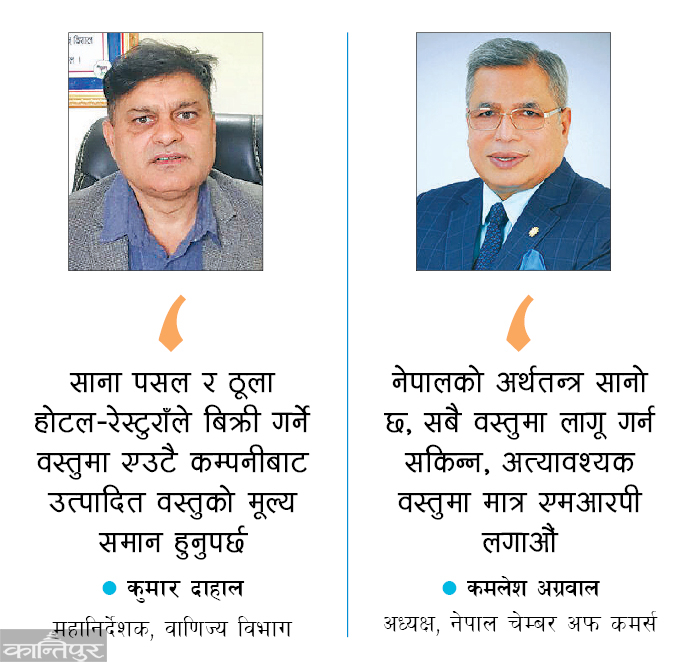
Kamlesh Agarwal, president of Nepal Chamber of Commerce, claims that there is no situation where the MRP of goods can be applied in the market. "Nepal's economy is small, there is no happiness without importing even small items," he said. He says that if this situation continues, businessmen will flee. Businessmen argue that the implementation of MRP has worsened the market and increased prices.
Commerce said that it is trying to implement the Constitution of Nepal and the Consumer Protection Act, 2075. Kumar Dahal, Director General of the Department of Commerce, said that in accordance with the spirit of the consumer's rights in Article 44 of the Constitution of Nepal and in accordance with the spirit and spirit of the Consumer Protection Act, 2075, ``labelling'' has been made mandatory in accordance with Section 6, Subsection 3. "The only demand of the businessmen is that we should not make MRP implementation mandatory," he said. Dahal says that the MRP is mandatory in the
Act and is only intended to implement that right. MRP should be applied to all items from small to large. Even the products sold by small shops and large restaurants should have the same price as products produced by the same company. Because big restaurants charge more in the name of service and facilities. But he says that the price cannot be increased when he gives the goods bought from the market to the consumers. Dahal said that the department is conducting a study on this matter. In the
act, the manufacturer has to put a mandatory label on the goods that are being sold and distributed, if the goods are manufactured by the manufacturer and the goods that are imported. It is mentioned that the label should be in Nepali and English language so that common people can understand it. The label must contain the name, address, address, quantity, weight, quality, date of manufacture, batch number, shelf life of the product. When the regulatory body implements this rule, businessmen have started a campaign to stop it.
Commerce has implemented the legal provisions in the Constitution and the Consumer Protection Act. Instead of assisting in the implementation of the law, it is wrong for businessmen to put pressure on stopping it. After making MRP mandatory and imposing fines on big commercial houses like sand, cement, and vehicles, industrialists are stuck," President of the National Consumer Forum, Premlal Maharjan said, "MRP on goods is a provision in the law. Since 4/5 of the laws have made MRP clear, not implementing it is a crime against the consumer.
During the monitoring, the businessmen were found not implementing the MRP, and the department imposed a fine ranging from 2 lakh to 3 lakh rupees. Before imposing the fine, the department had given time to the businessmen by publishing notices several times. It was said that the businessmen who do the altering will be fined. Now, after starting the action, the businessmen have been 'lobbying' to stop the MRP.
President of Consumer Rights Research Forum Madhav Timalsina also said that the rules clearly mentioned in the law should be implemented immediately. He says that the general public will not get justice due to the tendency of people to withdraw from the implementation of MRP when they are motivated by businessmen or some limited interests.
'Label is mandatory for a clean and competitive market. MRP is also included in that," he said, "MRP is in favor of businessmen and consumers who do business in a clean and transparent manner. It should be implemented rather than discussed. The Customs Department also tried to implement labeling in sub-section 4 of section 18 of the Economic Act, 2080. For this, the department has already issued a notification regarding labeling on 22 June 2080 by including it in the economic bill. But the businessman refused. Lately, commerce has tried to implement it strictly.
In the event that the government has removed the provision of black market and some other social crimes and punishments in the Act, 2032, the market can be regulated through MRP. There is also an opening for regulation. Therefore, Timalsina says that MRP should be implemented.
According to the law, no businessperson can take more than 20 percent profit in general according to the goods and business practices. Taking more profit automatically attracts the Black Market Act. And, for the crime of black market, the businessman can be imprisoned for 5 years or fined or both. But the government has already removed this system through an ordinance to benefit the businessmen,' said Timalsina, 'but again in the policies and programs of the next financial year, a loud slogan has been given to make the market clean, competitive and consumer-friendly by controlling the black market, syndicates etc. It shows the double character of the government.'
Director General of Commerce Department Dahal also said that MRP should be mandatory. Even after studying the field, some quality has been found. MRP can be implemented, all together can be implemented. It is in favor of the businessmen as well as the consumers," Dahal said. "It makes the market clean. It identifies the right businessmen and also increases the government's revenue. He says that MRP is necessary in an open economy. Industry Minister Bhandari said that the government is moving forward to create a procedure to implement the MRP.