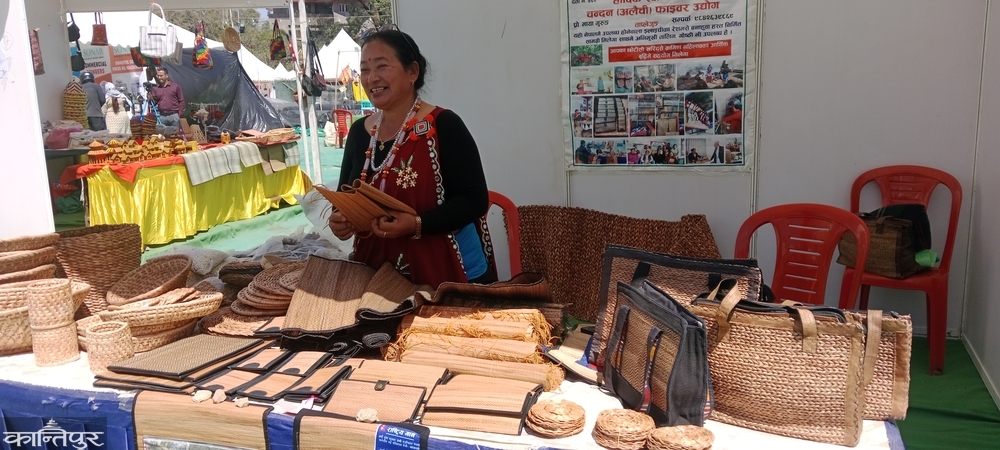
There are now 15 workers in the industry which was started by learning. Now the annual turnover is up to 25/30 lakh rupees.
We use Google Cloud Translation Services. Google requires we provide the following disclaimer relating to use of this service:
This service may contain translations powered by Google. Google disclaims all warranties related to the translations, expressed or implied, including any warranties of accuracy, reliability, and any implied warranties of merchantability, fitness for a particular purpose, and noninfringement.
From T-mats made from cardamom stems and leaves to purses, ladies bags and the flag of Nepal, many liked it. These materials produced in Fungling of Taplejung attracted the attention of the Gorkhali located in Dehradun, the capital of Uttarakhand, India, about 350 km from Kanchanpur in the far west.
Maya Gurung of Taplejung Fungling Municipality-2 was invited to inform about her products. She had reached the Indo Nepal Trade Fair held in Dehradun in the first week of March with her products. 'I have reached from Jhapa in the east to Kanchanpur in the west, now I have brought my products to India as well,' said Gurung, 'I have found a good market, and the customers also liked me a lot.' Cardamom production is good in his village . But its stems kept wasting away. Some used to make ropes for it . Even in his house, cow-buffalo-tying ropes were made of the same. Gundri is made by mixing cardamom leaves and straw. But straw rots but cardamom leaves do not. Seeing this, Gurung felt that nothing can be made from the wasted cardamom stalks. "After that, I started to spin and make cloth little by little, I learned slowly," said Gurung, "In the beginning, when I needed a little, I used to get only what was wasted, but now I need a lot, so I have to buy it." After the cardamom is produced, she goes to Bari Bari to buy leaves. Some of them go to his industry.
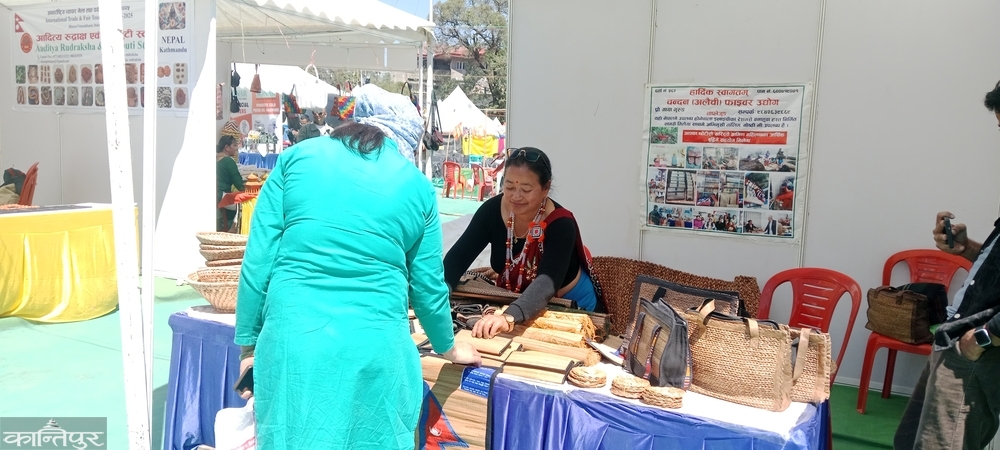 At the beginning of the turn the wasted leaves are collected . The same leaves are dried and made into fibers according to the required size . Then cloth is made by putting it on the loom . Finally it is sewn and given different shapes . The price of the material produced by him ranges from 100 to 4000 rupees. Various materials such as mats, gundris, chappals, bags, flags of Nepal are produced in his industry . These materials reach abroad along with the country . "You don't even have to put color on it, even if the color doesn't fade," said Gurung, "those who understand it well will buy it and order other items." According to her, the material woven from cardamom leaves can also be washed. Food can also be placed in it.
She started selling her products for the first time at the festival held in Taplejung in 2067. Then she registered Sandalwood Fiber Industry in 2068 . There are now 15 workers in the industry which was started by learning. Now she is doing business up to 25/30 lakh rupees a year . From this she is earning 10/12 lakhs a year . She has reached the festival from Kolkata to Dehradun in India and from Jhapa to Kanchanpur in Nepal. Even now, he is eager to reach the festivals that are being held in different districts. This has also increased his business along with the growth of his business.