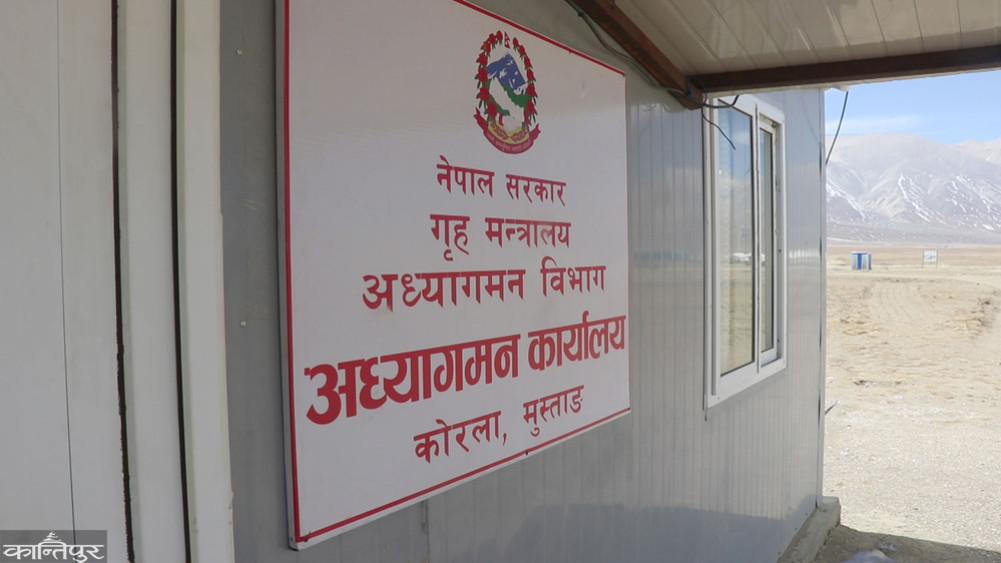
There is no place to store goods brought from China to Nepal
We use Google Cloud Translation Services. Google requires we provide the following disclaimer relating to use of this service:
This service may contain translations powered by Google. Google disclaims all warranties related to the translations, expressed or implied, including any warranties of accuracy, reliability, and any implied warranties of merchantability, fitness for a particular purpose, and noninfringement.
Korla Pass, located on the Nepal-China border, is at an altitude of 4,600 meters above sea level. Pillar Thingg No. 24 written Nepal, buried in the year 2029, has fallen. About one and a half hundred meters to the south, Nepal has built a charkothe building (a single-storey building covered with tin).
The immigration office was opened at Korla border on November 14. It closed in a few days and did not open until the third week of March.
"The state government built the Charkothe building, the immigration office was also inaugurated," said Pasang Wangdi Gurung, a businessman in Korla Naka Mustang, "It may have been open for three or four days, but no one has come since then." The lock is hanging in the office.'' Trader Gurung said that a huge building has been constructed on the China side of Korla border. There is a provision to go to Nepali to do business from 9 am to 2 am .
China has given all the facilities to its country . Gurung said that on the Nepal side, they had to trade in carts and tents. Due to the lack of buildings on the Nepal side, it is not so crowded because of the wind. "People who come here can't stay for even an hour," he said, "there is no place to pour water." That's why everyone rushes back immediately.'
Some of the business people have buried their tents . But those who do business in the open market are forced to cover their mouths due to the wind. However, they have sold goods brought from China. There is no infrastructure for storing goods brought from China. There is no place to bring goods from China. Karchung Bista, a businessman from Lomanthang, complained that she had to come to Nechung, 13 kilometers away, to get the goods brought from Korla border checked.
"It's just that China has developed so much," she said, "Nepal has nothing". And even if you go to do business, the customs check is too far away. The government has not been able to think about this matter.'
There is no regular presence of customs and security agencies at the checkpoint. A policeman goes to and from the checkpoint on a motorcycle. Bista says that there is no building, drinking water, communication facility and toilet management in Nepal. She said that there is a problem for anyone who does business and reaches the border. Locals of Lo-Ghekar Damodarkund and Lomanthang Rural Municipality of Upper Mustang have been given entry passes, so they go to China to do business and return after two o'clock. They have been buying and selling goods. According to
traders, after the opening of the Korla border, business, traffic and transactions have started between Mustang and China. Businessmen say that clothes, electrical goods, beverages, daily necessities and other goods are imported to Nepal through Korla crossing. Sheep wool, pashmina, jimbu and other goods are sold to China from Nepal. Sheep and goats are also bought and sold from Korla pass.
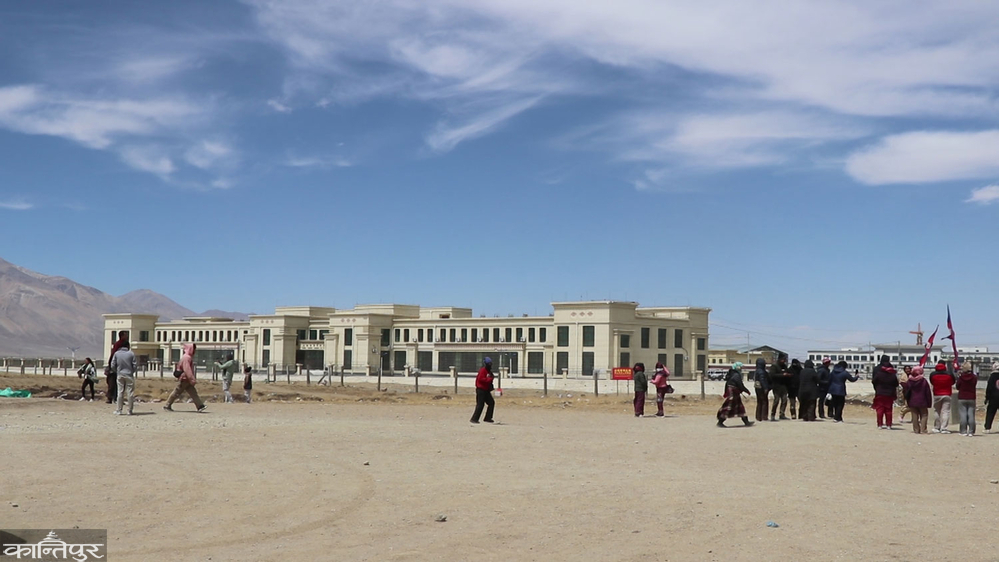
Mustang Nechung, 13 km away from Korla border crossing, has security arrangements including customs, quarantine and immigration. But Karma Angdel Gurung of Lomanthang, a businessman, says that it has not been permanently managed at the border. If the government builds and organizes buildings towards Nepal, it would be easy to trade Chinese goods and Nepali goods. On the Chinese side, a fenced gate and a large building have been built. China has already prepared the infrastructure for everything from the customs office. "Everything is being done on China's side, but nothing on our side," Gurung said. How to work without infrastructure?'
It has been years since the building of integrated customs office was built from the 24th pillar of Korla crossing to China. Customs offices, roads, electricity, water and other works have been done towards China. A four-room building was built on the Nepal side. That too has been opened and closed.
The process of bringing 1000 ropani land under the name of the customs office to open an integrated customs office at Korla border crossing has been going on since 4 years ago . It has been demarcated and recommended. 13 km away, the Nepal Police watches the Korala border. There is no infrastructure to monitor the border. Manpower and resources are nothing . "They watch when they go and come," he said, "sometimes one or two policemen are seen at the checkpoint." That too, they will return after the wind blows.'
If the tourists who have visited Korla Naka face any problem, there is also a problem in rescuing them in time. Those who have the problem of liquefaction have to be brought to the armed police camp in Nechung, 13 kilometers away, and have to be given oxygen.
The building is constructed for security agencies and emergency rescue. Charkothe is not effective for professional growth . Pema Angya Gurung, Ward President of Lomanthang Rural Municipality-1 Mustang, said that the government has neglected the construction of necessary infrastructure to advance the border commercially. He says that even though the rural municipality and ward have taken initiatives for physical infrastructure, they are not able to work on their own.
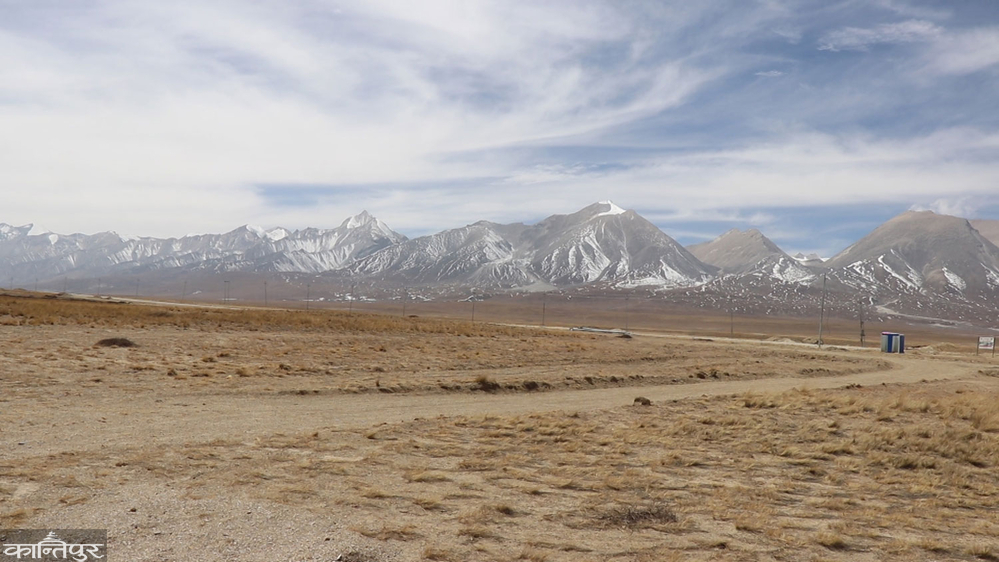
"Even though we have taken the initiative, there has been a problem because the state and federal governments have not given permission," Angya said, "We have complained many times to MPs and ministers. However, from the physical infrastructure to water supply, electricity and toilets, there is no good system. He said that even though the land was managed, the work could not proceed because the federal government was not interested in it.
One thousand 344 ropani land has been allocated for the construction of physical structures. The rural municipality has been managing the land for many years. But the work for physical infrastructure has not progressed . "With the upgrading of the road, hundreds of tourists reach Korla Naka every day and return," he said, "but since there are no facilities, they have to return without stopping for even an hour." From Jomsom in Mustang, 112 km north of Jomsom, access to a two-lane unpaved road has been reached.