Provision should be made for national political parties to receive grants from federal funds, parties to receive donations from the banking system, and candidates not to receive donations.
We use Google Cloud Translation Services. Google requires we provide the following disclaimer relating to use of this service:
This service may contain translations powered by Google. Google disclaims all warranties related to the translations, expressed or implied, including any warranties of accuracy, reliability, and any implied warranties of merchantability, fitness for a particular purpose, and noninfringement.
The High Level Economic Reforms Recommendation Commission has submitted a report to the government with recommendations ranging from the need to review the exchange rate with India to the opening of foreign investment to Nepalis. The commission formed under the coordination of former Finance Secretary Rameshwar Khanal submitted the report to Deputy Prime Minister and Finance Minister Bishnu Paudel on Friday.
The recommendations of the report, which was prepared after 6 months, have been effectively implemented, the economic activity will expand and the relaxed economy will continue, the Commission has claimed.
Commission has emphasized on the need to implement the policy of 'creating economic opportunities, encouraging them to be created and building an economy where all sectors and classes can compete for opportunities equally'. For that, the Commission has mentioned the existing conditions, problems and solutions in dozens of areas in the report.
Exchange rate options with India should be discussed, researched and prepared, the cost of production and commercial work should be reduced by actions such as the availability of electricity and land at low prices, business-friendly government agencies, investment promotion and service to citizens should be provided. The commission has given suggestions to be determined.
The commission also suggests that secretaries who are posted in federal and state ministries should not be transferred before completing two years. "The secretary shall not be transferred more than once during his tenure, and no employee shall be transferred inter-ministerially without completing at least five years in a ministry to develop efficiency in the ministry," the report said.
It has also been suggested to arrange for a two-year term in the provincial ministry to be promoted to the post of secretary of the federal government. The commission also suggests not to transfer the project chief and related technical staff until the project is completed.
The commission has recommended the government to provide annual grants from federal government funds to nationally recognized political parties. "Political parties are allowed to receive donations using the banking system subject to certain conditions and limits, it is necessary to arrange that candidates cannot receive any donations during the election," the report said, "All political parties must provide details of income and expenses. Arrangements should be made to send it to the Election Commission quarterly and put it on the Commission's website.'
It is mentioned in the report that 15 laws should be repealed, 8 new laws should be created and one law should be amended to make the economy sustainable. It has also been said that the Act prohibiting investment abroad, 2021 should be repealed and investment should be opened to Nepalis abroad.
The commission has suggested to the government to control double benefits by increasing the use of national identity cards in social security allowances. By amending the Social Security Act, 2075, it has been suggested that the age for senior citizens to receive allowances should be raised from 68 to 70 years, Dalits and single women will receive allowances after reaching the age of 60, and it has been suggested to change it to 65 years. is. The commission has suggested not to announce allowances in the budget except as provided in the
act. In the current expenditure, it is necessary to take measures not to increase the expenditure on social security in the context of the rapid increase in current expenditure, it is said in the report. It is appropriate to remove or reduce the arrangement.'
The commission has suggested to the government to arrange for 50 percent of the social security allowance to be given as government bonds or hydropower company shares with the approval of the beneficiary. "This will help in capital formation in the economy," the suggestion says, "There should be no increase in the social security allowance for the next 5 years and after that the allowance should be increased only every two years based on the price increase." All salaries and wages It is also suggested that a 1.5 percent social security tax be levied on the payment and deposited into the social security fund. Workers in the informal sector are asked to join contributory social security.
Public Expenditure Review Commission 2075 suggests that administrative restructuring in the federal environment should be done in order to reduce unnecessary current expenditure, according to the economic reform roadmap submitted by the commission.
"The number of federal offices and employees should be reduced from the perspective of increasing work rights at the provincial and local levels," the report said, "only in a targeted way in projects that give high returns in the context of increasing interest payment obligations." Debt must be mobilised.
The commission also suggests that the trend of the federal government taking loans by paying interest but not spending the grant funds transferred to the provincial and local levels and remaining in the banks at zero interest should be improved. According to the commission, arrangements should be made to make payments from the federal government after spending by the state government and the local level to improve it. For this, it is suggested to bring the state and local level expenses into a single account system.
The federal government should not keep a budget for small and medium development, make the tax system easy for taxpayers to understand and follow the rules, abolish the revenue research department, and take action against those who determine the tax in bad faith. The commission has suggested to the government. The Commission is of the opinion that it would be appropriate to give some concessions in the integrated property tax to encourage the construction of large commercial buildings.
It is suggested that the amount of penalty should be reduced by 50 percent as per section 120 (a) of the Income Tax Act for general errors and omissions other than planned tax evasion. As it is not a good practice to impose income tax when there is no real income, it is suggested to completely remove the provisions of Section 95 (a) of the Income Tax Act. "Tax should not be determined maliciously and wrongly and action should be taken if this is found," the report states. It is suggested to levy only percentage income tax.
The commission recommends providing loans to manufacturing industries, small and micro businesses and exporters at a fixed interest rate for a period of 3 to 5 years and not to set a maximum percentage of the profit of the services sold by any business. Similarly, all procedures related to business registration should be done online, business registration should be free, at least 10 percent of the capital budget should be spent on agricultural infrastructure every year, foreign employment promotion programs by the government and It is also mentioned in the report that the activity should be stopped. Commission recommends that
loans should not be mobilized for current expenditure. The commission said that short-term treasury bills should be issued only to cover the gap between revenue and expenditure. "Development bonds should be fully linked to development projects," the report states. It is suggested that a strategy of subsidized foreign loan mobilization should be adopted by selecting projects that give high returns. "The better the credit rating, the cheaper the interest rate when mobilizing loans from the international financial market," the report said, "therefore, policy stability, budget and plan implementation should be improved."
When there is plenty of liquidity in the banking system and the private sector is not increasing the demand for loans, the commission suggests that the government should invest by issuing infrastructure 'bonds' for high-return projects. It is mentioned in the report that 'EKYC' based on national identity card should be arranged. "Infrastructure bonds should be issued targeting insurance companies for infrastructure projects that give high returns," the commission said, "Insurance authorities should establish an insurance academy in co-investment with insurance companies."
The Commission has also put forward a new concept of facilitating 'remote workers' and 'digital nomads' in order to earn foreign currency, control manpower migration, promote tourism and develop a knowledge-based economy. The conclusion of the commission is that only demand-side policies are not enough to solve the immediate problems of the economy.
5 public institutions that could not operate the business, Janakpur Cigarette Factory, Butwal Thread Factory, Nepal Engineering Consultancy Service Center, National Construction Company Nepal and Nepal Orient Magnesite Pvt Ltd were canceled and named after those companies. The commission suggests to bring the existing immovable property under the name of the government and manage it. It is mentioned in the suggestion that the audit of all public institutions should be completed on time and made public.
Hetaunda and Udaipur Cement Udyog The commission suggests that the government should keep only some shares and sell the shares to the private sector. "Nepal Airline Corporation should be restructured and managed in a professional manner by bringing in external strategic partners," the report said, "It is appropriate to give foreign management for some time to make such an organization professional."
It is also suggested that dairy development institutes should be converted into public institutes of the provincial government and should be abolished if not necessary. It has also been suggested that loans should be stopped for payment of employees' salaries or other expenses in public institutions.
The commission suggests that the agricultural and animal insurance subsidy should be given from the local level and not from the federal level. It has also been said that the arrangement for the secondary market trading of government bonds should be started immediately.
It is mentioned in the suggestion that the government of the three levels should stop opening new cooperatives and branches of existing cooperatives for the time being. "Cooperatives with more than 100,000 branches should be ordered to close their accounts," the report said, "Sufficient manpower should be provided to the problematic cooperative problem solving committee to clean up the accounts of problematic cooperatives." It is suggested that the government should provide funds to the said committee to return the amount up to 25 lakhs. The commission suggests to stop the passports of the directors who make cooperatives problematic, to ban them from going abroad and to freeze their assets.
It is mentioned in the report that the minimum educational qualification of the assistant and authorized level employees who enter the revenue administration should be only accounting, commerce science, business science, tax policy, economics up to the prescribed level.
Khanal, the coordinator of the commission, said that within the responsibilities given by the government, a recommendation report has been prepared after analyzing all areas. "After preparing the report, we did not sit down and discuss with all the areas," he said, "but all areas are included in the suggested report." If it is implemented, many problems seen in the economy will be solved.'
According to the mandate given by the government, the commission started the study in the second week of October. The commission had submitted an interim report to the government on December 24, covering the urgent matters. Convenor Khanal mentioned the suggestions in the report and said, "decreasing loan growth, decline in real estate transactions, savings of millions of people in the cooperative financial system, non-payment of some payments due by the government and problems in business loan recovery and It seems that there has been a decrease in consumption and investment due to the fact that the construction sector has become a crisis.' Khanal informed that it was suggested to make sustainable and best use of natural resources, build a borderless economy and increase the economic growth rate while maintaining macroeconomic stability. "Since regional economic policies cannot work without improving the institutional capacity and credibility of public bodies, the commission has suggested the government to improve it," he said. According to Khanal, the coordinator of
, the commission has suggested reforms to reduce the obstacles in the areas of economic growth, agriculture, forestry, land, mining, water resources, tourism and information technology and to expand opportunities in those areas. In order to create opportunities in the areas of economic growth, physical infrastructure development, urban development, energy security, education and skill development, health and research and development are necessary to identify the policy and programmatic interventions in these matters. The commission has also done the work," he said, "The commission's opinion is that we should work in an innovative way with a strong will to benefit from the world economy by breaking the boundaries created by the country's geopolitical location.
Mahesh Acharya, Prakash Kumar Shrestha, Rajesh Agarwal, Kamlesh Kumar Agarwal, Chandra Prasad Dhakal, Kalpana Khanal, Vishwas Gauchan and Ram Prasad Gyawali were members of the recommendation commission. Prakash Kumar Shrestha, a member of the commission, said that many suggestions have been made through the report after studying different sectors to make the economy sustainable. "In order to promote investment, to create an environment of trust, some laws need to be amended," he said. The issue to be raised is also mentioned in the report. "If the report is implemented, there may be an economic growth rate of 6 to 7 percent." "A high-level commission has been constituted to get into the problems seen in the economy and suggest solutions," he said while understanding the report from the commission, "we are on the eve of budget formulation, the report of the commission tells us that the budget
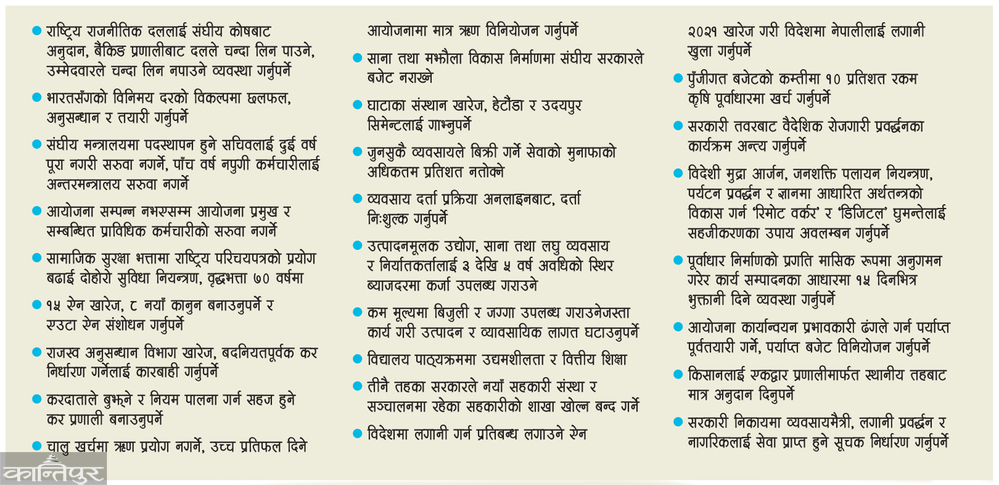
Main points
- Grants to national political parties from federal funds, parties can receive donations from the banking system, candidates should not receive donations
-
should be discussed, researched and prepared on the exchange rate option with India -Secretaries who are posted in the federal ministry should not be transferred before completing two years, employees should not be transferred inter-ministerially after completing five years
-Until the project is completed
not to transfer the project head and related technical staff - double facility control by increasing the use of national identity card in social security allowance, old age allowance in 70 years
- 15 laws should be repealed, 8 new laws should be made and one law should be amended
- Revenue Investigation Department should be abolished, those who determine taxes should be prosecuted
- tax system that is easier for taxpayers to understand and follow the rules
to be made - Do not use loans for current expenses, loans should be allocated only to projects that give high returns.
- The federal government will not budget for small and medium development.
- Loss-making institutes abolished, Hetaunda and Udaipur Cements to be merged
-No maximum percentage of profits of services sold by any business
– Business Registration Process Online, Registration To Be Free
- providing loans to manufacturing industries, small and micro businesses and exporters at a fixed interest rate for a period of 3 to 5 years
- Reducing production and commercial costs by providing low-cost electricity and land
- Entrepreneurship and financial education in school curriculum
- All three levels of government will stop opening new cooperatives and branches of existing cooperatives.
- Act banning investment abroad 2021 has been repealed and Nepalese investment abroad.
should be opened
- At least 10 percent of the capital budget should be spent on agricultural infrastructure.
- Foreign employment promotion program should be stopped by the government
- facilitating 'remote workers' and 'digital' nomads to earn foreign currency, control manpower migration, promote tourism and develop knowledge-based economy Measures to be taken
-Monthly monitoring the progress of infrastructure construction and making arrangements to pay within 15 days based on performance
-Enough preparation to implement the project effectively, enough budget
to be allocated -Farmers should be subsidized only from the local level through a one-door system
-Indicators of business-friendly, investment promotion and services to citizens should be determined in government bodies

