The farmer's statement that the situation has come to be displaced from agriculture
We use Google Cloud Translation Services. Google requires we provide the following disclaimer relating to use of this service:
This service may contain translations powered by Google. Google disclaims all warranties related to the translations, expressed or implied, including any warranties of accuracy, reliability, and any implied warranties of merchantability, fitness for a particular purpose, and noninfringement.
Dipesh Dangal's farm of Mechinagar Municipality-2 Gadagalli produces 300 crates of Golbheda (tomatoes) every week. He cultivates commercial tomatoes on one and a half square meters of land and picks them twice a week and delivers them to the market.
He has been engaged in agriculture since the 50s, but recently he has been displaced. What to do with growing tomatoes? No market . This time, there is no investment,'' he lamented when he was met in Bari, 'I am paying wages to the farmers who pick and carry tomatoes by looking for loans, there is no income.'
He started tomato farming by taking a loan from the bank in search of a future in agriculture. About 6 lakh rupees were spent to plant tomatoes in one and a half acres. When production started, tomatoes did not have a market. He said that now the bank that has taken the loan is paying attention. "The bank is making inquiries, it is feared that the auction will be the Lalpurja," he adds . According to him, the produced tomatoes should be delivered to the agricultural market in Charali or Birtamod. One crate contains 23 kg of tomatoes . The cost of delivery to the market is 50 rupees.
You have to pay 10 rupees for unloading in the market and 10 percent of the sale price has to be paid to the market as a commission . The cost of picking tomatoes is separate. As many as 20 people should be engaged in farming in a week, they should be paid a wage of 500 rupees per day . Tomatoes brought to the market after incurring many expenses are sold at the rate of 200 to 250 rupees per crate.
'Now the market itself has told not to bring tomatoes . In such a situation, what should the farmer do?,' he says, 'we don't even get 5 rupees per kg after cutting costs.' How to pay the loan ? How to pay wages to those who have worked?'In the market, tomato farmers are getting around Rs.
The current situation of most of the farmers who cultivated tomatoes due to lack of price is not different from that of Dangal. There is a majority of tomato producing farmers in Mechinagar, Buddhashanti and other municipalities. There are many farmers who have cultivated tomatoes commercially in North Mechinagar-2. Bimala Bhujel is one of those who started in agriculture by registering the Pathibhara agricultural vegetable industry in Mechinagar 2.
She has planted tomatoes on two acres of land . She said that it cost about 8 lakhs to grow tomatoes in two fields. "We had to sprinkle medicine to protect us from various diseases, we had to plant fields to tie the soil to see if the plants would fall, we have reached a situation where we are displaced from agriculture if the crops produced by using fertilizers and seeds do not get a market," says the Bhujel couple.
When Bhujel reached the couple's farm, four women were picking tomatoes and some were carrying them. Someone was picking up some of the fallen plants and planting them. "Many have flourished and fallen". The plant could not hold the seeds,'' Bimala said, 'It makes me happy to see it flourish, but it is disappointing when I think of the market . It would have been a great help if the state would have arranged the market.'' He said that when tomatoes were imported from India, the local produce did not find a market. She says that if the state stops the import of tomatoes, it will be a big relief for the farmers. "Investment has sunk, we have to sell the land and pay the loan," she says.
This is a wild elephant affected area under Savik Bahundangi under North Mechinagar . Because wild elephants come here almost every day, farmers have to protect their crops. "Elephant will eat another question". There is no market when the crop is prepared amid many disturbances, who will listen? We are farmers," he said. Farmers here plant tomatoes in the fields and betel nut plants in Alima. Which has made the farmer's field attractive .
Purna Bahadur Khadka of Boudhamode in Mechinagar-2 also planted tomatoes on one bigha of land at a cost of four lakhs. He has been engaged in commercial agriculture since 2057, but now he says that he has to find an alternative to agricultural work. 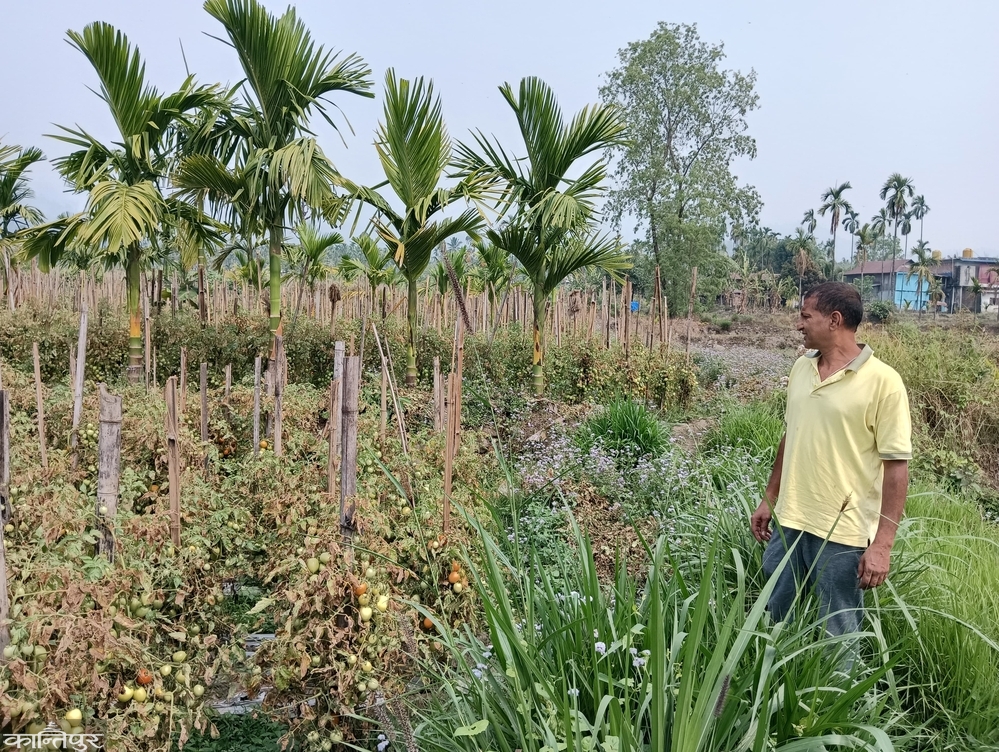
'Nowadays, if you tell a villager to go abroad, they will give you a loan, if you do agriculture, they will not give you a loan. The entire village society has stopped seeing the future in agriculture," he complained when he was met while picking tomatoes. Who is going to control this market?' According to him, in the current situation, the farmers do not even get 4-5 rupees per kg after cutting expenses.
'Let's leave aside the expenses of buying seeds, pesticides, and tying the dam. It costs 35 to 40 rupees per plant to make it bear fruit,' he said, 'one plant gives 3 to 3 and a half kilos of fruit . After deducting all the costs of harvesting, transportation, commission to the market, unloading expenses, the wages should also be given to the farmers by looking for loans. Where hundreds of farmers are involved in agriculture . Shantinagar Agricultural Cooperative Society here has only planted tomatoes on 3 acres of land and most of the members under the organization grow tomatoes . Here too, the market situation is the same. According to the chairman of the cooperative, Dilnath Kafle, more than 80 bighas of land have been planted with tomatoes in Buddhashanti-5 and 6 only.
whose market is Birtamod and Charali. Even if farmers reserve vehicles and take them to the market in Birtamod and Charali, they have to return with disappointment if they do not get the price . Since the tomatoes came from Pari (India), the products here did not find the market. The Indian government has given a lot of concessions to the farmers, due to which the tomatoes there are cheaper,' says Kafle, the chairman of the cooperative, 'There is no such concession for the farmers here, the farmers here cannot compete with Indian tomatoes.
According to Krishi Gyan Kendra Jhapa, tomatoes have been cultivated in an area of 1100 hectares across the district. Where per hectare is produced at the rate of 22 metric tons. Chetraj Bhandari, the information officer of Gyan Kendra, says that it is the season of tomatoes and the production is too much to get the market.
However, once it rains, tomatoes can get a reasonable price, he said. It seems that a large amount of tomato is imported from India as the production of indigenous farmers does not get the market. According to the Mechi Customs Office in Purvinaka, tomatoes worth Rs 40.27 million have been imported from India till the end of February of the current financial year. Which is being consumed in the Nepali market.

