Farmers' complaints about the government's neglect of Chaite paddy, which produces more
We use Google Cloud Translation Services. Google requires we provide the following disclaimer relating to use of this service:
This service may contain translations powered by Google. Google disclaims all warranties related to the translations, expressed or implied, including any warranties of accuracy, reliability, and any implied warranties of merchantability, fitness for a particular purpose, and noninfringement.
In terms of productivity, the planting of Chaite rice, which has more potential and production, is booming. Experts say that planting in the hilly areas is over. In Terai, most of the areas are being planted.
But what is the state of chemical fertilizers at this time? Did the farmers get fertilizer easily? Ganeshchandra Timalsina, president of Nepal Kisan Federation, says, "Although there is no trouble, the farmers have not been able to get it easily. According to the government data, although the fertilizer is full, it has not reached the farmers. Farmers are doing it.'
Timalsina said that road agitation is being prepared to end the lack of fertilizers seen in every crop. Even though the people paid money, we did not get fertilizer easily, even though the Minister of Agriculture came, the supply of fertilizer was not easy. A meeting of the farmers' umbrella organization network is being held soon on this matter,' he said, 'We will submit a memorandum to the Agriculture Minister Ramnath Adhikari.' Barkhe paddy crop productivity in 2081/82 is 4.13 tonnes per hectare. The productivity of chaite rice is 4.98 tons per hectare. In 2081/82, 13 lakh 11 thousand 328 hectares of Barkhe paddy were planted in the Ministry's data. 54 lakh 11 thousand 83 tons were produced from that area.
In 2080/81, chaite rice was planted in 1 lakh 9 thousand 3 hundred 9 hectares. Chaite crops planted in 2080/81 were brought in by farmers towards 2081/82. The ministry has presented it as the data of chaite paddy for 2081/82. 544 thousand 393 tons of Chaite rice was grown from that area. "Chaite rice planted in 2080/81 will be imported by the first week of 2081/82," said an official of the Ministry of Agriculture. Uddhav Adhikari, Founder President of Farmers' Group Federation of Nepal, said that the Chaite crop, which is the best in production and production, has been neglected. "According to the place, the paddy planting has almost finished in the hilly areas. Running in the lowlands. Chaite rice is cultivated by real farmers, farmers plant in places where there is a possibility of water," said the official, "but the problem of fertilizers always remains. Production has increased not because of the government, but because of the farmers.'
Although it is an important crop for food production, the official says that the support price of paddy has not been fixed in time. He claims that it has not been implemented even though it was specified. When the rice is brought in, it rains. It is easy to bring in old crops and grow new crops," he said. "This crop needs to be dried and planted. There is a possibility of chait paddy if the government can collect it from the farmers' fields at a reasonable price.'
Chaite paddy is planted mostly in Koshi. In 2080/81, 53 thousand 944 hectares are planted in Koshi. According to the ministry, 284 thousand 298 tons were produced from this area. In Madhesh, chaite paddy is grown on 26 thousand 736 hectares. It is reported that 1 lakh 26 thousand 861 tons of chaite rice was produced in Madhesh.
Bagmati has produced 90,346 tons from 19,742 hectares. 22 thousand 862 tons have been produced from 4 thousand 836 hectares in Gandaki. The ministry said that 13 thousand 278 tons were produced from 2752 hectares in Lumbini.
Chaite paddy is planted on 39 hectares in Karnali. 2080/81 rice crop planted in 2081/82 has produced 160 tons. According to the ministry's data, 6,588 tons of chaite rice was planted in 1,260 hectares in Far West. Looking at the facts, there is an improvement in production. But there was no initiative from the government to increase production. The first priority is fertilizer, it was not available, said the official.
Agriculture contributes about 24.1 percent to the country's gross domestic product. Rice contributes 15 percent to the domestic production of the agricultural sector. It plays a significant role in food and nutrition security. The official said that rice also played an important role in making the national economy viable. But he says that the government has not been able to fulfill its role.
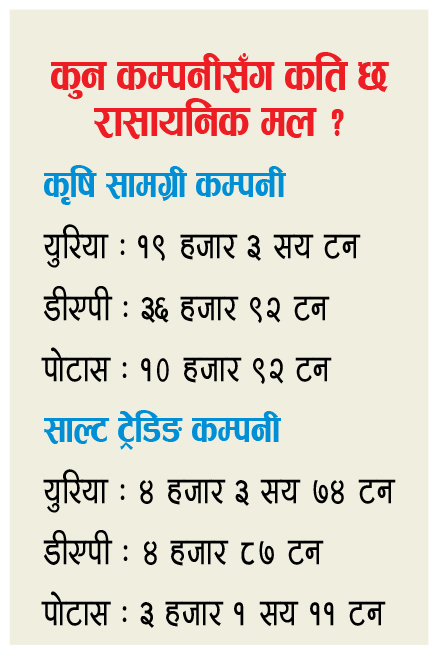
The Ministry of Agriculture has stated that there is no shortage as the stock is sufficient. Spokesperson of the ministry Matina Joshi Vaidya said that the government has 77 thousand 59 tons of chemical fertilizers such as urea, DAP and potash. He said that 65 thousand 485 tons of agricultural material company and 11 thousand 574 tons of fertilizer are available with Salt Trading.
The government allocated a budget of 27 billion 25 million for the purchase of fertilizers for 2081/82. Out of that, 267 thousand 978 tons of fertilizer have been supplied, according to the ministry. Of this, agriculture supplied 238,648 tons and salt supplied 29,330.3 tons, said Vaidya.
Fertilizer quotas are determined by the state government according to the subsidy chemical fertilizer vendor arrangement procedure. Municipalities/Villages distribute quotas. Accordingly, fertilizers are distributed to farmers through cooperatives. She said that due to problems in the distribution process, not all farmers received it on time. He said that the ministry is working to amend the procedure.

