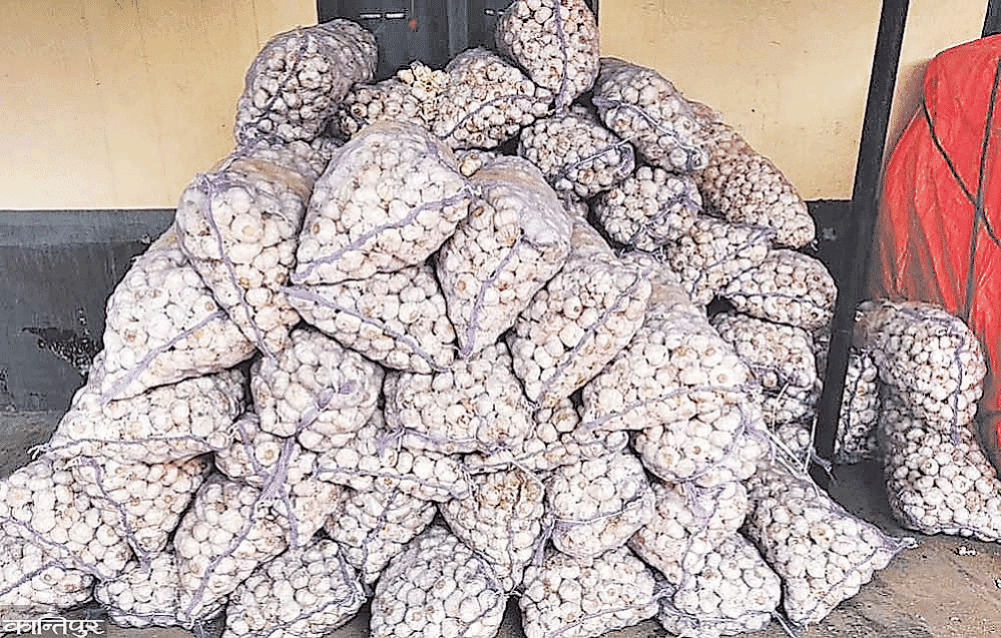
The gang imports garlic from China and transits Nepal to India
We use Google Cloud Translation Services. Google requires we provide the following disclaimer relating to use of this service:
This service may contain translations powered by Google. Google disclaims all warranties related to the translations, expressed or implied, including any warranties of accuracy, reliability, and any implied warranties of merchantability, fitness for a particular purpose, and noninfringement.
After the price of garlic imported from China has gone up in Nepal, its smuggling has increased rapidly. Jhapa, Morang, Sunsari and other border crossings of Koshi province are the main routes of garlic smuggling. The price of garlic in Nepal has reached around 400 rupees per kg. While in India it is more than 450 rupees per kg.
Taking advantage of the price difference, the smuggling gangs have been found to be importing garlic from China and smuggling it to India by transiting through Nepal.
Smuggling is increasing from the eastern and southern border crossings of Jhapa, the southern crossing of Morang and the southern open border of Sunsari. According to locals, garlic is openly sent to India with the connivance of security personnel. Despite allegations of police involvement, Koshi Police Chief DIG Rajan Adhikari claimed that there was no police involvement in garlic smuggling. "The police is not involved in such illegal business, it cannot be," he said, "This is a baseless allegation."
From Jhapa to Sunsari, there is an open border of about two and a half hundred kilometers, due to which security personnel are challenged to control activities including smuggling. "But we are also coordinating with the counter part to control criminal activities including smuggling," he said.
The open border between Nepal and India has facilitated smuggling. Price disparities, supply imbalances and weak border security mechanisms are the main reasons behind the increase in smuggling. "The price of garlic in India is higher than in Nepal, so there is constant supply from Chori," said a trader.
Smuggling gangs are smuggling garlic by influencing border guards. Smuggling is being done under the influence of both the Nepal Police and the Armed Police. "If there is a line with the security personnel, we will send garlic across even during the day," said a trader.
Garlic imported from China in containers or trucks is stored in border warehouses. Garlic is transported to India especially at night. Especially, garlic is being smuggled using the small traders of water tanks in India, in which some Nepalis are also involved.
In the first 6 months of the current financial year, about 6.5 billion worth of garlic was imported, according to the data of the Customs Department. But a large part of the imported garlic is sent to India through smuggling, so that Nepalese consumers are forced to buy garlic at high prices. "If the garlic imported from China was to be consumed in the country, consumers would not have to pay high prices," said Shyam Prasad Dahal, a consumer of Jhapa, "Nepali consumers have been hit hard when it is imported and sent to India."