We use Google Cloud Translation Services. Google requires we provide the following disclaimer relating to use of this service:
This service may contain translations powered by Google. Google disclaims all warranties related to the translations, expressed or implied, including any warranties of accuracy, reliability, and any implied warranties of merchantability, fitness for a particular purpose, and noninfringement.
Suraj Gautam of Rampur Municipality-5 Materi has cultivated sugarcane in 15 plantations. Gautam, who saw sugarcane cultivation in the fields of Lekbensi slums when he was a child, found that it has been dying for a few years. Cultivation of sugarcane does not require much suffering. But why did he leave, sugarcane farming came to him. "I was curious as to why I stopped cultivating sugarcane," he said, "Then while studying, I wanted to cultivate myself."
Gautam asked neighbors, relatives and friends to start sugarcane cultivation again. Some agreed to cultivate sugarcane. He said that we are going to resume sugarcane cultivation by forming our multi-purpose farmers group with 6 young people.
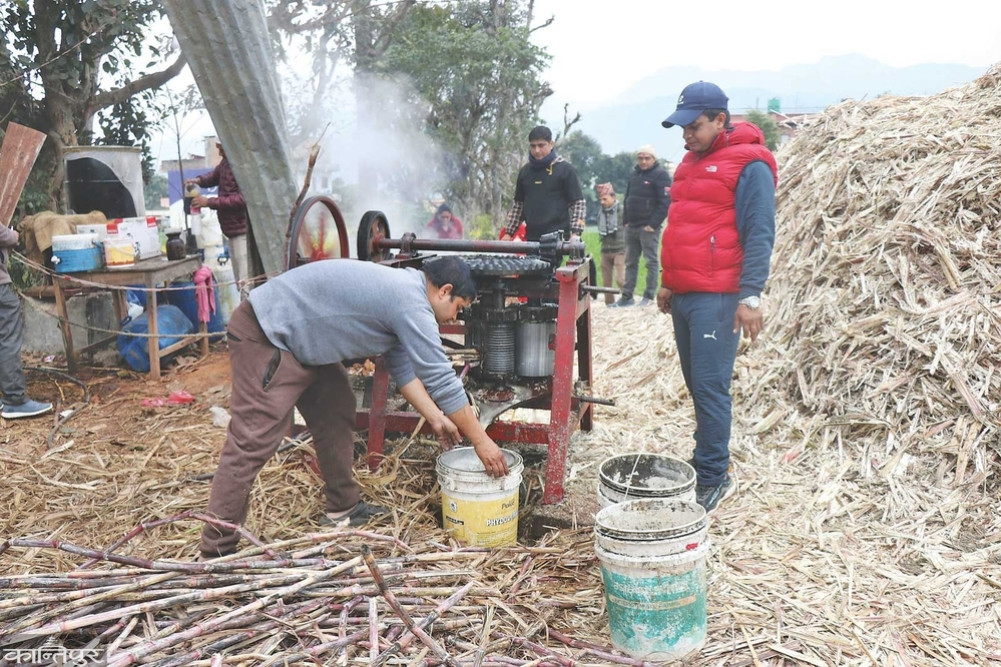
Bishnu Prasad Gautam of Rampur Municipality-5 is also busy cutting sugarcane, cleaning it, grinding it in a machine and cooking it. For the past three weeks, Gautam's daily life has been spent in this work. "The last three weeks have been spent in the sugarcane field and cooking," he said. He said that the months of January and January are spent in harvesting sugarcane and making sugarcane from it.
After the practice of sugarcane cultivation is disappearing, youths have started individual and collective sugarcane cultivation to meet its demand. Till 20 years ago, Palpa's Rampur municipality was like a pocket area for sugarcane cultivation. The older generation left sugarcane farming, the youth showed no interest. After that, the sugarcane fields in the Lekbensi slums are slowly disappearing, said Gautam, a young farmer. "We have also studied why sugarcane cultivation has stopped," he said, "The older generation has stopped farming for various reasons including migration." In the new generation, there was no desire to live in the village and suffer.' But now it has reduced to 50 plants in recent times, according to Shambhu Aryal of Rampur Municipality-9 Lamdikhola. As a result, more than 20 million worth of khudo, veli and good have been imported in Rampur area alone. Santosh Paudel, a young farmer, said that seeing the recent demand for Khudo, Veli and Gud, he has decided to expand this cultivation again. Sugarcane has been planted in 35 plantations this year through our multi-purpose farmer group. He said that gradually it will be taken to 100 plants.
Most of the farmers in the Rampur municipality area have stopped cultivating sugarcane because they are afraid of migrating to the lake settlements and working in the valleys. At present, only a few farmers cultivate sugarcane in Gejha, Jagbadi, Piluwa, Lamdikhola, Rampur and Gandakot of Rampur Municipality. First it was commercial farming.
Khudo and good made here used to reach Syangja, Pokhara, Kathmandu, Tanahun, Butwal, Bhairahawa. Some farmers are still active to prevent the extinction of sugarcane cultivation. "There was no problem for organic retail sales," said Champa Gautam, a farmer from Rampur, "Why did we stop farming, but now it seems like there will be."
A farmer group has been formed in Rampur to promote sugarcane farming. Some have even started wearing more sugarcane individually. With the opening of the Kaligandaki Corridor Road connecting from Siddharth Highway to Mahendra Highway, the sugarcane farmers are excited again after the ease of transportation.