40,000 megawatts hydropower projects in various processes including national parks, protected areas, reserves, intermediate areas and their borders are at risk.
We use Google Cloud Translation Services. Google requires we provide the following disclaimer relating to use of this service:
This service may contain translations powered by Google. Google disclaims all warranties related to the translations, expressed or implied, including any warranties of accuracy, reliability, and any implied warranties of merchantability, fitness for a particular purpose, and noninfringement.
The National Parks and Wildlife Protection Act, 2029 amendment passed by the government through an ordinance on the occasion of the third investment conference was canceled by the Supreme Court on January 2, and the future of the projects in the national parks, protected areas, reserves, intermediate areas and its borders has been confused.
The Association of Independent Power Producers (IPPAN) held a press conference on Sunday and said that the future of the 19 thousand 736 megawatt hydropower project under construction and operation is in doubt due to the Supreme Court's constitutional decision.
The government, through an ordinance, amended the National Parks and Wildlife Protection Act, 2029 by adding 5 'a' to section 5 and sub-section (1 a) to section 6. According to the private sector, the said amendment has opened the door for the economic benefit and national prosperity of Nepal and the Nepali people and the natural resources and means and potentials on the border of the Himalayan and hilly regions of Nepal from East Mechi to West Mahakali.
The government has added section 5A to the National Parks and Wildlife Protection Act, 2029, providing that 'any area within a national park, reserve or conservation area may be designated as a sensitive area'. Similarly, section 6 (1A) states, National priority projects, investments to maintain nature and human coexistence in areas other than highly sensitive areas The government of Nepal can give approval to conduct projects approved by the board or projects of national pride. In the same way, it will be possible to operate projects in the intermediate area and to operate other industries including tourism. Since the provisions of 'Section 5 A' and 'Section 6 (1A)' are contrary to the clause (3) of Article 30 of the Constitution of Nepal. Lawyers Dilraj Khanal, Prakashmani Sharma and others filed a writ on July 13 to declare it invalid and void. A constitutional bench headed by the then Chief Justice Vishwambhar Prasad Shrestha issued a short-term interim order on July 30.
On this January 2nd, the Constitutional Court has repealed the Act in accordance with the demands of the petitions. 'National Parks and Wildlife
Conservation Act, 2029 added to Section 5A and Section 6 (1A) as it is in conflict with the mentioned constitutional provisions, according to the petition to amend certain Nepal Acts related to investment facilitation, according to Section 3 of the Act, 2081 National Parks and Wildlife Conservation Act, 2029 Section 5A and Section 6 (1A) added in Article 133 of the Constitution of Nepal (1) has been invalidated and annulled since the beginning,' the order of the Supreme Court mentions.
With the repeal of the Amendment Act by the Supreme Court, Ippan claims that 267 hydropower projects with a capacity of 19,736 megawatts, which have invested billions by paying fees, royalties and revenues according to the prevailing laws, and also obtaining permission for electricity generation and surveying, will have to face complications again.
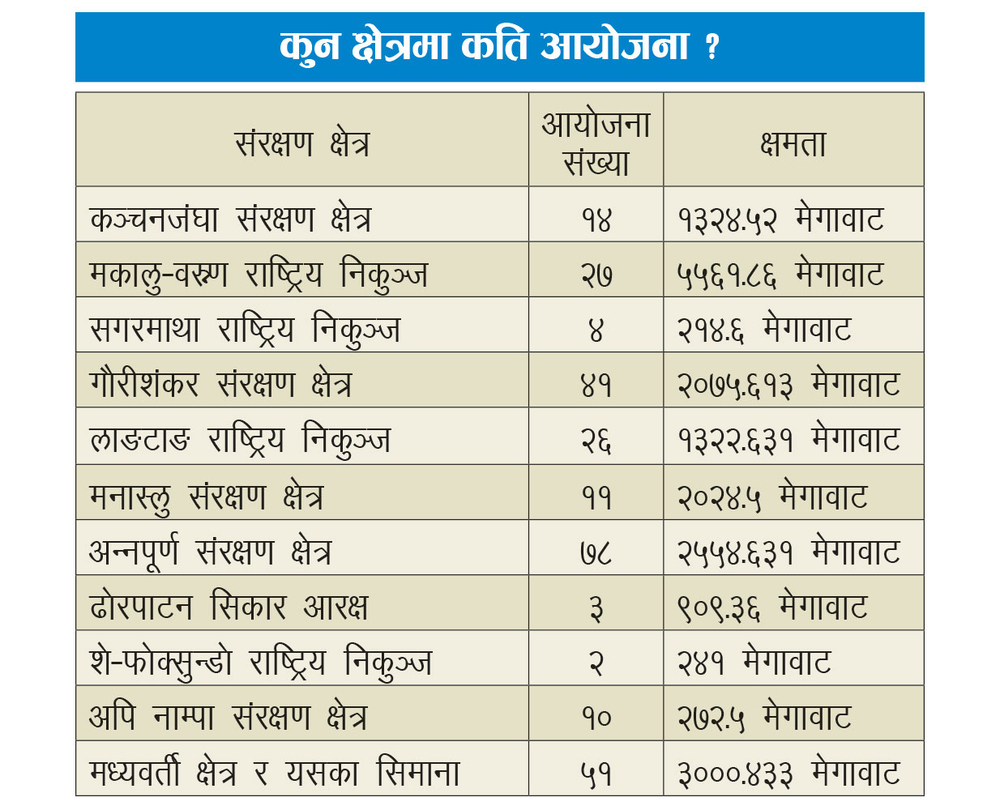
According to IPPAN, 14 projects of 1324.52 MW in Kanchenjunga Conservation Area, 27 projects of 5561.86 MW in Makalu-Varun National Park, 4 projects of 214.6 MW in Everest National Park, 41 of 2075.613 MW in Gaurishankar Conservation Area, 1322 in Langtang National Park .26 projects of 631 MW, in Manaslu Conservation Area 11 projects of 2024.5 MW, 78 of 2554.631 MW in Annapurna Conservation Area, 3 projects of 909.36 MW in Dhorpatan Sikar Reserve, 2 projects of 241 MW in She-Foksundo National Park, 10 of 272.5 MW in Api Nampa Conservation Area and intermediate areas and It has 51 hydropower projects of 3000.433 MW within its boundaries.
The future of 267 projects of 19,736 megawatts under construction and operation is in doubt, said Ganesh Karki, president of IPPAAN. , Upper Knife A, Knife Khola, Bhotekoshi-1, Balefi A, Indrawati, Nigiri-1, Nilgiri-2, Langtang, Chilime, Rasuwagadhi, Sardi Khola, Khimti Khola, Upallo Khimti, Sikles, Midim Khola, Bhujung, Supermadi and dozens of other projects have been constructed by IPPAN.
"Dozens of projects are under construction, dozens of projects are under construction after approval of Environmental Impact Assessment (EIA)," said a statement issued by IPPAN, "Awaiting land acquisition." Hundreds of projects are studying EIA.
Karki said that in addition to 267 hydropower projects, more than three dozen projects are still waiting for study approval. Dozens of projects are under process in the Power Development Department and the Ministry of Energy. Calculating all these, there are 40,000 MW high potential projects within the protected area,” said Karki. Even though the constitutional bench of the Supreme Court decided to cancel it, he also requested to reconsider as the full text is yet to come. "The court's decision made it necessary to throw the investment into the river," he said, "such decisions affect the development of Nepal as a whole." said. "If there is no environment for hydropower projects to be built within protected areas, we will be dependent on electricity," the statement said, "out of 72,000 megawatts, only 32,000 megawatts can be built outside protected areas. Among them, Karnali Chisapani Multi-Purpose Project, Paschim Seti, Upper Karnali, Saptakoshi High Dam Project, Tanakpur, Pancheswar Multi-Purpose Project, Sunkoshi 1, Sunkoshi 2, Sunkoshi 3 etc. are beyond our capacity Ippan says that if the project is not constructed smoothly, even the government's target will not be fulfilled. "If the projects that have been approved to be built within protected areas are not built, according to the energy development roadmap 2081 recently released by the government, the target of producing 28,500 megawatts of electricity by 2091 is unlikely to be implemented and the country will also have to bear load shedding," said the statement. is.

