We use Google Cloud Translation Services. Google requires we provide the following disclaimer relating to use of this service:
This service may contain translations powered by Google. Google disclaims all warranties related to the translations, expressed or implied, including any warranties of accuracy, reliability, and any implied warranties of merchantability, fitness for a particular purpose, and noninfringement.
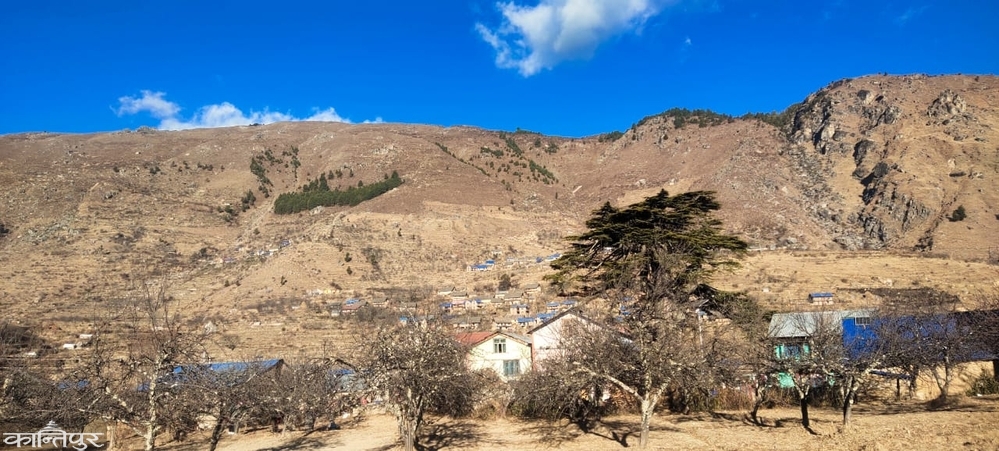
Until 5 years ago, Sita Rokaya of Simkot Rural Municipality-7, who depended on vegetables from Nepalgunj and Surkhet, now cooks vegetables such as tomatoes, radishes, greens, cauliflower, bananas and other vegetables from Humla. She who is running Rokaya Hotel in Simkot market, has got rid of the high prices since vegetables started to be produced locally, she has also started serving fresh vegetables to the customers.
"One is that there is no flight, even if there is a flight, they will not bring the goods," she said Now that 'fresh' and organic vegetables are available, the hotel's food is also becoming sweeter. According to him, till 5 years ago only potatoes and beans were grown as local products in Humla.
After the production of fresh vegetables at the local level, not only the sweetness of the kitchen of the Humli has changed, but the farmers have also started to become self-sufficient . Dhugma Bohora of Simkot rural municipality-2 has been producing various seasonal vegetables in plastic tunnels for 5 years. Despite the cold weather in Humla since October with the snowfall, vegetables such as green vegetables, cabbage, cabbage, and tomatoes are grown in plastic tunnels near his house .
Bohora, who has sold half of the vegetables produced, has earned 40,000 rupees in this season alone. On his neighboring land, Bhandari's garden has also grown vegetables such as cabbage and tomatoes. Not only them, the women of Simkot, which is about 3,000 meters above sea level, and the surrounding villages have started to become self-sufficient through seasonal vegetable farming. There is a wave of commercial vegetable farming in Thehe. ``Earlier, we had to send men to work in India to earn a living,'' said Bohora. break 2 dozen women staying with him sell vegetables after walking for 3 hours to the headquarters Simkot. She said that the demand for green vegetables increased a lot in winter. According to him, a handful of green vegetables is being sold for 30 rupees in the local market. Bhandari said that since most of the youths of the village are unemployed, it is easy to manage household expenses with the income from vegetable production.
'After starting to grow vegetables, it has become easier to educate my sons and daughters, the need to depend on my husband's income has also stopped,' she said, 'now we have started saving some money by running household expenses.' told . During the dry season, she produces vegetables such as onions, potatoes, chillies, radishes, and now 10 tunnels are producing different types of greens. According to him, the women of the village are earning 1 lakh to 3 lakh rupees annually from vegetable production.
Until 5 years ago, the demand of headquarters Simkot was met with vegetables brought by ship from Nepalgunj and Surkhet. Road transport facility was reached in Humla only last March. But since the road transport is not reliable, the goods are transported by ships. But now, even though some fruits produced in Tarai have arrived, the arrival of vegetables has stopped completely, said local Prem Lama. According to him, due to the vegetables transported by ship from Nepalganj, the price had also increased in Humla.
'Due to the high cost of transportation, vegetables were reduced to 250 rupees per kilo, and there was no need to eat stale vegetables, sometimes half of the vegetables arrived rotten when the ship did not deliver them on time,' he said, 'now the vegetables picked in the morning 1 It ripens in our kitchen within 2 hours, which has also solved the problem of malnutrition.' He informed that there is a wave of vegetable farming in villages like Rotopa, Limatang, Dojam, Chhipra. Nandu Budha, a trader in Simkot, said that most of the vegetables can be found in the Simkot market for up to 150 rupees per kg. "Almost half of the potato and bean production here goes to Nepalgunj and Surkhet, and we have become almost self-sufficient in other vegetables as well," he said, "If the government agencies help with fertilizers, seeds and irrigation, we can export the vegetables here in the next 2/3 years." '
Now in Papugaon, Mugum Karmarong Rural Municipality, Mugu, which is about 3,400 meters above sea level. Paddy has started to grow . "Because of the extreme cold, only one crop of lice grew in a year before, after the heat started to rise, mosquitoes also appeared in our village in the summer," said the local Chiringdorje Lama, "since 5/6 years We have also started planting paddy during the rainy season.' He said that tomatoes, chillies, banana and cauliflower are growing in villages such as Rowa, Bhambara, Pina, which are at an altitude of about 2,300 meters above sea level. "The snow started to move up and down, the crops of the plains also began to grow towards our village," he said.
Naveen Hamal's apple farm at Tilagufa-3 Foimahadev, Calicut. Photo: Tularam Pandey/ Kantipur
 Village chairman Chhiringkapne Lama said that after the heat has climbed towards the mountains, now millet, pea and lice are ripening fast. According to him, the locals who used to celebrate the festival by bringing Marsidhan from Jumla, have now started producing Paddy of Chinamuri, Thulidhan, Bhuwalo, Dhogro, Ratalo etc. "It used to take at least 10 months for the crops to ripen because it was very cold, now the millet planted in May-June has started to be harvested," he said According to this year, the municipality has allocated about 1 crore rupees to make the farmers professional in Raithane crops and vegetable farming. is .
Not only food crops but also fruits which are not produced in the lake in recent years have started to grow and bear fruit easily. Ganesh Giri of Khatyad rural municipality-8 in Mugo has been growing mangoes in his garden for 6 years. In his turn, apples also grow . He earned 80 thousand rupees last year by selling mangoes. He has planted 10 mango plants in turn. Sukadhik's bald paddy also planted 15 mango plants in turn. Among them, 5 plants are producing . He said that due to the effects of climate change, mangoes are being produced commercially since the mountains started to grow. Last year he sold 3 quintals of mangoes. Produced mangoes are sold at 20 rupees per grain in the local market. He said that pomegranates, mangoes, and bananas, which are produced in the lowlands, have begun to grow in the sukadhi at an altitude of about 1,900 meters above sea level.
Locals have been going to Nepalganj, Dang and Surkhet every year to buy bunches of fruits after they start producing mangoes, pomegranates, bananas and other fruits. Among the five districts of Savik Karnali, mangoes are grown only in Sukadhi village of Mugu, said local health worker Takk Dangar. ``No one believes that mangoes ripen in our village,'' he said. He said that during the mango ripening season, residents of Bajura's Boldik, Dhim, Faiti and other villages come to Sukdhik village for purchase.
Agricultural scientist Dr. Ramesh Sharma said that now Raithane crops are disappearing and the hilly settlements are being covered by the cultivation of vegetables and fruits in the plains. "Though this meets the needs of the local people for the time being, it will gradually reduce the fertility of Raithane's crop-friendly soil," he said. The effect of climate change will change the type of seeds in grain crops, reduce the fertility of agricultural fields, He said that Raithane crop is in crisis in Himalayan settlements due to crop damage caused by seasonal pests.
Environmentalist Arjun Acharya said that Karnali's biological diversity is different from other provinces. "Apple plants are growing in the same place here for years, cereals and fruits are also growing in the same place from the plains to the mountains, broiler chickens are also growing in the snowy places," he said. It has become possible to produce in one place.'
Due to the effect of climate change, the climate of the Himalayan districts of Karnali is changing, said Dhan Bahadur Kathayat, spokesperson of the Ministry of Land Management, Agriculture and Cooperatives of Karnali Province. "After the fruits and vegetables produced in the Terai district started to flourish in the Lekali district, the farmers are gradually becoming professional. He said, "After the increase in the interest of the farmers in the Himalayas, fruits such as oranges, lemons, and mangoes have been distributed to the Himalayan districts as well."

