We use Google Cloud Translation Services. Google requires we provide the following disclaimer relating to use of this service:
This service may contain translations powered by Google. Google disclaims all warranties related to the translations, expressed or implied, including any warranties of accuracy, reliability, and any implied warranties of merchantability, fitness for a particular purpose, and noninfringement.
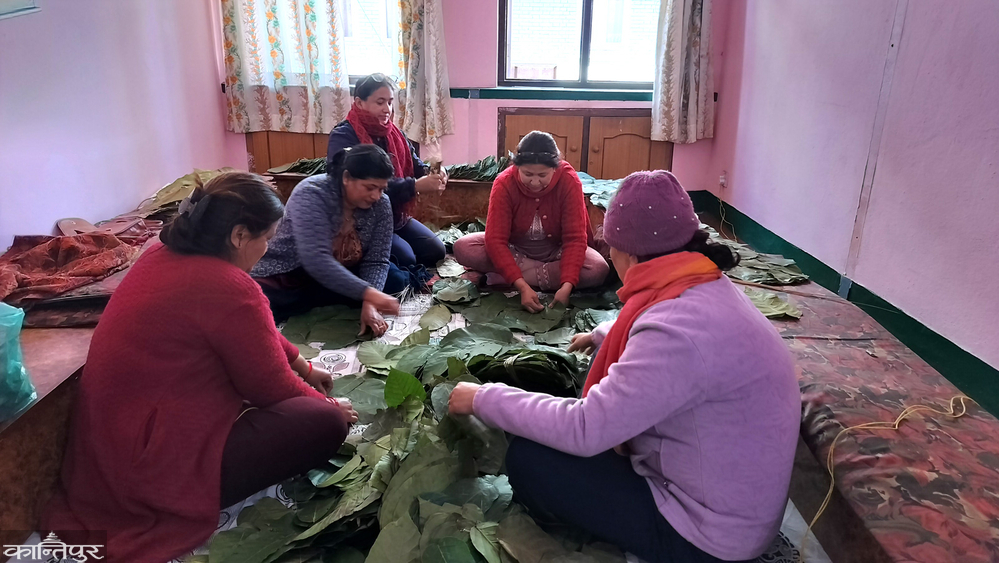
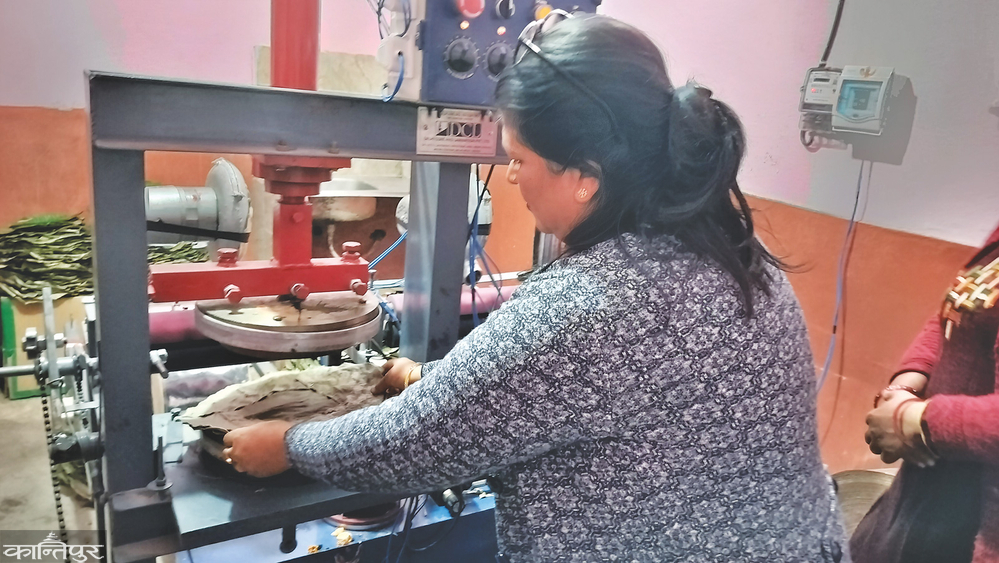
Sal leaves are being made into lafa for lapis by spinning them with bamboo sticks. Lafa prepared on one side is wave dried. The dried lafa is placed in the machine. After cutting according to shape and size by the machine, lapis is ready.
In the creative women's industry in Banepa Municipality-7, women are giving a new look to Duna and Tapari using traditional skills and technology. With technical knowledge, 7 women of Banepa are now producing duna, tapri, lapis. Rupa Khatiwada, president of the industry, said that the plan of two years ago to make duna and tapri using
technology has now been completed. There are currently 7 women directly involved in the industry.
'Even though this work looks normal, it is a long process when it comes to the end,' she said, 'In the beginning, we collect sal leaves through a local woman, and the leaves are made into lafa with a bamboo hook and dried in the air for 3 days. Khatiwada said that duna, tapri and lapes are ready after 'cutting' according to size by
machine. Sal leaves and bamboo sticks are procured from the local level. The industry buys zinc at Rs 150 per mouth and sal leaf at Rs 80 to Rs 120 per mouth. According to President Khatiwada, this job is a bit easier for those who have traditional skills related to Duna, Tapri, Lapes.
'You have to pay special attention while running this machine,' she said, 'you have to know how to adjust the temperature of the machine, now we have 6 dies (equipment for adjusting size and shape), from which 6 types of duna, tapri and lapis are made, duna, tapri in the machine Care should be taken while keeping.'
Yashoda Bogti, manager of the industry, said that special attention should be paid to its management. "Sal leaf is not available forever, its season is only from June to March, for later, we have to bring leaves now, and the other main challenge is in marketing," she said, "because lapis is used a lot in the Newar community, the demand for it is high, for now There is a good demand in the local market.' They have invested about 10 lakh rupees for the operation of the industry. "Even though the price of the machine is a bit higher, a lot of investment has been made in it," said Khatiwada, "One machine costs about 6 lakhs, raw materials and other materials, industry registration all together, about 10 lakhs has been invested." Today, 1200 duna, tapri and lapis are being produced from
industry. The price of 25 lopes/topris is Rs 200, while the price of 40 small dunas is Rs 60 and the big duna is Rs 80. They take sal leaves and make lafa at home in their spare time.
"After doing housework, I make Lafa in my spare time," said Khatiwada, "My family also helps me, it's fun when everyone works together." She does not limit her skills to herself. She also teaches this skill to anyone who wants to learn it. "If you want to learn how to make duna, tapri, lapis using technology, we will teach you through the industry," she added, "We will also provide training to those who want to take this training."