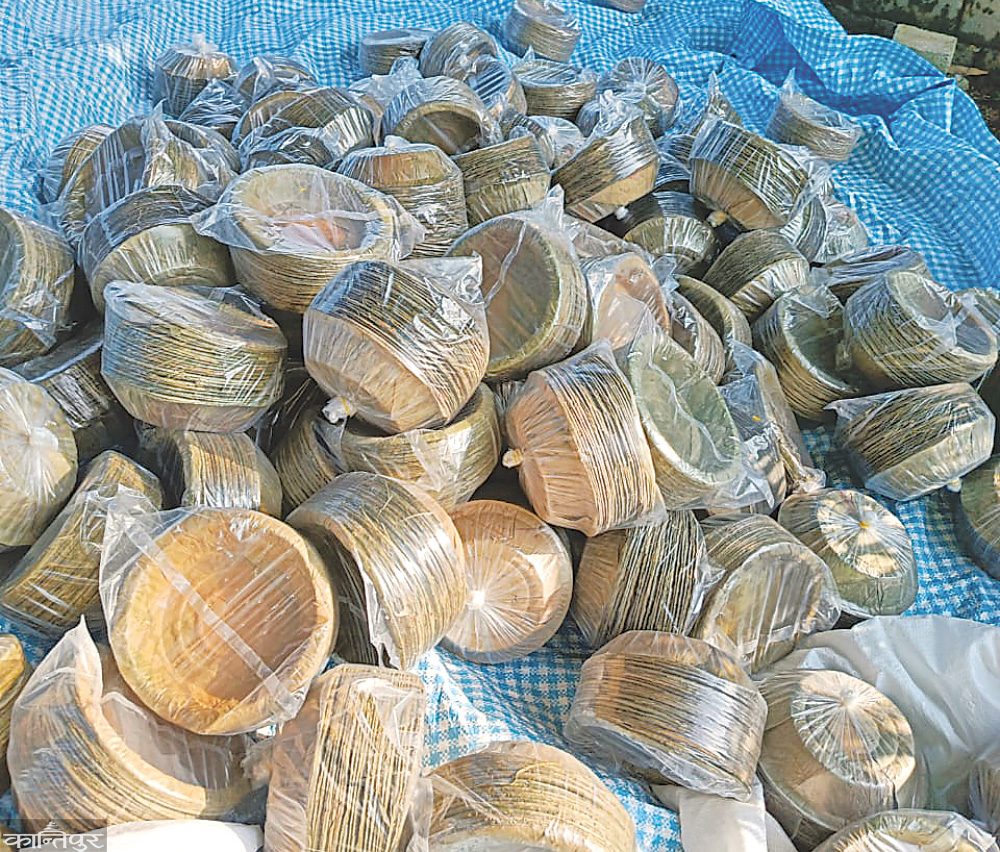
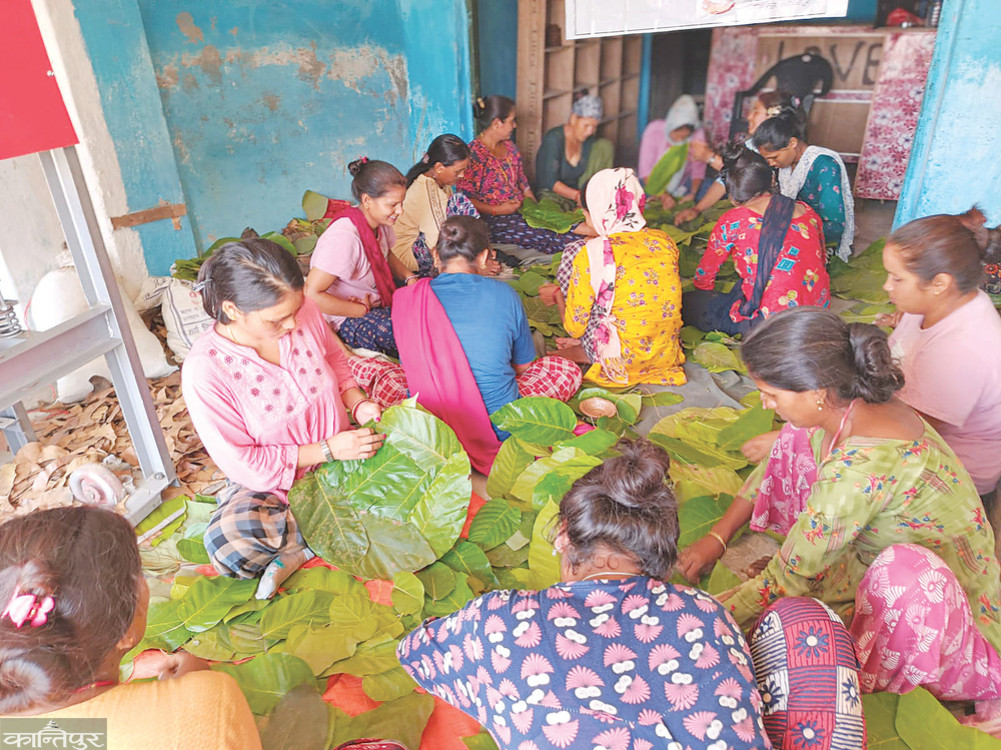
Bhavna, who opened an industry in a flower garden located in Dhangadhi-14 5 years ago and started making duna-tapri, is now producing and selling 2200 tapri and 3500 duna daily. More than 50 village women are getting direct/indirect employment in the industry. Produced duna-tapri Australia , have reached Britain and America
We use Google Cloud Translation Services. Google requires we provide the following disclaimer relating to use of this service:
This service may contain translations powered by Google. Google disclaims all warranties related to the translations, expressed or implied, including any warranties of accuracy, reliability, and any implied warranties of merchantability, fitness for a particular purpose, and noninfringement.
36-year-old Bhavna Pulami Magar of Dhangadhi sub-metropolis-14 Phulbari Sanitol in Kailali is often known as 'Duna-Tapariwali didi'. The Panidanda Duna-Tapri industry is famous throughout the far west of Bhavna for making duna-tapri by tying sal leaves.
Bhavna has not only become an entrepreneur, she has also provided a way of income to other interested women in Kailali's flower garden. She said that she has been selling duna-tapri for at least one lakh rupees per month from the industry. Many women in the village are benefiting from the Duna-Tapari business.
Bhavna went to her sister's house in Nawalparasi seven or eight years ago. After seeing the duna-tapri industry there, he felt that he could do it too. In 074, after he received training in making duna-topari from the domestic and small industries office She started making
at home. In 076, three people together with Bhavna registered Dunatpari industry in Phulbari. Production also started. Bhavna made local Vishnu Bhusal and Sarita Budhamgar partners in the industry. But their partnership did not last long. They separated. Bhavna ran the industry alone.
There are currently three women directly employed in the emotional industry. More than 50 people of the village have been able to collect sal leaves from the forest and sell them. Bhawana said that those who collect sal leaves from the forest and bring them earn up to two and a half hundred rupees in a day. She buys green leaves at Rs 8 per kg.
Some collect leaves from the forest and sell them at the rate of kilos, while some come to the industry and apply leaves. "We used to get 1 rupee for a tapri and 30 paise for a duna for tapri," said local Bunu Lama, "four-five hundred rupees can be easily earned in a day."
Sarita Chaudhary has also collected sal leaves from the forest and brought them for sale. Sarita said, "Sometimes I collect leaves and sometimes I use duna-topari after arranging the time. According to Bhavna, the industry produces 2,200 tapris and 3,500 dunas in a day. He has problems with modern machines and electricity. Although there are seven machines in the
industry, only three are operational. Electricity voltage is not enough for all operations. A separate three-phase line is required. There is no money to keep it," she said. The hydraulic machine cannot be operated without electricity. He said that if there is a hydraulic machine, it will produce about 10,000 per day.
Bhavna sells one piece at the retail price of one and a half rupees. For wholesale purchases, the price per duna has been fixed at Rs. The wholesale price of tapri is Rs 4 and the retail price is Rs 5. Duna-tapri produced by Bhavna's industry is mostly purchased by Dhangadhi, Mahendranagar, Pokhara and Kathmandu businessmen.
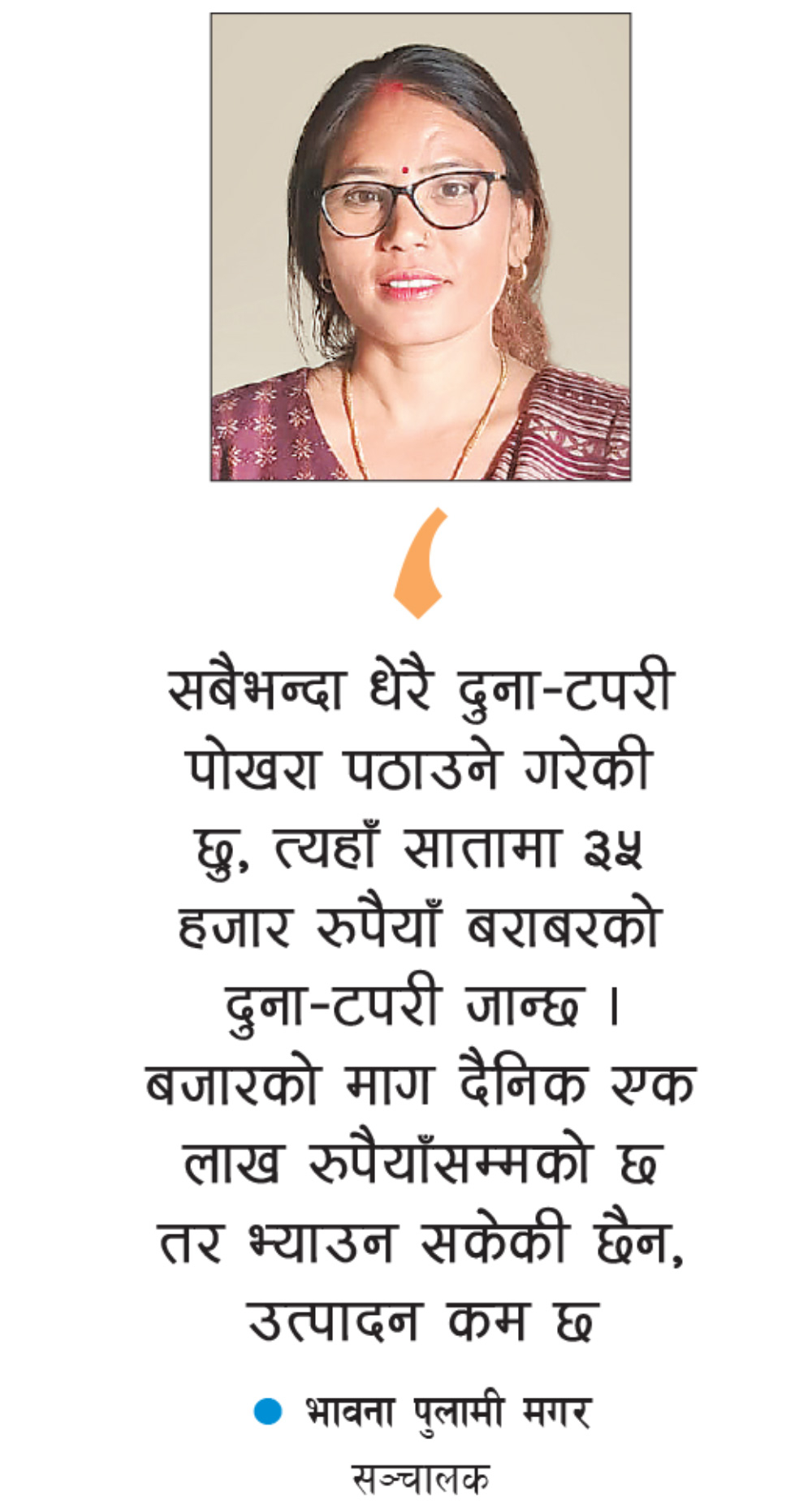
"I have been sending the most to Pokhara," Bhavna said, "I have been sending duna-tapri worth 3 to 35 thousand rupees in a week to Pokhara. There is a demand to send up to one lakh rupees daily. But I haven't been able to harvest it, the production is low.'' said Bhavna, who buys duna-tapri from the Pokhara-based Sada Shiv Pooja Bhandar.
She tells the feeling that the shop takes duna-topari produced from here and sends it to Australia, UK and America. “They have a packing machine. They export abroad by improving the finishing of the said machine,' said Bhavna, 'their earnings are even better.' She said that there is a need for modern machines in
packing machines. It will be expensive. Can't afford to buy it myself. I have made a request to the municipality,' she said, 'what can they do, it would have been better if they had bought it.' After the ban on plastic, the use of duna-tapri started to increase as an alternative. Bhavna also got its commercial benefits. Duna-Tapri demand and market
increased. "Now there is no problem of demand and market," Bhavna said. Bhavna said, "I have reached all the districts of Far West for the training day. Now, time is spent on training.
She said that she used to coordinate the work and supervision of the industry over the telephone. She said that one week to 10 days of training is required for training related to duna-tapri production. "I have gone to Elam in the east for training," she said, "I have just completed 10 days of training in Baitadi. Doti will go soon after this.' To break the story, the identity of the training coach and entrepreneur that he has now created, he had to face a lot of challenges in the beginning. Bhavna, a mother of a son and a daughter, recalled the tough days when she started the venture. She expressed her grief of not getting support from her husband.
The husband was Saudi on foreign employment. He did not listen to others and support them. He used to stress by listening to different things. He did not like going outside the house. "I would have said not to go," she said, "but I continued to move forward unperturbed in my purpose." She said that now her husband also agrees. "Now my husband is happy to see the progress I have made," she said.