We use Google Cloud Translation Services. Google requires we provide the following disclaimer relating to use of this service:
This service may contain translations powered by Google. Google disclaims all warranties related to the translations, expressed or implied, including any warranties of accuracy, reliability, and any implied warranties of merchantability, fitness for a particular purpose, and noninfringement.
It has been revealed that these countries are receiving semiconductors even though the US has openly and harshly banned advanced technology like semiconductors exported to China and Russia for a few years. Reports published in the media and the US government's own investigation have also raised concerns about the effectiveness of such sanctions.
A recent published in Bloomberg. In this report, Russia managed to obtain more than 1 billion US dollars worth of advanced chips from American and European companies in the first nine months of 2023 . These chips are considered essential for military and other advanced technological missions.
It is mentioned in the report that chips from American and European companies have entered Russia through intermediaries from countries such as China, Turkey and the United Arab Emirates. The US has been banning the export of advanced chips such as semiconductors to Russia and China citing the use of military technology against them, violation of intellectual property and cyber risks.
However, the efforts of the US Department of Commerce for almost three years have been judged to be 'inadequate' by a report of the US Parliament Senate. It has pointed out the need for more financial mobilization and strict implementation. Entrusted with implementing such restrictions and controls The report also states that the US Bureau of Industry and Security (BIS) has been struggling since 2010 with a shrinking and low-priority budget and insufficient resources.
In the same way, China is also receiving advanced US technology chips and other materials from US media and studies. China, which is not transparent about its import-export details, was the largest importer of American advanced chips and technology before the chip war with the US.
In 2020 alone, China is estimated to have imported US advanced technology worth around 350 billion US dollars. A large part of this was related to advanced chips and technology.
China, which is trying to modernize its infrastructure in terms of national security, is bringing in those technologies in a smart way even after the US export ban.
Taiwan-based TSMC, one of the world's largest chip makers, was recently ordered by the US not to export to Chinese buyers. TSMC's advanced technology in Huawei's latest AI processor It was found to be used . The US suspects that it violated its export ban.

China has been trying to increase its semiconductor capacity after the US sanctions . China's semiconductor sector has increased investment and policy leadership in AI, 5G and automated vehicles with national campaigns such as 'Made in China 2025'.
In the period from 2010 to 2022, the number of Chinese semiconductor design firms increased almost 6 times to 3,243. President Xi himself has announced to give about 144 billion US dollars for the development of the semiconductor sector. However, Chinese firms still lag behind world leaders in high-volume manufacturing of what are considered advanced chips. Their lithography equipment is believed to be generations behind the most advanced technology.
The US, which wants to stop China and control its own or its allies in the manufacturing and supply market, has invested heavily in strengthening the domestic semiconductor industry through the Chips Act. The US has provided billions of dollars to companies like Micron Technology and SK Hynix.
Micron has received nearly $7 billion in grants to expand its DRAM production . The US has announced more than $50 billion in government grants and investments in 2022, with these investments aimed at reducing dependence on US suppliers and enhancing national security. Under the Chips Act, various companies have also announced investment plans of more than 350 billion US dollars .
Similarly, the US has been using multilateral platforms such as the G-7 countries' meetings and NATO to prevent China from accessing advanced chips and technology.
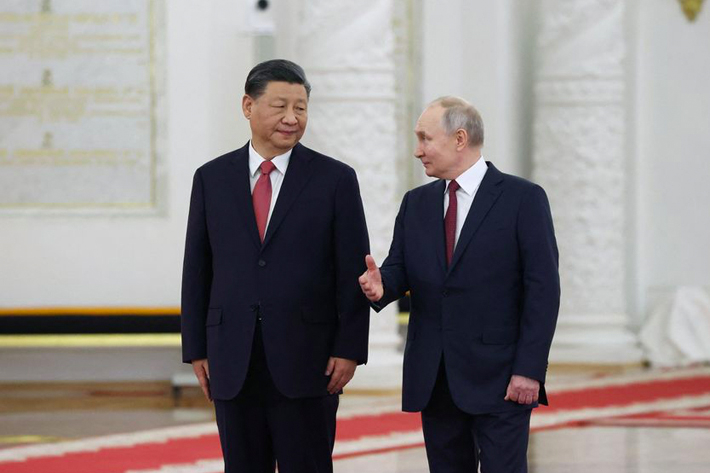
Russia is a little behind in the race for semiconductor chips, but it has announced that it will invest nearly $3 billion in the development of advanced chips.
Russia has insisted on importing American technology and equipment even if it is from the third market. As the tension between US and China regarding cyber, chips and connectivity is increasing, countries like Japan, European Union, UK, South Korea have also started thinking about what will be the alternative if the tension increases .
Despite the efforts made by America at the domestic and international level, the illegal flow of advanced chips to China and Russia has added a big challenge to the American administration. US Commerce Secretary Gina Ramando said there is an urgent need for additional financial and technical resources from the US Congress to address the latest national security threats.
Similarly, Senator Richard Blumenthal has been calling for tougher action against companies that facilitate the illegal use and proliferation of American-made semiconductors.

