We use Google Cloud Translation Services. Google requires we provide the following disclaimer relating to use of this service:
This service may contain translations powered by Google. Google disclaims all warranties related to the translations, expressed or implied, including any warranties of accuracy, reliability, and any implied warranties of merchantability, fitness for a particular purpose, and noninfringement.
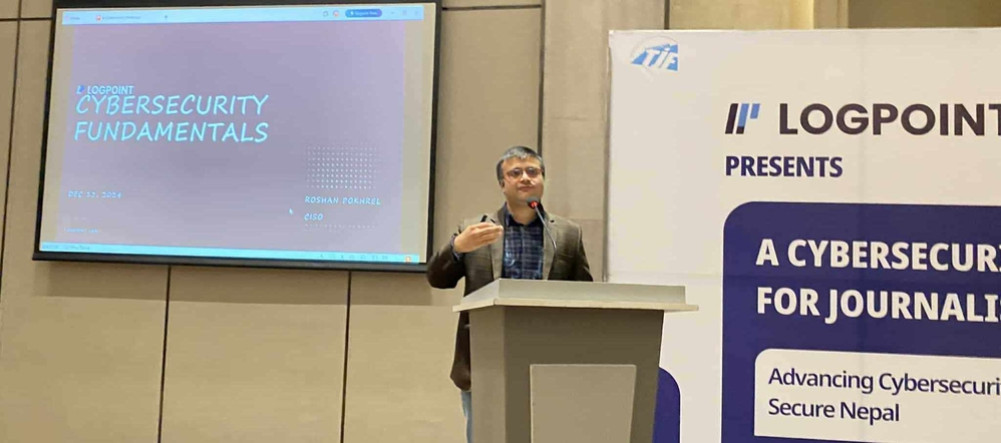
Among the many challenges of cyber security, cyber security experts have pointed out that the attack through 'social engineering' has emerged as an emerging challenge in Nepal. In a program organized by Technology Journalist Forum (TJF) and Nepal Association for Software and IT Services Companies (NAS-IT) on Friday, experts highlighted various aspects of cyber security.
Speakers in the program identified social engineering as a major emerging threat among cyber security challenges in Nepal. Basudev Raut, director of product management at Logpoint, an organization providing cyber security services, told how social engineering is becoming an easy medium for hackers. "It's easier to trick people than to trick firewalls, antivirus or bots," he said, "It's easier to trick people into accessing their devices or systems than to get access to technical security systems, so incidents through social engineering are on the rise."
Social engineering is a cyber attack in which a hacker tries to trick, convince or influence the user in some way to reveal their sensitive details like username, password, bank account, OTP code . Examples of social engineering hacking include activities such as sending a password reset link to the user with false information that their account has been hacked and stealing sensitive information if they click on such a link, to calling someone pretending to be an employee of an internet service provider or a mobile wallet company and asking for an OTP code or router password.  ; According to
experts, through social engineering, cybercriminals are making users even more vulnerable by circumventing technical security systems. Roshan Pokharel, chief security information officer of Logpoint, said that government and private sector information technology systems are frequently subjected to cyber attacks due to weak defense mechanisms. "The recent malware attack on the Passport Department and the recent leak of details from Pocket Wallet and Foodmandu reflect the state of our cyber security," he said.
Biz Serve IT Chief Executive Officer Prabhat Pokharel pointed out that even though the legal aspects of cyber security are relatively good in Nepal, there are weaknesses in terms of technical and capacity development. "We are lagging behind in inter-agency cooperation and technical capacity enhancement in cyber security," he said. We have a tendency to hide such incidents as much as possible. It's not right .'
NAS-IT Treasurer Abhay Paudel opined that awareness program is necessary to strengthen various pillars of cyber security. Logpoint director Prakash Thapa said that he has been working in the field of technology in Nepal for 15 years and is ready to use the experience of Europe and America in Nepal. Similarly, Secretary General of NAS-IT Deepen Chapagain opined that there are not many experts in latest technology and cyber risks in Nepal and the risk that Nepal and Nepali can face is also their own.