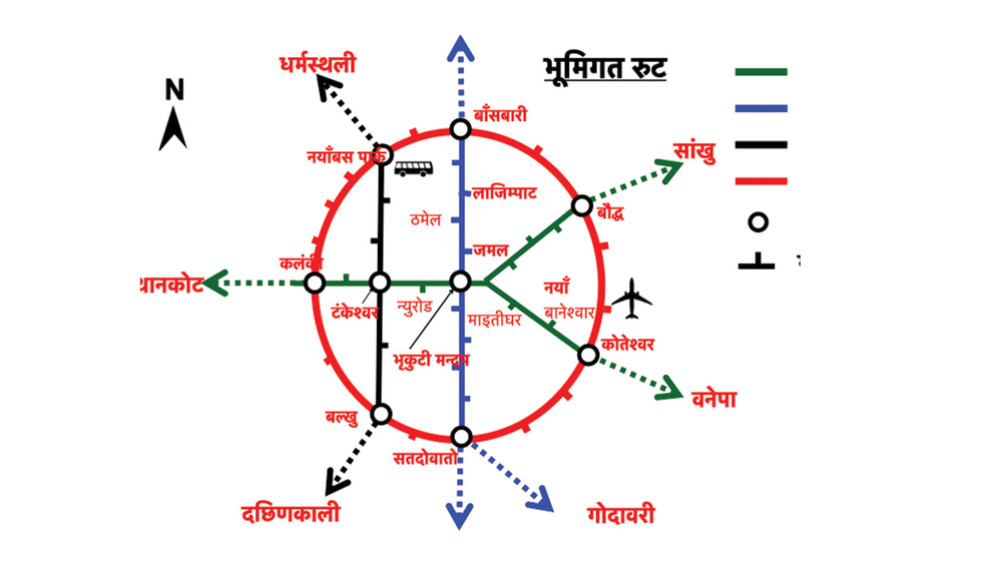
The master plan includes Kathmandu Line (Banepa, Dhulikhel, Koteshwar, Bhrikutimandap via Thankot), Patan Line (Godavari to Bhrikutimandap, Budhanilkanth), Bishnumati Line (Dakshinkali, Chobhar, Balkhu, Tankeshwar, New Bus Park, Dharmasthali), Chakrapath Line (Around Ring Road) and Valley Line. (Outer Ring Road) proposal
We use Google Cloud Translation Services. Google requires we provide the following disclaimer relating to use of this service:
This service may contain translations powered by Google. Google disclaims all warranties related to the translations, expressed or implied, including any warranties of accuracy, reliability, and any implied warranties of merchantability, fitness for a particular purpose, and noninfringement.
British engineers have presented various bases for running metro trains in Kathmandu Valley. In a program organized by the 'Institution of Civil Engineers' and the 'Society of Nepalese Engineers UK' last Wednesday, British and Nepalese engineers also discussed the master plan with its feasibility and long-term effects.
Dr. Civil Engineer, who presented a working paper regarding the master plan of metro rail development, which requires trains to reduce traffic pressure in Kathmandu, increase regional connectivity, reduce environmental pollution, improve urban development, employment and economy. Vinodlal Amatya says. It also leads to urban regeneration. When mobility increases, productivity also increases,'' he, who is also a fellow of the Institution of Civil Engineers, told Kantipur.
Five lines in the Kathmandu Valley in the master plan – Kathmandu Line (Banepa, Dhulikhel, Koteshwar, Bhrikritimandap to Thankot), Patan Line (Godavari to Bhrikutimandap, Budhanilkanth), Bishnumati Line (Dakshinkali, Chobhar, Balkhu, Tankeshwar, New Bus Park, Dharamsthali), Circular Path Line (Around Ring Road) and Valley Line (Outer Ring Road) are proposed.
It will have a total length of 192.5 km, of which 85 km will be underground tunnels and 107.5 km overhead (above ground). It will have 39 underground stations and 49 overground stations. It is estimated to cost 2.6 billion US dollars to build the 36.5 km long Kathmandu line. It will have 15 km tunnel and 21.5 km above ground. There will be 12 overground stations and 9 underground stations.
14.5 km tunnel and 11.5 km above ground should be built on the 26 km long Patan line from Godavari to Bhrikutimandap, Budhanilkanth. Amatya suggests. It will have 9 overground stations and 11 underground stations. Its estimated budget is 2 billion US dollars. It is estimated that the cost of operating the Kathmandu line will be 17 to 43 million US dollars annually and for the Patan line it will cost 12 to 31 million US dollars. It is said that the budget can be financed from private commercial establishments, soft loans, foreign investments, taxpayers, etc.
In 2018, 15 students studying at the University of Warwick in England conducted a 6-month research on metro rail in the valley. The research was focused on how the tunnel technology works in the soil of Kathmandu. The ground surface in the valley is not flat. Therefore, a tunnel can go 15 to 35 meters underground to hold the train track. Because the train cannot go up and down very much. The tunnel should be 5.4 to 5.8 diameter. Concrete slabs 275 to 300 mm thick should be brought and placed to make them earthquake resistant. Amatya says that issues such as integrated transportation, culture and heritage preservation enhancement, mobility and connectivity, urban regeneration, green maintenance, use of underground space, economy should also be considered while operating the
metro rail. He said that in order to build metro rail, it is necessary to increase the efficiency of government institutions, builders and consultants, increase the research capacity of universities, increase the capacity of political leaders, plan to increase the quality of construction materials and social awareness among citizens. He suggested that the government should create a metro rail authority and take responsibility for building the metro under it, just like the London Underground Limited in Britain.