Even though there are many problems found in the water industry, the industry is being released by only giving instructions to follow the guidelines
We use Google Cloud Translation Services. Google requires we provide the following disclaimer relating to use of this service:
This service may contain translations powered by Google. Google disclaims all warranties related to the translations, expressed or implied, including any warranties of accuracy, reliability, and any implied warranties of merchantability, fitness for a particular purpose, and noninfringement.
It has been found that the government is silent on the actions of the water industry even though it is constantly playing games with the health of the common people. Although the Department of Food Technology and Quality Control has introduced 'Guidelines on Production Standards for Processed Drinking Water-074' to manage the production and distribution of treated drinking water, the industrialists have not implemented it.
But the regulatory body is helpless. The latest example of this is the department's market monitoring. The
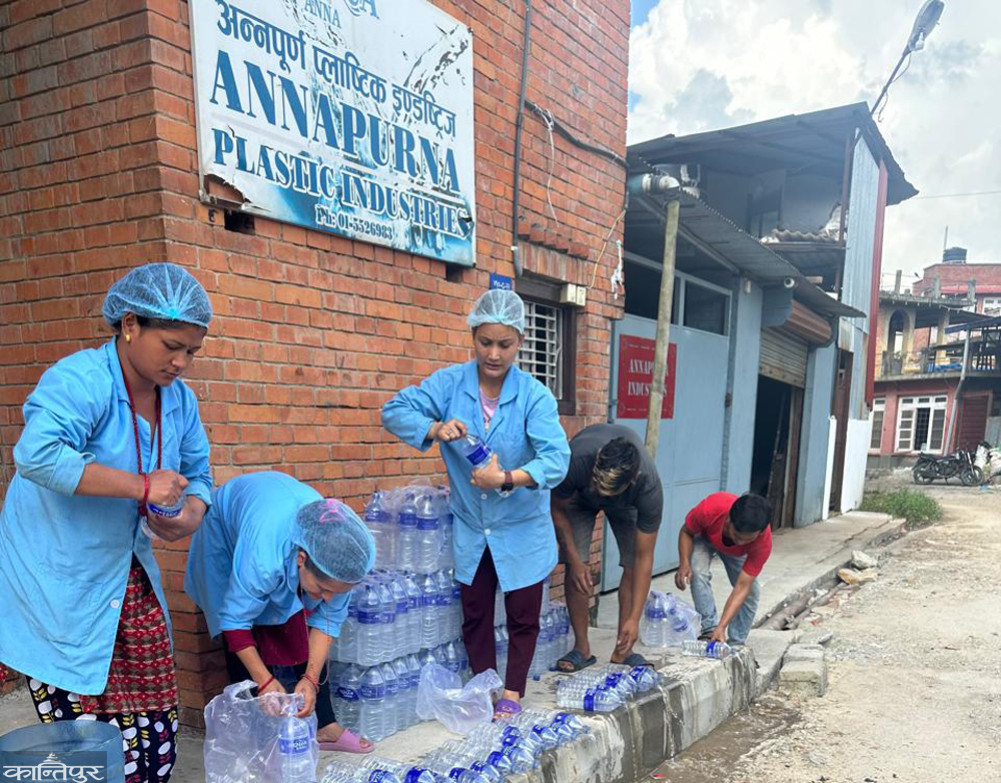
department, while monitoring the market, has found something odd every time. When the food team reached Annapurna Industries in Patan Industrial Area on Wednesday, the same was found. 25 cartons of treated drinking water stored in a storage room at the water treatment industries did not have the product label, date and batch number. The Consumer Protection Act prohibits such acts and can result in immediate financial penalties. But the team of food gave immunity only by destroying the water which did not mention the selling price.
Food's team monitored Sharan Mineral Water & Beverages Pvt Ltd, Real Mount Everest Beverages Pvt Ltd, Greenland Mineral Water & Beverages Pvt Ltd and City Water & Beverages Pvt Ltd in Tokha on October 14. During that time, Sharan did not renew the permit, did not pay attention to cleanliness and also kept the processing room in disarray. However, the team only instructed to correct the deficiencies and adopt the guidelines. The situation in Real and Greenland was similar. Even though there was a problem in the water production industry, the crushed jars of two industries were only destroyed and given instructions accordingly.
Food's team also monitored the water industry on October 9 (Wednesday). During the inspection at Pachli Bhairav Water Processing Industry in Lalitpur, the bottle did not have the production date and batch number. Water quality test report was not done. No action was taken even though the sewage drains were kept unorganized and open. Exemption was given by directing to comply with the Guidelines-074 on Production Standards for Treated Drinking Water. Dhapasi's Sunrise Beverage Nepal Pvt Ltd was found to be filling water in jars of another company and selling it. It was found that the business was carried out without renewing the license of the department. But no action was taken. In this way, even though the water industry has been negligent, the government agency has got away with only giving instructions. In the same situation, Kathmandu Metropolitan City has been taking action.
Metropolis found quality in 11 brands while testing samples of 21 brands. Fecal coliforms were also found in the water during the testing conducted by the Metropolitan Municipality. The amount of coliform that should be zero was found up to 300. Colony forming units (CFU) per 100 milliliters of sample tested were found to be abnormal. In this, 11 companies have been banned from selling and distributing water and the metropolis has fined two lakhs each. While the Nepal Bottled Water Industry Association is saying that the guidelines issued in 074 cannot be implemented, the department has been giving exemptions only by giving instructions.
'Water cannot be made 100% clean, there is something wrong with it. Human error can also occur. There is also a problem with modern water treatment,' said Bikram Limbu Chemjong, the senior vice president of the association, 'if the standards issued by the Food Ministry are fully implemented, 500 of the 700 water industries in Nepal will be closed.'
Some water industries have treatment, storage and even filtration in the same room. Therefore, Chemjong says that even if there are instructions, it will be difficult to implement them. Talking about the valley itself, out of 200 water industries, 150 industries are running on a whim. What will the water produced by those industries be like?' he said.
Director General of Food Technology and Quality Control Department Director General Sanjeev Kumar Karna said that the guidelines must be followed. If the industry fails to comply with the standards, they can adopt alternative measures and go for merger. If they can't do that, they are closed. But because there is no capacity, they cannot sell contaminated and low-quality water to the general public,'
He said, "Those who don't follow the standards will be punished." The department said that even though the new food law has been issued, it has not been able to impose a financial penalty as its guidelines are still being prepared.