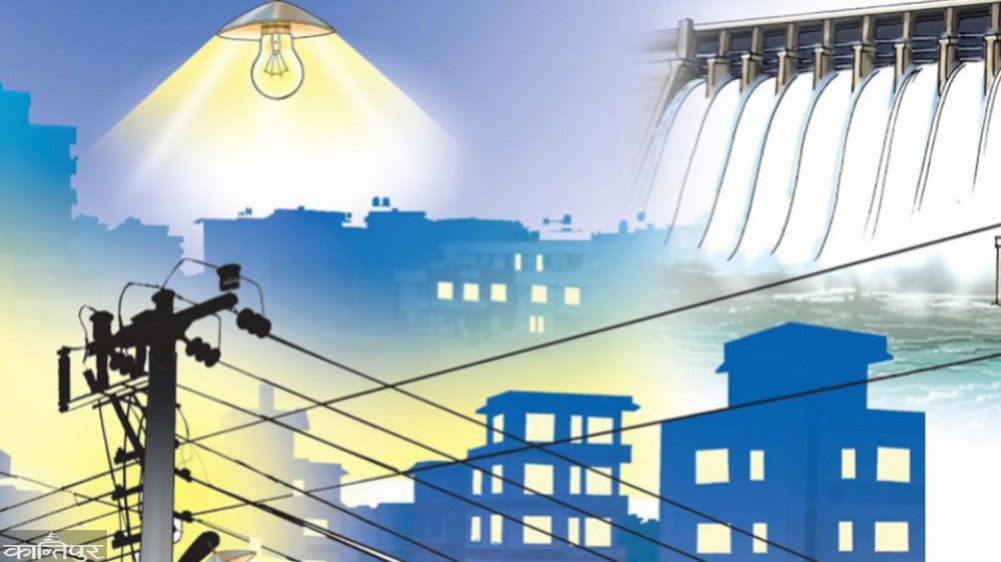
The shut down of the 456MW Upper Tamakoshi Hydropower Project, the largest of its kind in operation, halted domestic power flow to export.
We use Google Cloud Translation Services. Google requires we provide the following disclaimer relating to use of this service:
This service may contain translations powered by Google. Google disclaims all warranties related to the translations, expressed or implied, including any warranties of accuracy, reliability, and any implied warranties of merchantability, fitness for a particular purpose, and noninfringement.
Due to incessant rain, around 1,300 megawatts of electricity generated by various projects across the country has been stopped till Saturday evening. According to the Nepal Electricity Authority, the electricity production of hydropower projects in Likhu, Solu, Koshi, Kabeli, Tamor corridor has stopped.
The 456 MW Upper Tamakoshi Hydroelectric Project, the largest in operation so far, has been closed since 7 pm on Friday.
Chief Executive Officer of Upper Tamakoshi Hydropower Mohan Gautam said that the control room building of the dam project was completely damaged by the landslide. The condition of 5 people working in the project is also unknown, the company said. The authority estimates that the project's sand settling pond has also been damaged.
Power generation of Likhu 1, Likhu 2, Likhu A, Lower Likhu, Khimti and Upper Khimti hydropower projects has stopped due to the transmission line, Chandan Kumar Ghosh, spokesperson of the authority said. Due to the floods, electricity production of hydropower projects including Mandu Hydropower, Upper Tamakoshi, Middle Solu, Beni Solu, Solu Dudhkoshi, Upper Dudhkunda and Middle Tamor has also stopped. Ghosh says that apart from the damage to the power house, other hydropower projects will be put into operation after the water level decreases.
According to the authority, the Upper Tamakoshi and the 22 MW Mandu Hydropower have been damaged. Ghosh, the authority's spokesperson, said that the details of whether other hydropower projects were damaged or not could not be received. The Association of Independent Power Producers (IPPAN) said that along with Tamakoshi and Mandu, the Hewa Khola and Lower Hewa rivers were also damaged. Panchthar Power Company's Hewa River-A and Mountain Hydro Company's promoted Lower Hewa River have also been damaged, according to Balram Khatiwada, General Secretary of IPPAN.
"It has been reported that the powerhouse of the lower Hewa river has been completely submerged, the intake has been damaged and the generators have been swept away and the exact details of the damage have not been ascertained," he said. Khatiwada said that there was information that water had entered the project which was being prepared to be put into operation after the reconstruction of Hewa Khola-A which was damaged by the flood on 1st June 2008.
He also said that due to heavy rains, most of the projects are closed and the process of opening continues. Khatiwada said that even though there were general details about the hydroelectric project, including the falling of the poles, there was no detail about the amount of damage. According to IPPAAN, the power house of Mandu Hydropower was submerged due to the flood in Wagmati river and the opening of the Kulekhani dam.
Kulman Ghisingh, executive director of the Authority, said that due to the incessant rains, there is not only a problem of electricity flow internally, but also electricity export with India has stopped. Exports to India have also been affected along with domestic exports, he said. According to Ghisingh, the damage to the 456 megawatt Tamakoshi project is being ascertained to facilitate the supply of electricity and how it can be operated locally.
Two transmission lines have also been disrupted due to incessant rain. The main transmission line supplying electricity to Kathmandu Valley has been disrupted. The river Tamakoshi washed away tower number 7 of the 132 kV Khimti-Lamsanghu transmission line. After the power supply from Khimti-Lamsanghu transmission line was stopped, about 100 megawatts of electricity coming to Kathmandu valley has been stopped.
Although the 132 KV Lamsanghu-Kathmandu transmission line was not damaged, Ghosh, the authority's spokesperson, said that there would be a shortage of electricity in the valley due to the fact that electricity could not reach there. The electricity produced by the hydropower projects of the Bahrbise Corridor was mainly exported to India through the Khimti Lamsanghu line through Khimti. Exports have been affected due to damage to transmission lines.
According to the authority, usually 2800 megawatts of electricity was produced. At present, around 1300 megawatts of electricity production has been disrupted. The Kulekhani Reservoir Project is fully operational. 60 MW of electricity is generated from the first Kulekhani, 32 from the second and 14 MW from the third. Only about 1500 megawatts of electricity has been consumed till Saturday evening across the country.
Tower No. 51 of Kabeli Corridor, located between Damak in Jhapa and Godak in Ilam, collapsed, and the electricity produced by the hydropower projects of Ilam, Panchthar and Taplejung has been shut down. Also, transmission lines from Dhalkebar towards Chandranigahpur have also been affected due to falling trees. Due to the damage to the local distribution system, electricity has also been disrupted in some places in Kathmandu Valley.