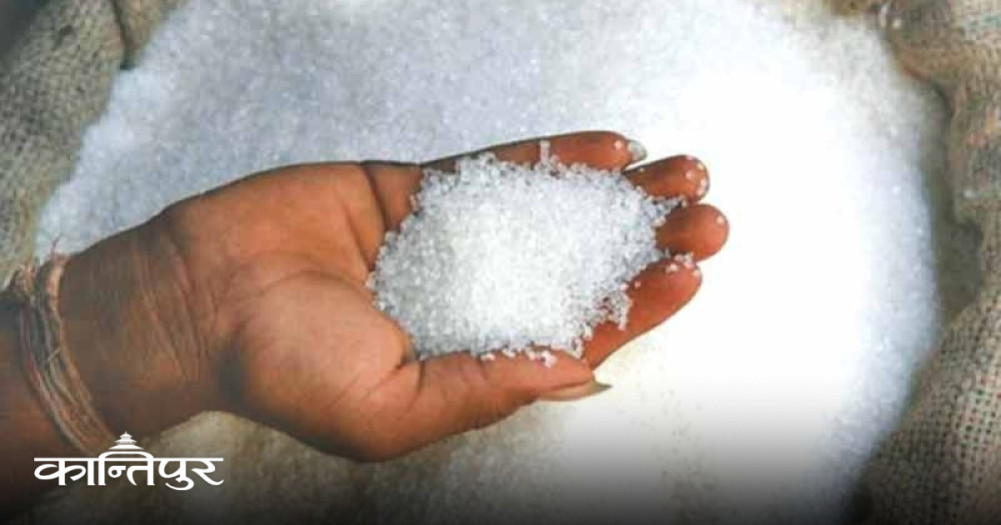
After the traders brought the sugar that the government could not bring, the industrialists started reducing the price
We use Google Cloud Translation Services. Google requires we provide the following disclaimer relating to use of this service:
This service may contain translations powered by Google. Google disclaims all warranties related to the translations, expressed or implied, including any warranties of accuracy, reliability, and any implied warranties of merchantability, fitness for a particular purpose, and noninfringement.
After some wholesalers imported the sugar which the government institutes could not import, the price started to fall. The sugar industry has increased the price every week on the pretext that there is insufficient supply of sugar according to the demand, but now it has reduced some prices.
When the Food and Trading Company and the Salt Trading Corporation did not bring sugar, the industrialists tried to increase the price. The retail price of sugar had gone up to Rs 120 per kg. According to the quota provided by the government, after some importers brought sugar, the price started to decrease.
After the import of sugar, the price dropped to 10 rupees within a week, said Vasant Shrestha, treasurer of the Retail Trade Association. Some importers imported the sugar that food and salt could not bring under discount by paying the full customs duty. After sugar came to the market, the wholesale price decreased to Rs 3 per kg," said Shrestha, treasurer of the association, "We had to pay up to Rs 114 when buying sugar in wholesale a week ago.
When it came to retail, it cost up to 120 rupees per kilo. Now the retail price has decreased to 110 to 115 rupees. He claims that the price will not increase during Dasain due to the import of sugar in the market. Shrestha says that if salt and food import sugar at a discount, the retail price will not exceed 100.
Sanjay Kumar Phuyal, a wholesale businessman, also said that sugar has now dropped to Rs 106 to 107 per kg. Phuyal, who is the managing director of Asma & Company Pvt. Ltd., said that he had to pay up to 110 rupees while purchasing from the sugar industry a week ago. "After the industrialists have reduced the price, we have reduced the price and sold it from wholesale," he said. If food and salt bring discount sugar, the price will further decrease. If discount sugar is imported, it will reach 85 rupees per kg in Nepal. Due to open borders, smuggling also occurs. Businessmen understand that there is a possibility of price reduction due to competition. But they say that it is necessary to bring discount sugar from food and salt to reduce the market price.
But the businessmen claim that the government is trying to increase the price. They say that the government agency Food and Salt is also involved in increasing the price. In previous years, they did not import even though they got the quota. Even now, there is hesitation to bring,' said a wholesale businessman, 'If sugar is brought by food and salt, the retail price of sugar is only 95 to 100 rupees. If the discount sugar does not come, it may reach 120 rupees again.'
salt is now buying sugar with traders and selling it at 2 hundred and 15 rupees per packet. According to the government quota, the sugar salt imported by Season Enterprises has been bought and sold for 120 rupees 50 paise after paying full customs duty. The said sugar is sold at 2 hundred and 15 rupees for 2 kg. If the government agencies can import at a 50 percent discount, the consumer price will be cheaper. But the government is not able to bring it to the festival.
In order to intervene in the market price of sugar during the festive season, the meeting of the Council of Ministers on August 24 decided to import 30,000 tons of sugar at a 50 percent customs discount. According to the government decision, 15,000 tons of salt and 15,000 tons of food have been assigned. After the decision to grant the discount, Industry, Commerce and Supply Minister Damodar Bhandari said that he would intervene in the market by importing subsidized sugar within Dasain. Although Salt made a global tender to import 50 percent duty free sugar, no process from food has increased.
Salt's global tender expires on Monday. But till Sunday, no company has applied. After the government decided to import at a discount, we conducted a 12-day global tender. "The tender period is ending on Monday," said Kumar Rajbhandari, joint general manager of SALT, "but no application has been received." According to the global tender, if an Indian company applies, SALT may bring sugar before Dasain. But Rajbhandari said that there is little chance of discount sugar coming before Dasain when companies from third countries get import licenses.
But food did not increase the process because the letter from the Ministry of Industry, Commerce and Supply did not come. "This is the case, there was no import in the past, this year too, there is little chance of food sugar," said a food official.
At present, 30 percent customs duty is levied on sugar imports. 13% VAT is charged on it. 5 percent payment tax has to be paid. Adding all these together makes the price of sugar higher when it reaches Nepal. The government institutions did not want to bring it because the price would be expensive. They have been saying that the government should impose only 1 percent customs duty. A 50 percent discount has been given by the government. Even after getting this discount, those institutes could not bring sugar in the past.
Last year, to prevent shortages during the festival, the government entrusted the import of 10/10 thousand tons to food and salt at a 50 percent customs discount. But it was not imported. When these institutes did not import, the market price rose to Rs 150 to 160 per kg. Then the government decided to bring it even if it was through government-to-government (GTUG). The government also failed to bring 50,000 tons of sugar from JTUG.
Salt and food could not bring 25 thousand tons out of 50 thousand tons of G2G in the first lot. After that, the government asked the industries willing to use 19,000 tons of sugar as raw material out of the 25,000 tons of sugar import permit quota to apply. According to this, nine private companies have obtained import permits but did not bring them. The government then allowed importation for commercial purposes. Although seven people got import permits, 3 importers imported 8,100 tons of sugar without customs clearance.
'According to the quota we got, after deducting all expenses including purchase price, shipping fee, loading charge in India, we sold it at 120 rupees per kilo when we reached Bhairahawa. We sold 250 tons of salt at 120 rupees 50 paisa,'' said Ishwar Shrestha, the owner of Season Enterprises.
The price of sugar brought by businessmen has been determined by the government. Rajan Paudel, Director General of Commercial Supply and Consumer Protection Department, said that the price of imported goods by traders cannot be sold at more than 170 rupees per kg. In the last fiscal year, 180,000 tons of sugar was produced when 2 million tons of sugarcane were crushed. Demand in the market is 250,000 tons. Even though 25/30 thousand tons come informally through the open border, there is a shortage of about 50 thousand tons every year. Average monthly consumption is 30,000 tons during festivals.
Krishna Prasad Bhandari (Marseille), president of Consumer Awareness Campaign Nepal, said that the decision to delay the introduction of discount sugar was a game to increase the price during the festival. The minister of industry canceled it saying that the private sector could not bring salt and food while the import process was going on. When some businessmen were preparing to bring it, it was decided to bring salt and food at a discount,'' he said. These bodies were not able to bring it in the past. Canceling the quota given to private persons will reduce the chances of coming to the festival. If food and salt cannot be brought, the price will increase as soon as there is a shortage. The price of sugar has been increased from 107 to 125 rupees.'