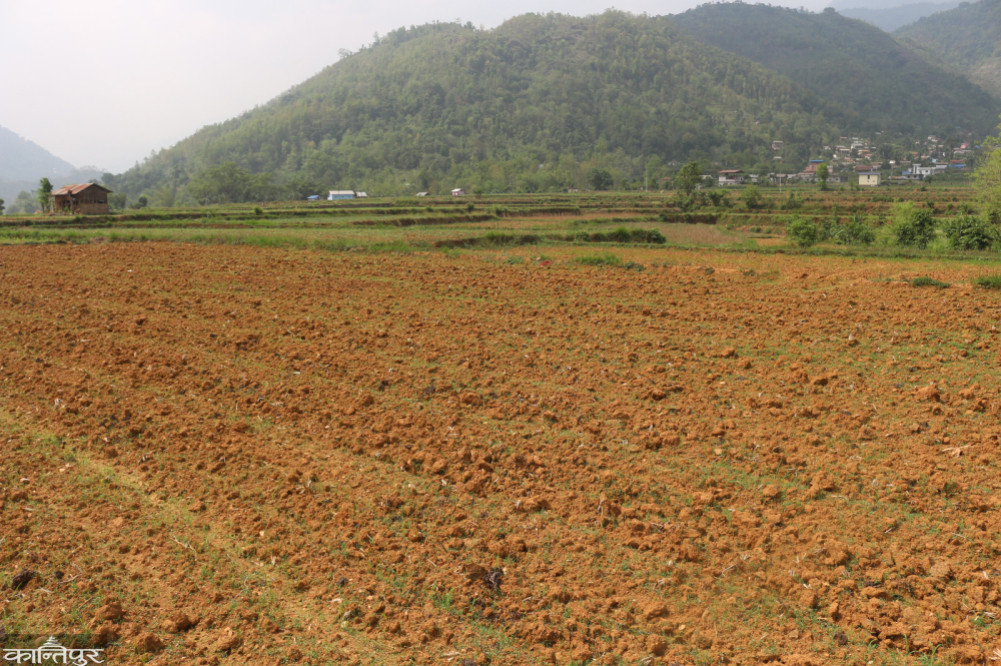
As the rain did not fall on time, the fields where corn was cultivated last year are barren
We use Google Cloud Translation Services. Google requires we provide the following disclaimer relating to use of this service:
This service may contain translations powered by Google. Google disclaims all warranties related to the translations, expressed or implied, including any warranties of accuracy, reliability, and any implied warranties of merchantability, fitness for a particular purpose, and noninfringement.
In Satyavati Rural Municipality-1 Aslewa field, corn cobs could be started at this time. Maize sown in March was brought in in June and rice was planted there. But this year, even till the third week of May, most of the fields in the district are barren. After not raining on time, not only the fields remain barren, but the farmers are also worried.
"There are more than 200 houses in Aslewa, every house used to have 15/20 muri of corn," says local 76-year-old Premlal Pandey.
After the lack of rain, the fields are not only barren in the places where dry corn is sown, but also the dry corn is not able to be sown in time. Usually on the 15th/20th of May is the second sowing time of corn. But most of Dhurkot's fields have only recently sown maize. "In the past, double corn was dug on 20/22 of June, now it has just been sown," says Jhup Bahadur Basnet of Dhurkot Rural Municipality-6 Dhur, "Also in Baisakh, some people are just sowing after there is no rain to soak the barren fields."
At this time, along with corn, vegetable plants such as greens, beans, and parsley were growing. Some are just being planted this year and some have just sprouted. Lokhari Kunwar, a farmer of Madane-6, said that due to lack of rain even in winter, the production of potatoes planted last January has decreased. "When the sky rained, my field used to grow 10 quintals of potatoes per transplant," he said, "now it has decreased suddenly, this year even green vegetables in the village are in trouble."
According to Navraj Bhandari, head of Krishi Gyan Kendra Gulmi, this year, crops such as grains, vegetables and fruits have been affected in Gulmi due to the change in the rainy season. Chaite rice which was cultivated in 341 hectares last year has been cultivated only in 319 hectares this year. "Since it has not rained, it has been delayed to sow dry corn, and the area for sowing has decreased," he said He said that the calendar itself has started to change.
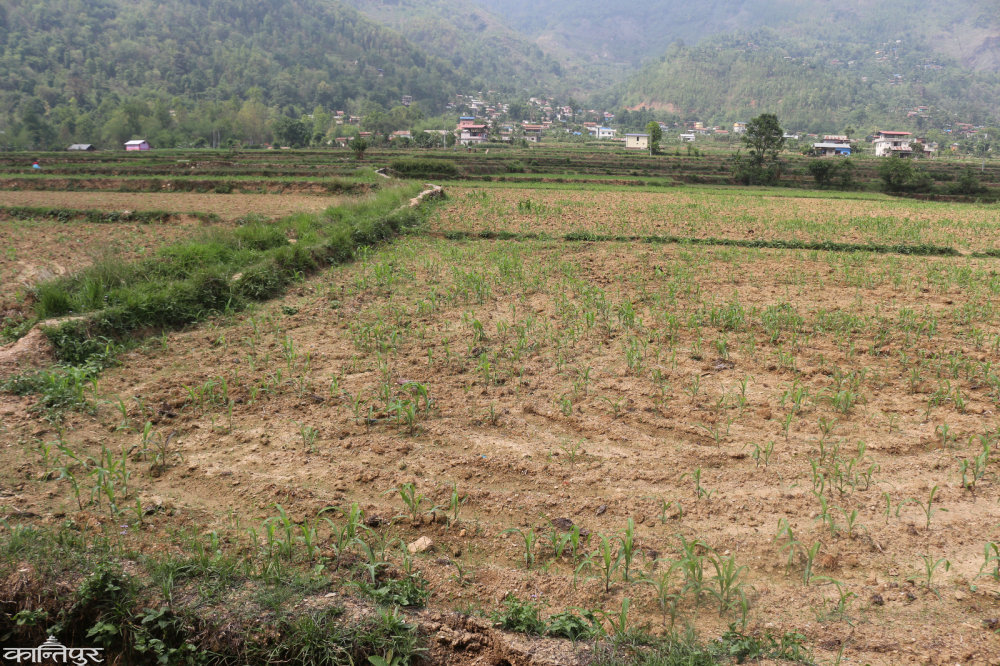 According to Bhandari, maize is grown in an area of 24,465 hectares in Gulmi. He said that the data could not be obtained due to the fact that the maize is being sown this year. According to climatologist Dharmaraj Upreti, due to the changes in the rainfall schedule and temperature, the date of cultivation has to be changed. This is the effect of climate change. The impact of climate change is intense in the Himalayan region including Nepal," he said. He says that when the sea temperature is higher than the average, there will be a drought in the Asia Pacific region.
Farmers have sown the second time in different places of Ishma Rural Municipality after the corn that was sown once did not grow. This causes the farmers to incur double expenses on fertilizers, seeds, wages, etc., says Tara Karki of Ishma-4. According to him, climate change has caused a lot of suffering to women. "Other times, maize was sown on 10/12 of Chait, this year it was delayed due to lack of rain, on top of that, the maize that was sown once did not grow and the cost of sowing twice was double," she said. According to climatologist Upreti, it can be assumed that there will be more rain in the pre-monsoon, more rain in the summer and more rain in the rainy season. He also said that it is affecting farming.
After climate change affects women and farmers in rural areas more, some local levels have started doing awareness activities about adaptation and mitigation. Neermaya Taramu, vice president of Satyavati rural municipality, said that the municipality is trying to explain to the farmers how they can do climate adaptation farming.
Malika and Dhurkot Rural Municipality have also conducted climate change adaptation training for farmers and women. Tikaram Pandey, Chairman of Satyavati Rural Municipality, said that since there is no rain on time, the farmers are being affected by the construction of irrigation canals and recharge ponds to make farming easier. "I believe that this will give relief to the farmers," he said.