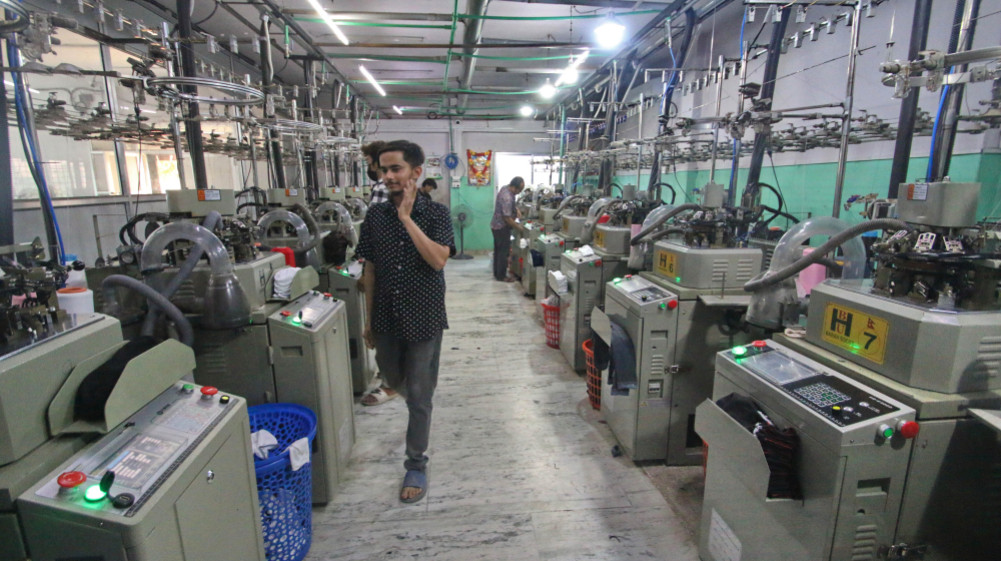
Entrepreneur Ekraj has been exporting socks to seven provinces of the country and abroad through Barah Hojiari Socks Industry.
We use Google Cloud Translation Services. Google requires we provide the following disclaimer relating to use of this service:
This service may contain translations powered by Google. Google disclaims all warranties related to the translations, expressed or implied, including any warranties of accuracy, reliability, and any implied warranties of merchantability, fitness for a particular purpose, and noninfringement.
Worked for 20 years in a yarn factory in Ludhiana, India. There he was in the role of quality controller of cotton yarn. Get close to the machine. From machine maintenance to settings, he started doing it himself. Become an expert in machine operation. After learning a lot about the machine, the company sent him to Baku, the capital of Azerbaijan, to install a new plant.
He also worked there for about two and a half years. It was well earned. However, I felt that something should be done in the country that sweats in foreign lands. After that, using his skills, he now operates Barah Hojiari Socks Industry. Employing 8 members of the family, they have been exporting socks to 7 provinces of the country and abroad. He is a 53-year-old Ekaraj Officer of Wanganga Municipality-4 Darkhast.
He has employed 8 members of his family by running a socks industry. Ekraj himself looks at the machine. Bhai Khemlal does marketing and another brother packs socks. Mother has also been given employment. 4 children of the family also work in the industry. 18 people from the neighborhood and others have also been employed. The industry has been started for 7 years by importing the latest knitting socks machine from China. They make socks using the most modern computerized machines. Initially brought three machines. Then 8 and now 16 have been made.
These machines produce 3,500 dozen socks per month. The capacity of the machine can be increased if the demand increases. Babies, toddlers to adults, military, police, students and football players wear them. They also produce slacks (long socks), tracking and sports socks for girls and young women. The industry has produced 52 to 56 varieties of socks. The machine sews a pair of long socks in one minute. A small sock sews a load in 5 minutes. They have their own brand. Produced under the brand BHU (Barah Hojiari Udyog). Khemlal, the owner, said that he has the ability to produce socks in any design according to the order of
shop. "We will show you the design," he said, "we will make it." Apart from that, we are looking at the current designs on the internet and producing them in the designs available in the world market. Ekraj, the owner, said that he is producing socks from cheap to expensive by paying attention to the customer's choice.
is usually made using 60 percent cotton and 40 percent polyester yarn. After the socks are produced, they are sewn with nylon. If there is a demand for cheaper, polyester is used more. Making socks using Legra spandex gives the feet grip, strength. At first, the sock fabric is prepared and thrown by the machine. It is then sewn with nylon to form a sock. The socks are then ironed. The tag is then attached with a hanger and clip. And it is packed and prepared to send to the market.
90 percent of the raw materials required for socks are imported from India and China. Apart from labels (tags), water paper, hangers and clips used in packing all come from India. 60 percent of the customs duty on these goods should be paid. "The import of ready-made socks incurs 30 percent customs duty," he said, "Packing material has 60 percent customs duty." There is a problem because the government's policy is not practical.'
Ekraj, who went to India in 048, returned in 071 and studied the market. He registered the industry in 073 and started production from 074. He said that before the corona infection, there was a good market where the industry was running 24 hours a day. Now there is only one shift of 12 hours. Initially 3/4 of the machine operators were Indian workers. Now all the local manpower is ready. Sock market has more than 40 districts. They deliver to the local market with their own vehicles. Now he has started exporting socks to Denmark as well. Ekraj says that he has sent to Dubai, Qatar and Saudi before.
After bringing the first state-of-the-art machine in Lumbini province and starting production, now 4/5 industries have opened around Butwal. Ekraj said that despite the competitive market, the business is good due to quality products and close contact coordination. He said that the country will be self-sufficient in the production of socks if the machines across the country can be operated at full capacity. Initially, the industry was established at a cost of 25 million. While earning and increasing investment, it has now reached 3.5 million. According to Ekraj, the annual turnover is around 20 million. Ekraj said that the monthly interest of one and a half million loans has to be paid and by cutting all the expenses, 20/22 lakhs is being saved in a year.