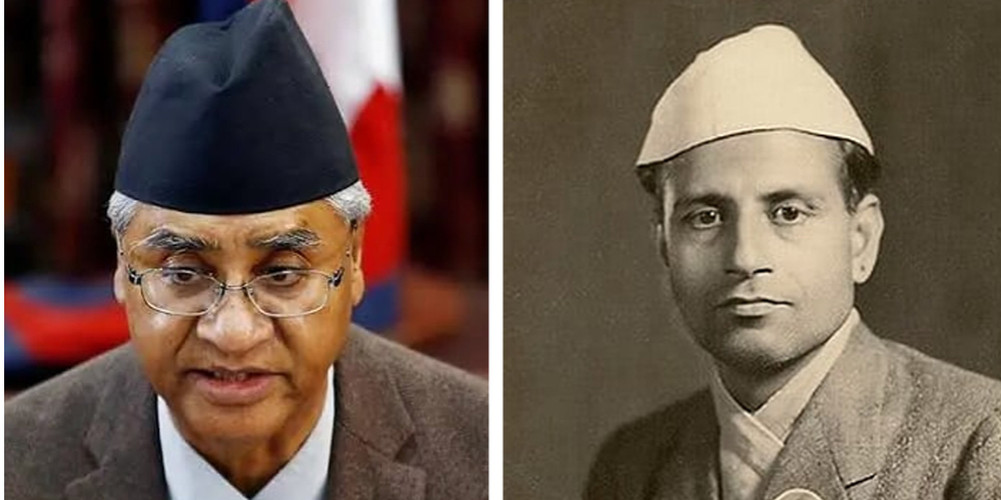
There is a possibility that the party could split if a special general convention is held. It is not that such a possibility is not there. We will know about it in a few days. But even if there is a split, this will not be the first split. Because the Congress has already faced major splits twice in history.
We use Google Cloud Translation Services. Google requires we provide the following disclaimer relating to use of this service:
This service may contain translations powered by Google. Google disclaims all warranties related to the translations, expressed or implied, including any warranties of accuracy, reliability, and any implied warranties of merchantability, fitness for a particular purpose, and noninfringement.
After it was confirmed that the regular general convention scheduled for December 26-29 will not take place, Congress general secretaries Gagan Thapa and Bishwaprakash Sharma have started preparations to call a special general convention. The central working committee meeting on December 15 had set a schedule to start the ward convention from December 16, but the general secretaries have moved towards a special general convention after it was disrupted.
The statement titled 'Regular General Convention Postponement/Alternative Special General Convention' issued by General Secretaries Thapa and Sharma on 17 Pus states- 'Since the regular general convention cannot be held on time, a special general convention has once again come forward as an alternative.' The hall of Bhrikutimandap has been 'booked' for the special general convention.
54 percent of the general convention delegates had submitted an application on 28 Asoj demanding a special general convention. Accordingly, the special general convention should be held by 28 Pus. But in the meantime, the issue of the special general convention was postponed after the central working committee meeting brought the same agenda as the regular general convention.
Even after the decision to hold a regular general convention was made, the Congress establishment party was opposing it. Now, even after the general secretaries have prepared for the special general convention, this party is giving more importance to the risk of party division. However, Gagan-Bishwaprakash is also being praised for taking the initiative against the party capture by the Congress establishment, the tendency of being unable/unwilling to hold a general convention at regular times. There are also those who say that this kind of initiative is inevitable after the Gen-G movement expressed an agenda of reforms within the party but the Congress leadership did not listen to it.
The possibility of a party split is emerging if a special general convention is held. It is not that such a possibility is not there. We will know about it in a few days. But even if a split occurs, it will not be the first split. Because, the Congress has already faced a major split twice in history.
Earlier, the Congress had faced a split due to disagreements between the government and the party. This time, the possibility of a split has increased due to the power struggle within the party and the disagreements between the party that wants a regular/special general convention and the establishment party that is preventing it.
The first division under the leadership of Matrika Prasad Koirala
After the Mohan Shamsher Jabra-led government formed with the declaration of democracy on Falgun 7, 2007, the Congress President Matrika Prasad Koirala became the Prime Minister as chosen by Indian Prime Minister Jawaharlal Nehru and King Tribhuvan Shah. At that time, BP wanted to become the Prime Minister, but failed. After the government was formed, disagreements increased between his elder brother Matrika and his younger brother BP. BP was of the opinion that Matrika should leave the position of President and play the role of Prime Minister only. He said, 'Only the party can stop the government's arbitrariness when there is no parliament, so Matrika should leave the leadership of the party.' But Matrika was not ready. This dispute ended when BP was elected President at the fifth general convention held in Janakpur on Jestha 10, 2009.
Dr. After the capture of Singha Durbar under the leadership of KI Singh, the government's decisions such as banning the Nepal Communist Party and calling the Indian military mission to Nepal continued the misunderstanding. Matrika did not show much interest in holding elections as per the assigned responsibilities upon becoming the Prime Minister. Meanwhile, he did not implement the party's instructions to reshuffle the cabinet. He argued that the party should not give instructions to the Prime Minister. As arguments and counterarguments continued through correspondence, ministers close to BP, Subarna Shamsher, Surya Prasad Upadhyay and Ganeshman Singh, resigned.
The Central Working Committee meeting held on 8th July 2009 gave a 48-hour ultimatum to the Prime Minister and the Nepali Congress ministers to resign. After rejecting it, the Central Working Committee meeting held on the evening of 23 August suspended Prime Minister Matrika Prasad Koirala, ministers Mahendra Bikram Shah, Mahabir Shumsher and Naradmuni Thulung from being active members of the Nepali Congress for three years. This decision was later approved by the Mahasamiti meeting. Shortly after the suspension, Prime Minister Matrika also resigned.
After being suspended from the party, on 21 Bhadra 2009, a 'Nepali Congress Ad Hoc Committee' was announced under the chairmanship of Matrika. It included Mahendra Bikram Shah, Naradmuni Thulung, Mahabir Shumsher and other leaders. The following year, a conference was organized from 15 to 17 Baisakh 2010. From the closed session on 16 Baisakh, the 'National Praja Party' was announced under the chairmanship of Matrika. Later, Matrika merged this party into the Nepali Congress.
Division under Deuba's leadership
Sher Bahadur Deuba was appointed Prime Minister for the second time on 2058 Shrawan 7. The emergency period imposed by the same government lasted until 2059 Jestha 11. There was a controversy over whether or not to extend the emergency period. Not only did the opposition UML not support the approval of the House of Representatives, but there was also no consensus within the Congress.
Meanwhile, the government registered a proposal to extend the emergency period by 6 months with the Parliament Secretariat on Jestha 3. After that, discord began within the party. On Jestha 7, Prime Minister Deuba was asked for a 24-hour explanation under the signature of General Secretary Sushil Koirala, 'Why not say that such activities that neglect and devalue the party have violated the minimum values, norms, culture and traditions of the democratic party system?' Deuba responded on Jestha 20 by saying that he had not taken any decision by going beyond the party's decision.
On Jestha 20, the Central Working Committee meeting directed the government to withdraw the proposal registered in Parliament. Deuba was also criticized in the parliamentary party meeting held on the same day. Deuba, who reached the royal palace that evening, recommended the dissolution of the House of Representatives. The king also immediately implemented the dissolution and set a mid-term. Angered by Deuba's move, President Girija Prasad Koirala called on all party members in the Council of Ministers to resign within three days. Some resigned, while others stood by Deuba.
Meanwhile, the Central Disciplinary Committee on Jestha 20 immediately suspended Prime Minister Deuba from being an ordinary member of the party and sent him a three-day explanation letter. Deuba responded to the Disciplinary Committee on Jestha 21. However, on June 12, the disciplinary committee also expelled Deuba from the party for three years, stating that the explanation he presented was not reasonable and that the dissolution of the House of Representatives without informing the party was against the principles of the party system and a serious violation of the party's objectives, policies, code of conduct and statute. Deuba appealed to the Central Working Committee to withdraw the action. But there was no hearing.
Meanwhile, Deuba called a meeting of his party's general convention representatives on June 2. He turned the meeting called to put pressure on Koirala into a general convention. On June 4, Koirala was removed from the presidency. On June 5, Sher Bahadur Deuba was elected as the president of the divided party. Thus, the Congress split. Later, the Koirala faction gained authority and Deuba's party became the Nepali Congress Democratic Party. This party later merged with the Congress.