Nepal became the first country to make a conservation action plan for forest dogs found in 12 countries including China and India
We use Google Cloud Translation Services. Google requires we provide the following disclaimer relating to use of this service:
This service may contain translations powered by Google. Google disclaims all warranties related to the translations, expressed or implied, including any warranties of accuracy, reliability, and any implied warranties of merchantability, fitness for a particular purpose, and noninfringement.
Nepal has been playing a leading role in the world in the field of conservation. A few weeks ago, an international conference was concluded with the participation of representatives from countries where snow leopards are found in Nepal. Nepal became the first country to fulfill the international resolution to double the number of tigers. Nepal has also received various international awards for its conservation work.
Nepal has now done new work in the field of conservation. That is by creating the first forest dog protection action plan. The forest dog, a rare creature on the list of endangered wildlife, is found in 12 countries of South and South East Asian countries. Among the countries where forest dogs are found, Nepal has made an action plan for the first time for the protection of this animal. Before that, Nepal held the second international forest dog conference in Chitwan under the leadership of National Nature Conservation Fund in 2023.
For the protection of forest dogs, Nepal has first made a conservation action plan. Recently, the National Parks and Wildlife Conservation Department and the Forest and Land Conservation Department have published a joint action plan for forest dog protection.
It is estimated that there are less than 500 forest dogs in Nepal, also known as Asiatic Wild Dog (Dhol). Along with Nepal, this creature has been found in India, China, Bhutan, Bangladesh, China, Indonesia, Malaysia, Thailand, Myanmar and Vietnam. However, it is estimated that its number is very low in Vietnam. It is extinct from Afghanistan, Kazakhstan, Kyrgyzstan and Uzbekistan.
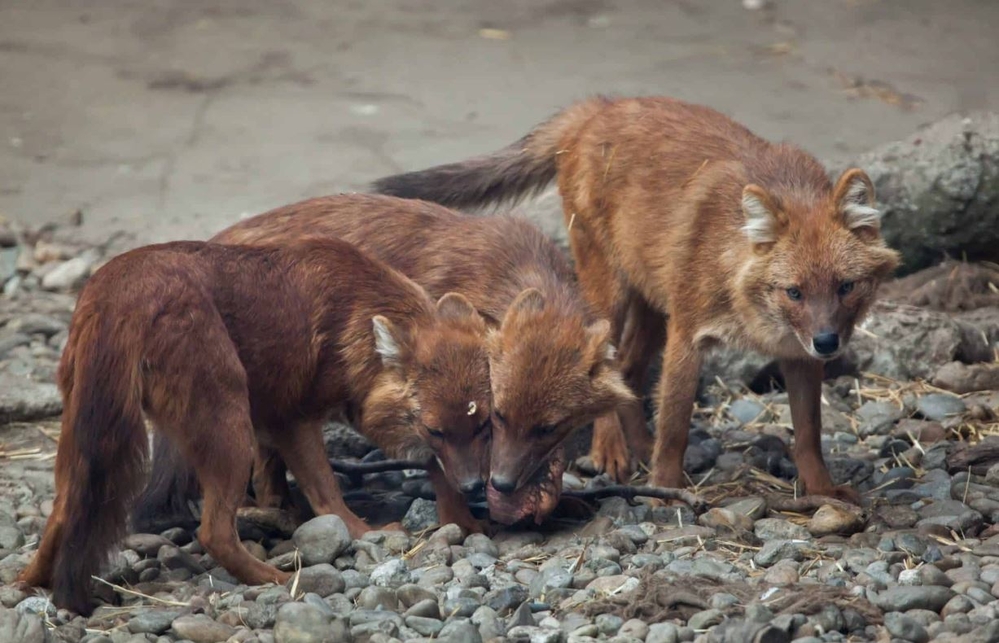 It is estimated that the adult number of this creature on the endangered list of IUCN is only 2000 to 2200 in the world. The detailed description of the condition of this carnivorous animal in the world has not yet been recorded. Recently, the IUCN Dhol Specialist Group has studied its distribution. Where its distribution is estimated to be found through West India, Central India and the foothills of the Himalayas to Southeast Asia.
The forest dog is found at a lower altitude than the wolf. Something bigger than a fox. This animal with a drooping black tail is known as Milke and Thadakane in the eastern hills. It is estimated that the number of this species is less than 500 in Nepal.
Conservationist Ambika Prasad Khatiwada from Kanchenjunga conservation area made a scientific record of forest dogs through camera trap. The height of 4,000 meters recorded by Khatiwada is the maximum height of the forest dog found in Nepal. In Ladakh, India, this creature has been captured at an altitude of 5,300 meters. Nepalese researchers do not have detailed information on forest dogs recorded from hot to cold places. Today's need is to understand more about its distribution area, habits. Its food species include yak, ghoral, malsapro, nirbiralo and other animals. It eats animals ranging from mice to rabbits.
Since 2010, this creature was caught on camera trip in Chitwan, Parsa, Bardia, Banke park area of Terai. There are records found in the mountain region Saval in Kanchenjunga, Tinjure-Milke-Jalajle, Makalu Varun National Park, Gourishank Conservation Area, Dhorpatan Shikar Arksha, Annapurna Conservation Area and others. It was presented in the 2nd International Dhol Conference that records were also recorded in Udaipur's Triyuga forest and Dang forest outside the conservation area.
Regarding the sighting of forest dogs in Nepal, famous conservationist and professor YB Jhala of India has mentioned that a forest dog was seen in Bardiya area in 1997. At that time, he told the second international forest dog conference in Chitwan in 2023 that he had the opportunity to study forest dogs during India's national tiger census.
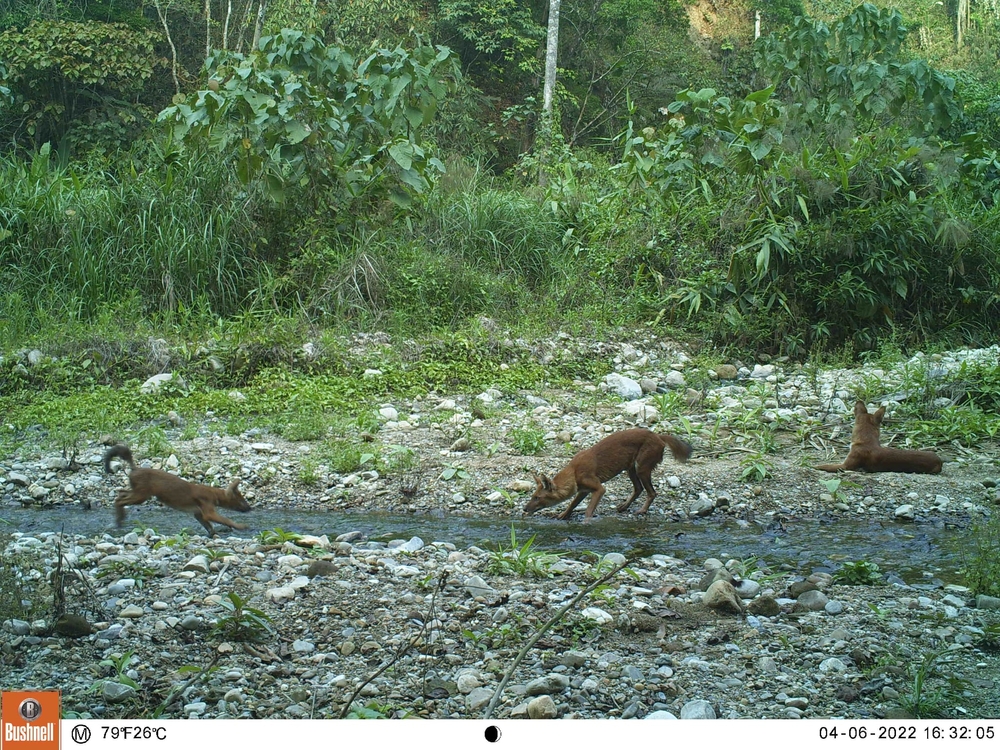 A forest dog seen in a camera trap in Parsa National Park. Photo: Cornell University
It is estimated that the condition of the forest dog living in the core area of the forest is more in danger than the tiger. This animal that hunts in groups is a member of the canid family. This family includes animals such as wolves, foxes, house dogs, etc. Even if this creature appears in low numbers, like other species, there is habitat destruction and degradation, lack of food species, human-wildlife conflict, disease and conflict and competition between species. Due to lack of sufficient study and research and lack of budget, more understanding about this carnivorous animal is not possible in the context of Nepal. Their weight is also 12 to 20 kg It is expected to happen. And, it is mentioned in the action plan that about 75 percent of the habitat has been destroyed.
National Parks and Wildlife Conservation Department and Forest and Land Conservation Department have jointly brought out the forest dog conservation action plan. In which Chitwan-Parsa section, Banke-Bardia section and Kanchenjunga geographical area are given special priority. In the action plan, it is also mentioned that the presence of forest dog in Nepal will be scientifically recorded and its distribution and numerical calculation will be known.
Similarly, there is an emphasis on developing a map of forest dog range, preparing and implementing long-term species monitoring standards, and integrating conservation efforts into existing wildlife management plans. Likewise, the action plan includes issues of reducing human forest dog conflict, spreading awareness among local communities and parliamentarians, and emphasizing international cooperation. What records are there regarding the human-forest dog conflict in Nepal and the damage caused by forest dogs and Records related to relief distribution are very few. In the
conservation action plan, improvement of the corridor connectivity is also emphasized while improving the ecological system. The action plan has included scientific research and research by collaborating internationally.
Forest Dog Conservation Action Plan is looking for something different about resource assurance. As it is the case that most of the wildlife protection action plans made by Nepal have to be relied upon by donor organizations to fully implement them. Regarding the forest dog, it is mentioned that 36 percent of the work will be completed when the topics mentioned in the tiger and snow leopard conservation action plans are implemented. It is estimated that 262.8 million 50 thousand will be required to implement the actions mentioned in the
action plan. It is said that 95.95 million of them can be spent through tiger and snow leopard conservation action plan. In the first year of the implementation of the 10-year action plan, 6.79 percent, 14.06 percent in the second year, 7.53 percent in the third year, and 10.04 percent in the fourth year, etc., can be protected by allocating the budget. It is said that this species will be evaluated for protection once in 5 years.
The main role in completing the tasks in the action plan is the park department, forest department and forest offices under the state government. It is mentioned that all the coordination work will be done by the Parks Department and the species research and monitoring work can be done in collaboration with organizations like National Nature Conservancy. What is the role of public officials for regular monitoring and evaluation of the action plan?
In the context of commenting that the state has to depend on the donor from time to time for the protection and counting of species, it seems that this action plan can be protected to some extent even if the resources and other action plans obtained at the local level are implemented. Although this action plan was created with the help of donors, if Nepal continues the conservation work it is doing, the contribution to forest dog conservation will surely be enough. As the world's first forest dog conservation action plan, Nepal is expected to make a significant contribution.

