Even though Chungba Sherpa is no longer physically present, his pictures of wild animals are decorated on the walls of various offices which will always remember him.
We use Google Cloud Translation Services. Google requires we provide the following disclaimer relating to use of this service:
This service may contain translations powered by Google. Google disclaims all warranties related to the translations, expressed or implied, including any warranties of accuracy, reliability, and any implied warranties of merchantability, fitness for a particular purpose, and noninfringement.
There is hardly a Nepali who is in the conservation area who does not see the pictures taken by wildlife photographer Chungba Sherpa. Every picture he takes gets a lot of attention. On YouTube, the videos of his jungle journey or the videos that he uploads on his Tiktok remain popular. The photos and videos he posts on social media also get discussion. From now on, photos taken by Chungba Sherpa in new places will not be seen. Now only the photos taken by him will be visible.
I was shocked by the news that he passed away during treatment on Sunday. Nepal has lost an important asset. The death of Chungba Sherpa, who has done significant work in wildlife photography in a short time, has shocked many. Born in Solukhumbu, he joined politics along with hotel and tourism business. After retirement, he chose wildlife photography to fulfill his hobby. Within a short time, he turned from a tourism professional to an established wildlife photographer.
On the eve of World Tiger Day-2024, I reached Chungba Sherpa's residence near Chappal Karakhana in Dhumbarahi. I went to his residence to ask for footage needed for a documentary on tigers. When we met him on the phone and at public functions, we would have informal conversations with him, but we could not get into gossip.
He made his own separate office in the house. Where his studio was also. He was busy editing the footages taken from the field and collecting them and keeping them in the hard drive. At that time he had returned from Bardia. A video of a pair of tigers drinking water was posted on social media. He was teaching his son to upload the same video to his other social networks. He showed me the videos of tigers taken by a recently purchased drone and told me to take them as I thought fit, but to mention the source of the footage. I said yes. He spent about two weeks to shoot the video. He used to buy the new gadgets coming in the market. Be it a camera or a drone. He used to buy new ones as soon as they arrived.
When discussing the tiger with him, he said, 'In the forest, perhaps few have seen tigers as different as I have.' He has photographed more than 50 different tigers in the parks of Nepal.
It took about an hour and a half to compile because there were many footages and the file size was also large. We shared our experiences. My first question to Chungba Sherpa was how much time and money did it cost to photograph the 4 wild yaks we encountered in Humla? Yak is an animal connected with the transportation of goods in the Himalayan region and the life of the people there. Domesticated yaks are kept in the Himalayas for transport as well as milk. Farmers spend more than 1 lakh for a pet yak. The wild yak was said to have disappeared from Nepal since 2000, but in 2014, a team including Naresh Kusi found it in the Limi Valley of Humla.
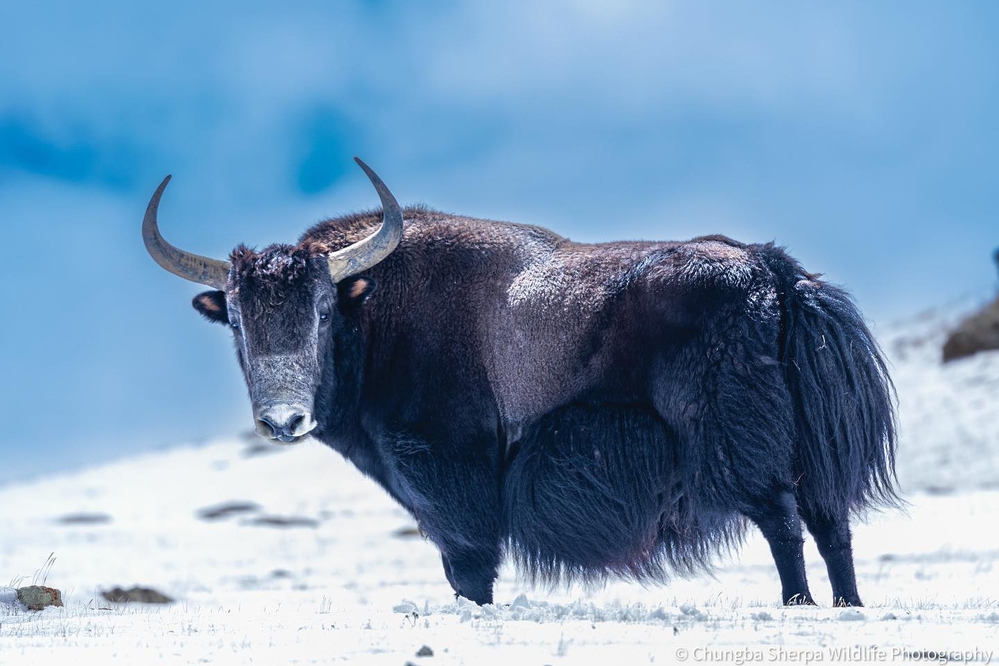 Chungba then took a close-up photo of a wild yak, in September 2022. Chungba captured a wild yak in a single frame with a clear and high-quality close-up. At that time, the photo he took was very popular.
In a conversation with him (still recorded) he reached Nepalgunj from Kathmandu in September 2022 and reached Simkot in Humla from Nepalgunj on the same day. After landing at Simkot, he spent 2 days there with his associates. He stayed there for two days to acclimatize to the temperature. He landed near the Nepal-China border by helicopter from Simkot. Stayed 2 nights at Lapcha Pass. After staying for 2 nights at an altitude of 5,100 meters, he did not find any wild yaks, he went down a few hundred meters and set up camp.
He camped there for 5 nights in the cold mountains along with his 4 other associates. He took 3 people with him from Kathmandu and two helpers from Simkot. He told that he took pictures of only 3 of the 4 yaks he saw. A wild yak is about one and a half times larger than a domesticated yak. He took pictures of 3 out of 4 yaks. He said that these yaks came to graze in the Himalayan region of Nepal and China border. Before he took the picture of the wild yak, the picture was taken in 2014 by the team of Naresh Kusi, a researcher associated with the Himalayan Wolf Project. The picture is also included in the Nepali 5 rupee note.
Chungba Sherpa took pictures of these yaks from about 4800 meters. He said that he was almost attacked while trying to take a close photo. Some believe that wild yaks come to the border villages of Nepal via Tibet to breed with the domesticated yaks of the Himalayas. Even in the Himalayan region, it is understood that the yak born from breeding between domesticated yak and wild yak gives more milk. Experts say that breeding with a wild yak, which is about one and a half times bigger than a domesticated yak, is very painful and even if the pregnancy is successful, there is a high chance of miscarriage .
The pictures of yaks taken by Chungba at an altitude of 4800 meters became very viral at that time. The National Nature Conservation Fund has placed the photos taken by Chungba in a separate place in the office premises. Similarly, every year, his pictures are pasted on the calendar on the wall of the fund. He did not say that the cost would be the same with the Yak incident. He himself has spent more than 500,000 rupees on the air fare, helicopter fee and weekday stay of Kathmandu-Nepalgunj-Simkot. He said that food, living supplies, cooking and satellite phone are also necessary for going to higher mountain areas. He said that it would take 17 days for an ordinary person to go from the place he went to. He said that wildlife photography is very risky and expensive. He suggested that anyone will not achieve success in this field easily but should continue to struggle continuously.
The first answer I gave to the new generation to enter this field was, 'You don't become a photographer as soon as you pick up a camera, you need skills.' He did wedding photography, landscape photography and asked the new generations not to make it a profession in the beginning. Stating that it will take more time to become professional in this field in Nepal, he suggested that one can move forward and achieve success by working part-time. "In Nepal, it is very difficult to spend money and earn by doing wildlife photography," he said, "When you are not working with other photography, you should take wildlife photos as a passion." After that, it is gradually established.'
He never did photography for money. He gave the money received from the photos provided to the tourism board directly to the Pokhara Bird Society. He said that the amount was provided to the students for thesis. He also said that a bank gave 2 lakh rupees from his photo to BCN to make it available to students for research. He said that he would be happy to give photo credits for the necessary photos so that future generations can learn from him. Chungba Sherpa, who also trained for wildlife photography in different places, is no longer with us. To show interest in photography to the young generation, he himself used to organize photo competitions. He was adamant when
gave him credit in a documentary made from his footage. On the day of the Tiger Day, I met him at the Aayogjit program and said, 'Brother, you put my name clearly, while others used to put it so that it was not visible even when they put the photo credit.'
My last meeting with him was at the Army Officers Club. Where he was discussing the establishment of an organization called Conservation Alliance Nepal with former Chief of Army Staff Gaurav Shamsher Jabara. I met him on the eve of establishing the organization. He is a working committee member in the organization led by Jabara.
Chungba Sherpa's role in bringing Nepal's wildlife photography to new heights will be very memorable. Also, he will always be immortal for the conservation sector. Although he is not physically present, the pictures of wild animals taken by him are decorated on the walls of various offices which will always remember him. Goodbye Chungba sir.

