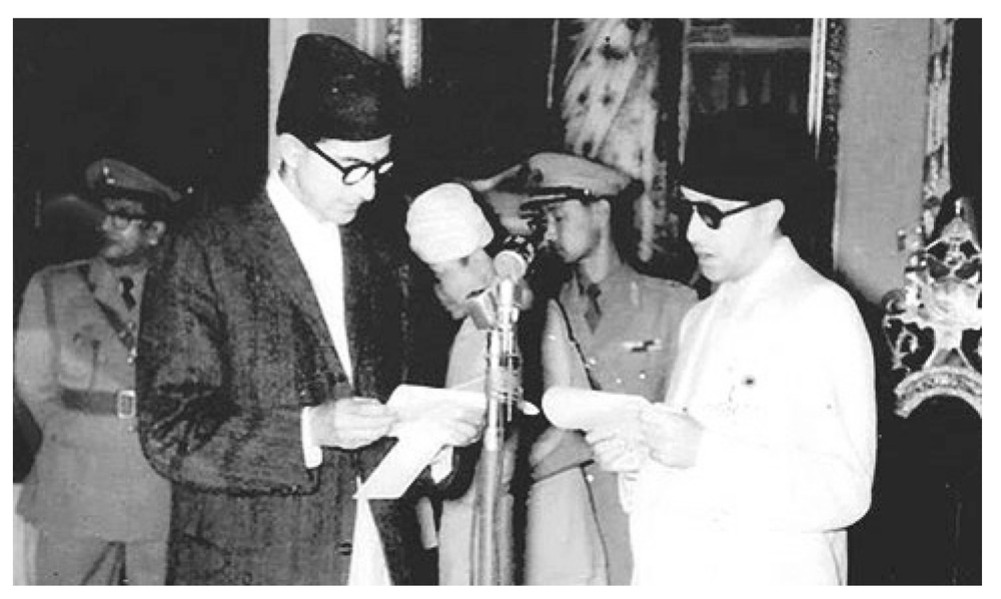
If Mahendra had accepted to live as a constitutional king, after closely observing the course of history and understanding the power struggle at that time, Nepal could have progressed a lot, the republic would not have come.
We use Google Cloud Translation Services. Google requires we provide the following disclaimer relating to use of this service:
This service may contain translations powered by Google. Google disclaims all warranties related to the translations, expressed or implied, including any warranties of accuracy, reliability, and any implied warranties of merchantability, fitness for a particular purpose, and noninfringement.
Based on the documents in the Parliament Secretariat, I wrote a book titled 'First Parliament: BP-Mahendra Confrontation'. Every year in December, there is a lot of debate about the clash between BP and Mahendra. It seems that the politics of that time and the BP-Mahendra struggle should be understood based on the process of writing the book and the additional information received after the publication of the book.
When I started writing the book, I was working in Kantipur TV. After the first Constituent Assembly was dissolved, there was confusion in the country. The Constituent Assembly was dissolved. But it was not clear what would happen next. At that time, I had a conversation with many people in Serofero about this topic.
At that time, I got to know something about the first parliament of Nepal, the Constituent Assembly that arose at that time, and the political struggle. I started visiting the library of the Parliament Secretariat to understand that time.
In 2007, the agenda of the Constituent Assembly was raised for the first time. It was said that the election of the Constituent Assembly would be held within two years after the king announced that he would move the country forward by making a constitution through Constituent Assembly elections. But the palace forced the parties to accept the election of the Parliament in 2015 without allowing the election of the Constituent Assembly.
At that time, within the Nepali Congress, Ganeshman Singh was in favor of holding elections for the Constituent Assembly, even if it was by using weapons. The palace was in no way in favor of allowing a Constituent Assembly. Because the palace was afraid, if the assembly of people's representatives was held, it could cut down the authority of the monarchy and overthrow the monarchy itself.
At that time, the Nepal Communist Party accepted the monarchy. Only after making the statement did the king agree to hold the election of parliament. In the meantime, he left for the country. He assigned his people to understand public opinion. He announced the date for the election only when it was decided that the parties would not get a majority from anywhere and could be used according to their own preferences.
This situation was covered at that time, in an official document inside the parliament. It has the signatures of both the then Speaker Krishna Prasad Bhattarai and Parliament Secretary Kulshekhar Sharma. But this document will not be seen by many people.
After flipping through a few pages of it, I found everything interesting. I carefully flipped the typewritten and punched paper and carefully read the letters written on it. I also made some news based on that. At that time I thought, a good book can be made on this subject.
Then I made a list of 2015 members of Parliament who are still alive. And among them I met and talked with leaders like Achyutaraj Regmi, Kamalraj Regmi, Maniram Shastri, Vishwabandhu Thapa, Tulsi Giri, Kamal Rana, Peshal Pokharel. And at that time, I also talked to veteran journalists Bhairav Risal and Madanmani Dixit who were reporting on the Parliament.
At that time, I didn't even have a mobile phone that could take fast photos. I had a friend, Man Bahadur Thapa. His son sent him an iPhone from America. I asked for the same and took a photo of about 2,000 pages of documents of the Parliament. I went home and zoomed in on every page and read it carefully.
After spending months reading all the documents and talking to dozens of people while writing, the manuscript of the book was ready. After all these studies and conversations, I felt that visible and invisible things are happening in politics. We speak one for public attraction. But there have been many difficult turns and twists in history.
If we look at the history, we do not find anywhere that BP and Mahendra insulted or criticized each other. While the elected Prime Minister BP was imprisoned by King Mahendra for eight years. That too without any spare part, without dispute. Despite this, BP does not seem to have criticized the king.
If you turn the pages of history, it is clear that King Mahendra used to say that the monarchy should be strengthened. While BP believed that the people should be given rights and the country should be run by public opinion. BP's understanding was that the king's job is to sit constitutionally as the head of state. But the king wanted to rule himself. Especially this was the main conflict between King Mahendra and BP.
At that time King Mahendra alone could not rule in front of BP Koirala's international fame and scholarship. That is why Mahendra embarked on the path of coup d'état to the elected Prime Minister. But King Mahendra did not tell anyone about the coup preparations. He kept this matter in his heart.
He also informed the Chief of Army Staff at that time that I was doing a coup on the day of the coup. I understand about this topic I also spoke to Vishwabandhu Thapa, Tulsi Giri. They also said that there was an assumption that the king would do a coup, but the date of the coup was uncertain.
Even when talking to other people of that time, it seems that the king had not made a coup after long preparations. This can also be inferred from the fact that Mahendra staged a coup using a second rank army general. Not only that, King Mahendra was not clear about what to do and where to go after the coup. Or it seems that he did not have a plan after the coup.
Panchayat Roadmap was made by Vishwabandhu Thapa. One day after the book came out, in a meeting with me, he said, "After the coup, the king told me that he is not my man, you will keep whoever you want." I did the coup, now you have to do it, let's find people.'
He then told that he had agreed with the king that he should make Mahendra Narayan Nidhi a minister, but when Nidhi did not agree, he made Anirudraprasad Singh a minister. There are many such facts, from which the king clearly wanted to show his authority. But it is understood that he did not have a clear plan.
Mahendra had a nature that even if he was a man, he should be agreeable. That you should accept your condition. But BP did not want to accept any of Mahendra's conditions. Despite all this, Mahendra and BP were at the same place on the issue of nationality. But they had different opinions about democracy. This was the main reason for the coup.
It was a different time then. Universities were not open in Nepal. There was no education like it is now. The level of consciousness was weak. Media was not as strong as it is today. The king was worshiped as an incarnation of God. The soil of the place where the king walked was taken and inoculated. In that society, the way BP tried to move the country forward was not a favorable environment. To some extent, even within his party, not all people agreed with BP's views.
This was the schooling of BP, who was born in India. When there was British rule. The king had a different kind of thinking and understanding. Even at the public level, there was no common understanding of what democracy is and who it is for. In that situation, the king made a coup. Therefore, interpreting the situation of that time through today's lens does not do justice to history. History should be seen through the lens of that time.
It seems that those who grew up under BP's umbrella left BP at that time and joined Mahendra's lot. That in itself seems like a strange scene. At that time, Tulsi Giri and Vishwabandhu Thapa were considered the right and left hands of BP. But they had extreme ambition. Therefore, they felt that staying in BP's party would not fulfill their ambitions. When the king showed them the position of profit, they went there. To say
, they have also said that they went there after the king said that he would return democracy after some time. Vishwabandhu Thapa told me in a conversation that he had made a mistake at that time.
In my understanding, those who left BP and went to Mahendra, they also do not seem to have understood that much. The king said that he feels that he has fulfilled his purpose by using the person as he can.
Behind all these circumstances, BP also had some weaknesses. Because BP does not have any weaknesses like normal people. The king was doing the work of calling people from his party to the palace, giving them feasts and inciting them against BP. But BP had to take that matter seriously and control it.
It seems that BP has not assessed the extent to which the king is doing the coup. Because he was preparing to visit Ramechhap and Sindhuli before the coup. At that time, BP understood that the king did not like me.
because when BP became the prime minister, he became the prime minister by accepting the condition of handing over power to Suvarna Shamser after one year. So BP was mentally ready to fulfill this condition. Looking at the political situation at that time, it seems that there was over-confidence in BP. And it was his weakness not to imagine that people within his own party would cheat!
That time is still important for Nepali politics. Because that was the moment, from where the game of instability in politics started. Which was started by King Mahendra. The big mistake of the king was to dismiss the elected government within one and a half years. That step laid the foundation for instability. The foundations of the republic were shaken and the fall of the monarchy began.
King Mahendra had a deep thought that this country is the product of our ancestors. At that time people considered him as God for various reasons. The social customs and culture of chakdi and flattery, which had flourished since the Rana period, were still deeply rooted in the royal palace.
There was no body that could question the king's working style. In that case, the king did not want anyone to be more popular than him. With the influence of this thought, he attacked the system. From the point of view of education, Mahendra was not that qualified. He was very less educated than BP. And this fact has been proven by many documents.
Looking closely at the course of history and understanding the power struggle at that time, if Mahendra had accepted to stay as a constitutional king at that time, Nepal could have progressed a lot. Republic would not come. And from the point of view of development, the country was progressing. Therefore, whatever step Mahendra had calculated at that time was wrong.