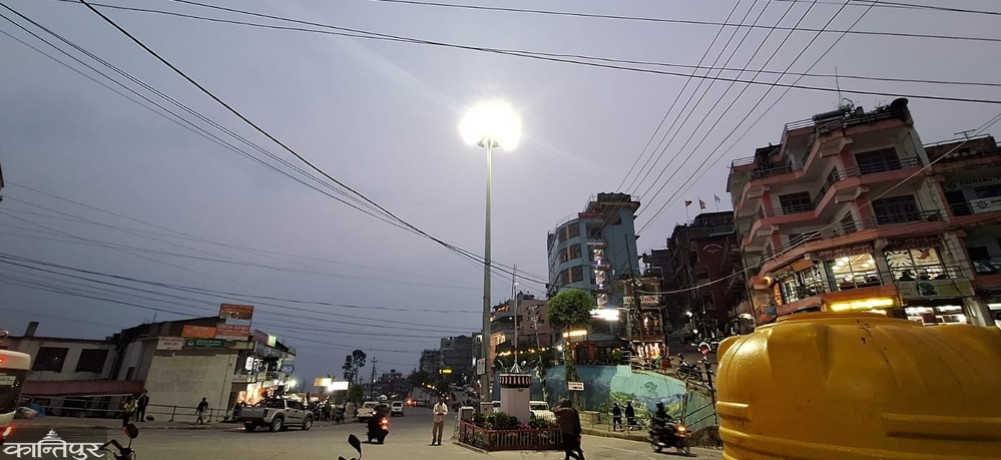
After the installation company submitted the software, Bhimeshwor Municipality will now be able to control all the smart lights that were previously operated from India.
We use Google Cloud Translation Services. Google requires we provide the following disclaimer relating to use of this service:
This service may contain translations powered by Google. Google disclaims all warranties related to the translations, expressed or implied, including any warranties of accuracy, reliability, and any implied warranties of merchantability, fitness for a particular purpose, and noninfringement.
Four years ago, the Bhimeshwor Municipality, in partnership with the Nepal Electricity Authority, installed smart street lights in the market area, including the 'Mas' light system, and all the technical aspects of the lights have been put into operation by the municipality. The company that installed them has submitted all the technical aspects of the lights, including the software, to the municipality.
After the news 'Lights Switched to India in Dolakha' was published in Kantipur on April 12, the company that installed them has submitted all the software to the municipality. A week later, the company's representative gave all the software and the municipality entrusted with turning them on and off on a schedule, said Arjun Tamang, an employee who has been looking after the street lights of the municipality. The work of installing the lights was started in 2078 BS to make Charikot a smart city and was completed in 2079 BS. 'Mas' smart street lights were installed in the main Satdobato and Pashupati Chowk of the market. The state-of-the-art street lights are 2,1600-watt mass lights with 8/8 flood lights in Satdobato and Pashupati Chowk. Similarly, 65 90-watt and 10 120-watt modern smart lights were installed.
All these have been scheduled to turn on and off at the same time. Although Suryodaya Urja Pvt. Ltd. won the bid and installed them, its control system was not provided. All its controls were purchased and brought by an Indian company. ‘The technicians of the connecting company came and checked the condition of all the lights and gave us all the systems,’ he said, ‘Now the municipality can adjust its switches.’
After the news was published, he said that the Nepal Electricity Authority’s street lighting project also inquired. Since all the lights were purchased from an Indian company, the Indian company did not agree to provide its software. The municipality has been paying more than 1.5 million rupees in electricity bills for the smart lights throughout the municipality every year. These state-of-the-art lights also have a sensor system with dimming at night. They were installed at a cost of 1.11 million rupees with 60 percent investment from the municipality and 40 percent from the Electricity Authority.