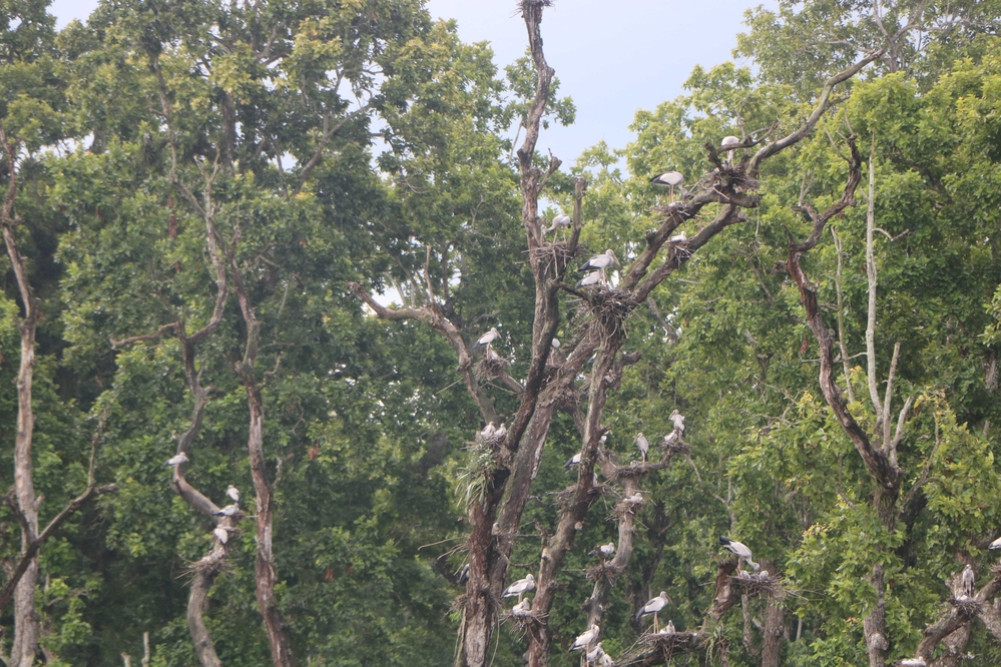
Hornbills have built 478 nests in 104 trees around the pond, and up to 10 nests have been seen in one tree.
We use Google Cloud Translation Services. Google requires we provide the following disclaimer relating to use of this service:
This service may contain translations powered by Google. Google disclaims all warranties related to the translations, expressed or implied, including any warranties of accuracy, reliability, and any implied warranties of merchantability, fitness for a particular purpose, and noninfringement.
Batulipokhari, located in Bharatpur Metropolitan City-13, has been developed as a breeding center for Ghungifor Garuda (Asian Openbill). Here Ghungiphor has carved hundreds of chicks.
Krishnahari Prasain, president of the group, said that 478 nests were made by hornets in 104 trees around this pond under the management of Batulipokhari Intermediate Community Forest Consumer Group. There are up to 10 nests in one tree .
'Gungiphore makes nests in dry trees and eats gungi and small aquatic animals,' President Prasain said, 'During our observation, only three of the 104 trees have nests in green trees, all the rest are in dry trees.'
Bird watchers and conservationists come excitedly to watch the activities of beetles during the breeding season . He said that tourist activities such as boating in the pond area were stopped during breeding season.
This area was earlier known as 'Thulo Ghol', where the water mixed with the Rapti River . But in the year 2065, a dam was constructed and converted into a pond in collaboration with Ganganagar Irrigation Project and Community Forest User Group. Now this area has become important not only for irrigation but also for biodiversity. According to
President Prasai, Siberian birds used to be seen here during the winter, but in recent years, permanent resident birds have started to appear. He said that Ghungiphor started coming here for seven years.
Hornets start making nests from March to May, flower in May and hatch chicks in August. President Prasai said that due to the habit of nesting in large flocks, other birds do not know their presence easily.
Ghungiphor used to make nests in Bisahazari Lake, but after the decay of the trees there, they started living in Batulipokhari as their new habitat. He said, 'Gungiphora nests only in dry trees, so such trees should be protected.'