The game of 30-32 has been played for decades to increase and decrease the provision of service and conditions by amending the police regulations. The government does not seem ready to put a stop to this and bring a law to establish rules, procedures and standards through the Act.
We use Google Cloud Translation Services. Google requires we provide the following disclaimer relating to use of this service:
This service may contain translations powered by Google. Google disclaims all warranties related to the translations, expressed or implied, including any warranties of accuracy, reliability, and any implied warranties of merchantability, fitness for a particular purpose, and noninfringement.
In the first week of August, the government tried to amend the police regulations to extend the tenure of some high-ranking police officers who were going to compulsory retirement due to their 30-year service period. However, contrary to the order of the Supreme Court and because of the objectionable and legal questions and criticism of the police bill that has already been registered in the parliament, the government withdrew from its own efforts.
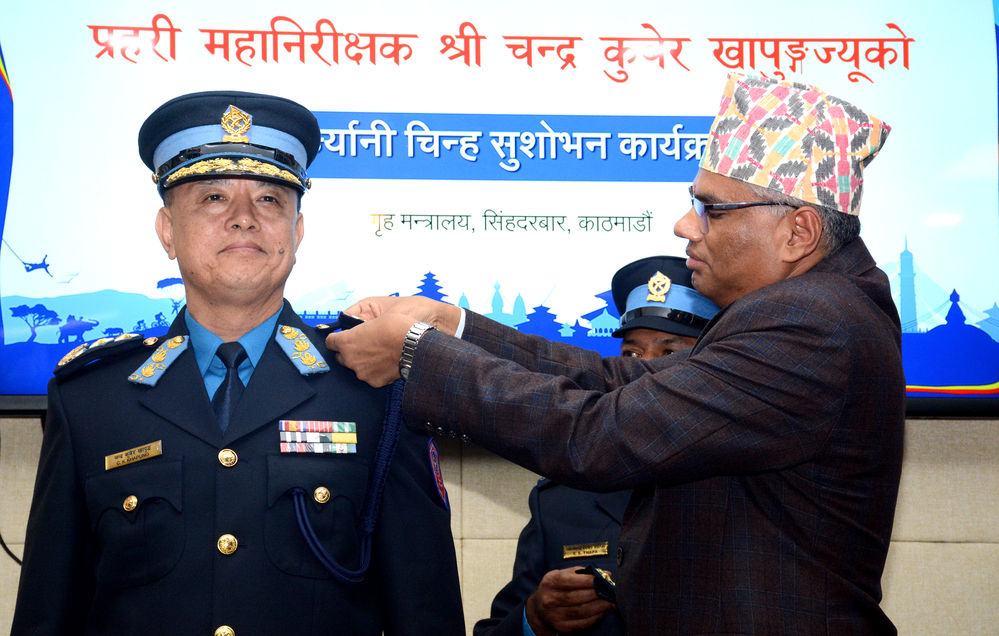
And, the cabinet meeting on 13 August left the way of amending the regulations and promoted senior AIG Chandra Kuber Khapung to IGP through the current legal process.
Based on the same decision of the Cabinet, IGP Deepak Thapa and AIG Sudeep Giri and Tek Bahadur Tamang retired on August 19 (Thursday). Thapa became IGP in Chait 2081 and remained in leadership for about 5 and a half months.
According to the Police Regulations 2071, there are three arrangements for retirement- Age, Tenure and Length of Service . Thapa, who joined the service in Chait 2052, retired at the age of 54 as per the provisions of the service period. Khapung went to the police headquarters and took charge from Thursday after Home Secretary Gokarnamani Duwadi handed over the badge of IGP. He will also remain in leadership for 68 days till 27 October 2081. In other government agencies, although only the term of office and age to retire are maintained, due to the manipulation of power and the government's arbitrary service period limit to use the 'police power' according to its own convenience, there is a compulsion to retire in a short time .
In the Police Bill currently under consideration in the Parliament, provision has been made for retirement only with tenure and age . However, the bill is not likely to be easily passed by the parliament. As a result, the 30-year provision is changing the leadership in a short period of time, while those who came to the leadership have not been able to make policy, administrative and structural reforms in matters of long-term importance .
Due to the 30-year game, 7 IGPs of the police have retired in less than 1 year. In particular, the government's game to destabilize the police organization by using scissors in the regulations is not only now, the unethical filth of the service period has started since 2049/50. which is still maintained .
After 2046, parties in government-in-power-power are causing instability by arbitrarily revising the rules. The current Congress President Sher Bahadur Deuba appears to be at the forefront of this. Even now, he has been seen as a 'decisive factor' when he was promoted to the higher level of the police. 33 years ago when he was the home minister in the Girija Prasad Koirala led government, Deuba planted the 'police interference and 30-year service period scam', now it is in the midst of extreme factionalism and controversy. Since the provisions of the service and conditions are in the regulation, the government has been "amending it according to its own needs".
Ruling on the petition filed by the police officers in 2070 against the provisions of the previous regulation which was made to send them to retirement with a service period, the Supreme Court ordered the government not to make arbitrary decisions in the future and to regulate the provisions of service and conditions only by making laws through the legislature.
The then AIGs Madan Khadka along with 11 officers demanding that they not be retired from their 30-year service period, along with the decision of the writ petition, since then the regulations have been changed and the work of reducing the period has not been done. The Constitutional Bench of the then Chief Justice Kalyan Shrestha and Judges Sushila Karki, Vaidyanath Upadhyay, Tarkaraj Bhatt and Gyanendra Bahadur Karki decided with a mandate.
The Supreme Court, in its decision on 20 Chait 2070, banned the amendment of the regulations by the Council of Ministers to amend the provisions related to the service and conditions of the Nepal Police . After that, there was no decision to change the IGP from the regulations, but the government and the police officers in the leadership kept trying.
000
The then administrator Keshavraj Rajbhandari filed a writ in the Supreme Court against the decision of the government formed after the political change of 2046 to impose a 30-year limit on civil servants and send them to retirement. In the verdict on his writ, the Supreme Court also canceled the 30-year service period as arbitrary, and Bhandari was reinstated in his position. Later he retired as Chief Secretary and became the Chief Election Commissioner.
In 2069, 11 police officers including AIG also showed this example and demanded cancellation of service period . The decision was not made as per the demand, but the Supreme Court stopped the arbitrary modification of the regulations. Currently there is no limit on service period in civil service . Recently, both the Civil and Police Bills are under consideration in the Parliament .
33 years ago the seeds of bethiti were planted
In order to understand the game of making a suitable IGP by amending the rules in the police, one has to remember the incident 33 years ago . After the general election of 2048, Girija Prasad Koirala was the Prime Minister and Sher Bahadur Deuba was the Home Minister. At that time, Ratnashamsher Rana was the IGP . After one year of the formation of the government, the Koirala government amended the rules and sent Rana on retirement with a '30-year service period'.
Rana was retired and Motilal Bohra of Sudurpaschim Achham was made IGP . The special game of making him IGP was played by then Home Minister Deuba. According to a former officer who understood politics in the police force at that time, Deuba sent Rana to retirement and made Bohra IGP while he was the home minister.
To what extent was the 'arbitrary' of the government, as soon as Rana was removed and Bohra became IGP, the police regulations were amended to increase the tenure of Bohra and the 30-year service period was removed .
According to a former police officer who was also knowledgeable at that time, the then IGP Rana was preparing for his son's marriage. "Invitation cards" were distributed from the IGP residence while preparations were being made for the marriage. It is said that he died due to a 'heart attack' shortly after the government 'suddenly' retired him. "According to the law, method and established tradition, the IGP's term of office was 2 years left and the effect of the then government's sudden retirement caused an unusual change in his behavior. It was a matter of debate in the public circle at that time whether it was the decision to send him to retire after the end of his term as a reason for his death," said the former police officer. That is the basis of the distortions seen now.' After retirement, Bohra became active in Congress politics.
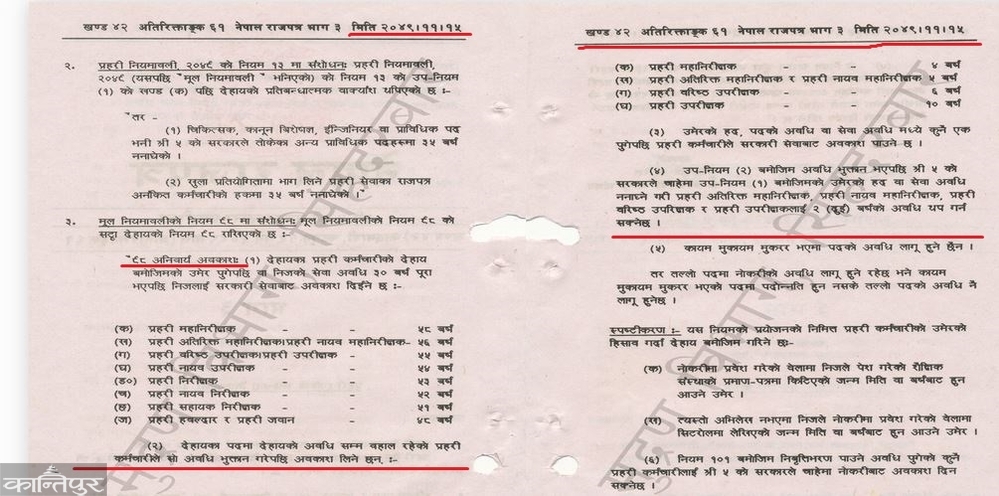
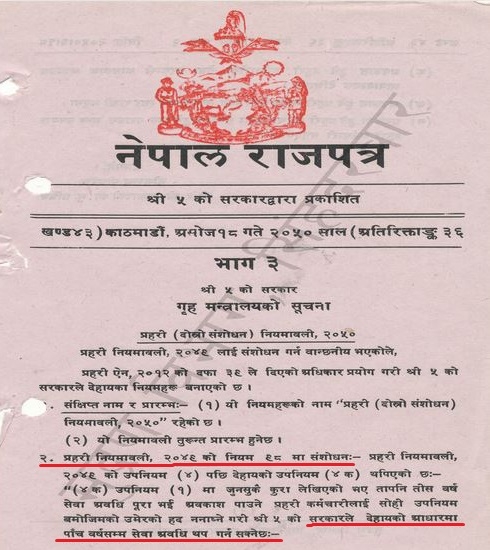
Before that, the police regulation 2033 provided for retirement based only on age and tenure. In the first week of January 2049, the regulations were amended and the service period was fixed at 30 years. Due to that arrangement, Rana, who became IGP in June 2047, was sent on retirement and Bohra was made IGP in February 2049. After Bohra became IGP, on 15 February 2049, the service period remained 30 years, and then, in the case of officers above SSP, the provision was made that the government could extend it by 2 years. An administrator at that time recalls that the proposal to amend the regulations was taken by the then Home Minister Deuba.
"Bohraji was close to the Congress on the basis of faith, Ranaji was also accused of being 'loyal to the Panchayat', Ranaji was also criticized for other personal reasons," recalls the former administrator, "However, when he had to be removed, he was removed with a term of service, the seeds of discord in the police were the same, and now the same issue has only flourished".
When Rana was IGP, the government issued a new police regulation on 6 January 2049 and fixed the age of IGP at 60 years.
made from ASI to AIG respectively from 51 years to 59 years . Similarly, if the government wants, the service period from SP to AIG can be extended by 2 years for the first time and one year for the second time without exceeding the age limit . 2 months later, on 15 February, Rana was dismissed by the government with a 30-year service period in the police force. At that time, from ASI to AIG, the age limit was 51 to 56 years and IGP was 58 years.
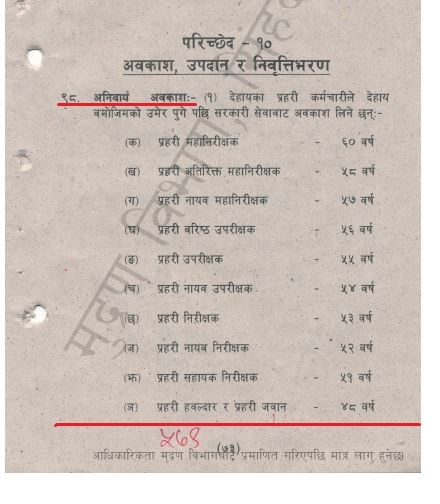
as well as the service period is maintained at 30 years for all . With this arrangement, Rana was sent to retirement. 7 months after that, in October 2050, by removing the provision of the previous 30-year service period, if the government wishes, the age limit at the SP level and above is not increased, and an arrangement was made to extend the period up to 5 years . The main reason for this was to keep Bohra as IGP.
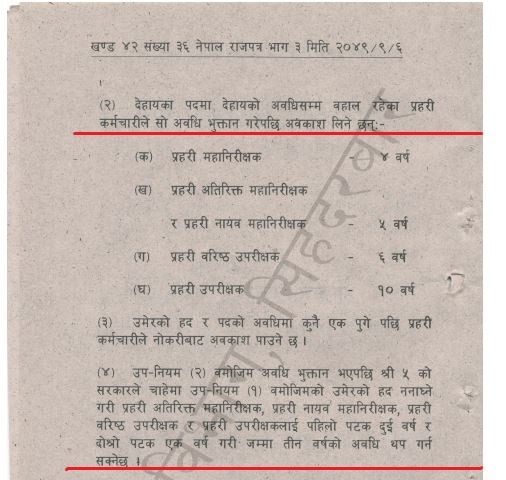
At that time, the police regulation 2033 was amended and on 15 February 2049, the service period was fixed at 30 years, and a provision was made that if the government wanted, '2 years can be extended in the case of high-ranking officers and 1 year for the second time' . When the Police Regulations 2033 were amended in 2034, 2036, 2037 and 2038, there was no subject of service period .
Bohra spent 4 years as IGP under the revised system. After him, Achyutakrishna Kharel became IGP in February 2053. However, the game of taking the "friendly" officers to arbitrary leadership did not stop . The government with Lokendra Bahadur Chand as Prime Minister from RPP and Bamdev Gautam as Home Minister from UML removed Kharel within 36 days of becoming IGP and transferred him to the National Investigation Department . In his place, AIG Dhruv Bahadur Pradhan was promoted and made IGP. In this way, the ``inside matter'' of unnatural changes is being tried to open the smuggling line and to make it a tool to win the election by abusing the police power Allegations were raised immediately.
The government of that time was accused of "opening the gold smuggling line from the airport" even today. Meanwhile, Kharel went to the Supreme Court against the government's decision to remove him as IGP. The Supreme Court refused to grant an interim order . As the case dragged on, the government changed. In October 2054, Surya Bahadur Thapa of RPP became the prime minister after the fall of the Chand government. Wise Tamang came as Home Minister . Next month, Khum Bahadur Khadka Home Minister from Congress will be reconstituted as the government. became .
Then by reversing the decision made by the previous government, the Thapa Cabinet transferred the IGP Pradhan to the adviser of the Prime Minister and reinstated Kharel . After some time, Pradhan resigned as security advisor. Later he joined the politics of RPP . Pradhan is still a member of the House of Representatives from RPP . Since Kharel was reinstated, there was no "30-year provision" in the police force for about 10 years.
The then IGP Shyambhakt Thapa and AIG Rajendra Bahadur Singh were under suspension for suppressing the public movement of 2062/63. Singh, who was on the roll of IGP after Thapa, was removed at the same time as the suspension by amending the rules and imposing a service period. Then Omvikram Rana became IGP. At that time, Girijaprasad Koirala was the Prime Minister and Krishna Prasad Sitaula was the Home Minister. After the first election of the Constituent Assembly, Pushpa Kamal Dahal of Maoist became the Prime Minister and UML leader Bamdev Gautam became the Home Minister. At the same time, by amending the regulations, the government removed the provision that the tenure of the IGP could be extended by 2 years, and Rana retired.
Hem Bahadur Gurung became IGP after him. Gurung had already stayed in the service by extending the period according to the provision that after completing 30 years if the government wants, it can be extended by 2 years. In the meantime, after Rana retired from service, the government made him IGP for about 5 months, taking advantage of it. He retired due to age limit of 58 years.
Before Omvikram Rana retired, the rules were amended . By amending the previous provision, the government maintained a 30-year service period.
Rameshchand Thakuri, who became the IGP after Gurung, got involved in the Sudan scam and was dragged to the Prime Minister's office. Rabindra Pratap Shah was made IGP in his place. Shah also retired after 30 years. Chand, who was taken to the Prime Minister's security advisor, was charged with corruption. Later, before the retirement of IGP Shah, his associates along with Madan Khadka went to the Supreme Court against the provision of retirement from the service period of 11 officers. Shortly before retirement in 2069 they When it went to the Supreme Court, the Supreme Court in Chait 2070 ordered the government not to change the provisions of the service and conditions from the regulations. 12 years ago, the Supreme Court called the decision to change the provisions of service and conditions from the
regulation as a 'contradiction and an arbitrary decision of the government' and ordered the Cabinet not to amend the retirement issue. On the other hand, the power of the security forces was misused as a weapon to fulfill political interests by bringing in people who were favorable to the police chief. So much so, since 2049, the police regulations have been amended at least 30 times. More than half of the amendments are only related to the service and conditions of the police.
In this way, the Supreme Court has commented that it is not a good thing that the writs regarding the service period are filed time and time again and the case has to be dismissed by the court.
'Considering the retirement provision mentioned in Rule 98(1) of the Police Regulations, 2049, even though cases have been decided in this court time and again in relation to the provision in the said rule, the process of challenging and suing the provisions of the same Rule 98(1) does not seem to be stopped every time under various pretexts . It is not a good thing to create a situation where the same case is given several times and decisions have to be made by different benches time and again. In this way, it was seen that the provisions related to leave were changed time and time again in the regulations. The thought of operating the administration mechanism of the service of a sensitive organ related to peace and security under the authority of political or administrative discretion in an ad hoc and opportunistic manner is simply unacceptable. It should not be tampered with. From entry to police service to character development and retirement from service, the necessary efforts should be made without delay to clearly define, ensure and clarify the situation and clear the confusion.
decision further states, "In the background of the repeated decisions of this court, to provide certainty in the said provision and to avoid further uncertainty through the process of amending the rules, the provision of retirement from service when setting the period of service for retirement or retiring from service due to age limit" Even so, instead of taking the route of amending the rules, it has issued a directive order in the name of the opposing Nepal government to make the necessary provisions in the Police Act itself.
The court commented that there is a continuous tendency to try to amend or change the rules related to leave.
Kuber Singh Rana became IGP after Shah's retirement. From the service period, he also retired and became Upendrakant Aryal IGP in the last week of November 2070. Even at that time, the government had tried to extend the period of IGP Aryal, who was going to retire after completing his service.
After Aryal retired from service, the then DIGs Navraj Silwal, Prakash Aryal, Jai Bahadur Chand and Bam Bahadur Bhandari were in competition for IGP . At that time, Maoist leader Pushpa Kamal Dahal was the Prime Minister and Congress leader Bimalendra Nidhi was the Home Minister. Dahal tried to extend Aryal's tenure by revising the police regulations after the power partner parties failed to agree on the selection of IGP. Dahal called the then Attorney General Raman Shrestha and Chief Secretary Somlal Subedi in the working room and revised the regulations contrary to the Supreme Court's order. He instructed to prepare a proposal to extend the period of the Aryal .
According to Senior Advocate Shrestha, who was also the Attorney General at the time, DIG Aryal was ahead and ranked second in performance evaluation. Even though Silwal was ranked first, the Congress tried to make Chand, who was ranked third, as IGP.
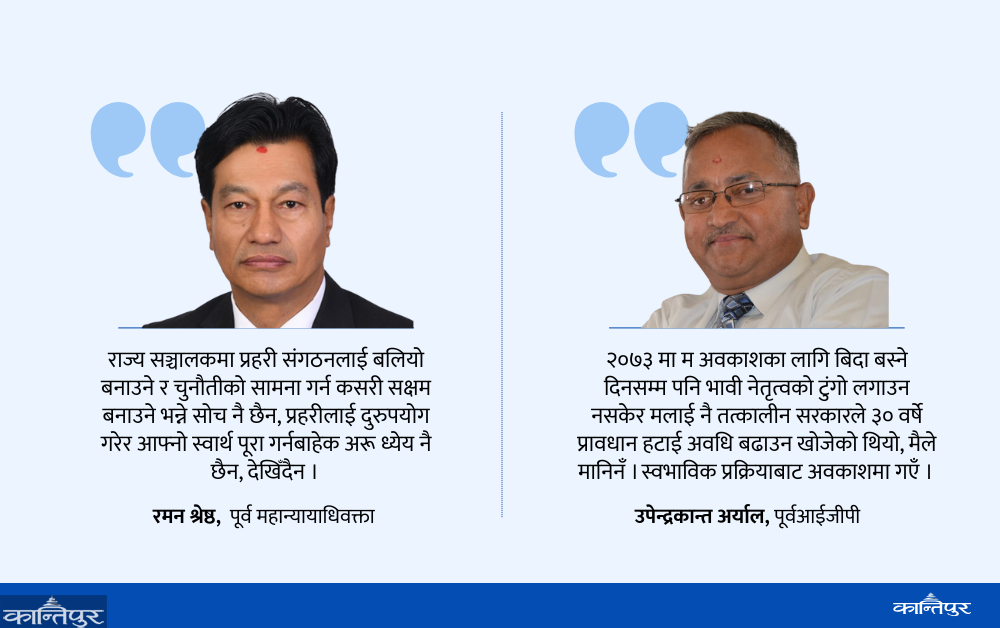
"Congress was reluctant to make the person who was ahead in the performance evaluation as IGP, the government did not like it after Silwal, who was ranked first, also went to court," he says, "Later, Chand, who was ranked third, was promoted to IGP, but after the court stopped it, on the last day, the government decided to extend the tenure of the outgoing IGP, and the government was engaged in discussions about that, and the draft was already prepared during that discussion." Shrestha adds, "Finally, this matter made the issue of police promotion so complicated that neither the official appointed by the government could be appointed as IGP, nor was a new appointment made. After all, IGP Aryal retired after giving the responsibility to hospital doctor Dinesh Pokhre." "The provision of the service period in the police is brought to the leadership rather than the needs of the nation, it has forced the experienced officers to go home at an early age," says Shrestha, "The state administration has no idea how to strengthen the police organization and enable it to face challenges, it does not seem to have any other goal than to fulfill its own interests by abusing the police." do . "I was in the retirement deal, the next IGP was not decided, because the government is in a coalition, they must have had their own choice on who to make the police chief," says former IGP Aryal, "On the day of my retirement and even before that, the Prime Minister (Pushpakmal Dahal) is not going to decide on the future leadership and is going to call him to the office to extend your term. I told him not to extend the period because he wanted to, meanwhile he was called from the President's office . The Prime Minister left by instructing the Chief Secretary that 'I left, after completing all the procedures and making a proposal to submit the file to the Council of Ministers to extend the period of IGP', but I did not agree to this, the nobleman who saw and heard the events of that day is still there.' After the court ordered not to execute the decision, the dispute went to litigation. Chand's appointment was stopped, at that time Dinesh Chandra Pokharel, a doctor (Technical AIG) of Police Hospital was made Acting IGP until further decision. Later, Prakash Aryal, who was ranked second on the basis of performance evaluation, became the IGP .
After him, Sarvendra Khanal, Thakur Prasad Gyawali, Shailesh Thapa Chhetri, Dheeraj Pratap Singh, Basant Kunwar and now Deepak Thapa have retired from service. However, the government's attention is still slow to put a stop to the 30-32 game that has been going on for decades and bring a law to establish rules, methods and standards in the law.

