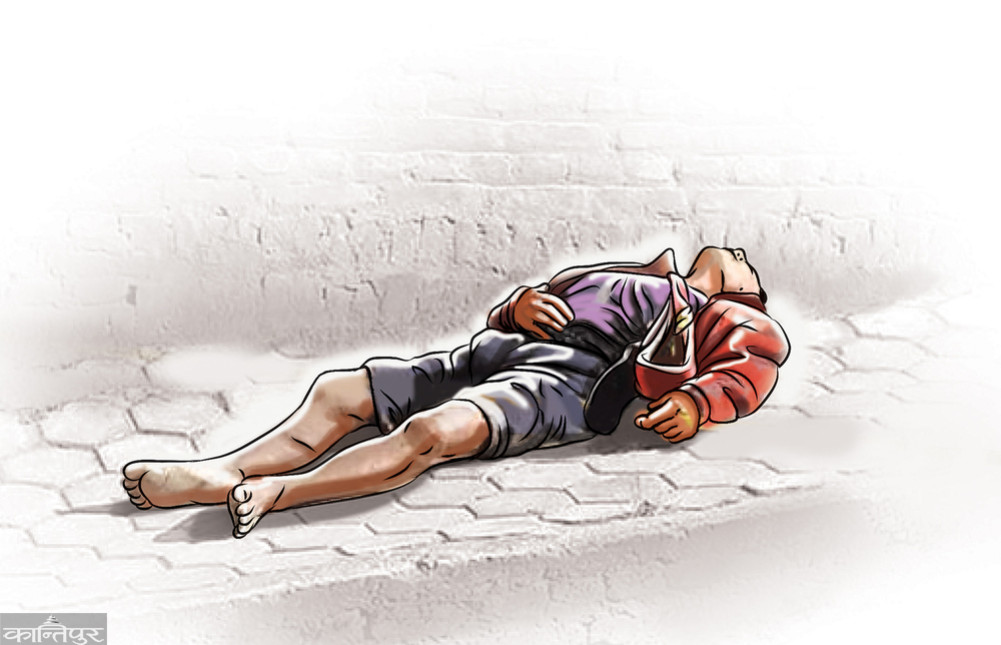
Although it is estimated that there are more than 5 million Nepalis working in India, no one has official statistics. Relatives of the victims say that as the number of killings and disappearances of Nepali workers in India continues to increase, the necessary initiatives of stakeholders for safety and justice have not been reached.
We use Google Cloud Translation Services. Google requires we provide the following disclaimer relating to use of this service:
This service may contain translations powered by Google. Google disclaims all warranties related to the translations, expressed or implied, including any warranties of accuracy, reliability, and any implied warranties of merchantability, fitness for a particular purpose, and noninfringement.
21-year-old Deepak Basnet from Birendranagar Municipality-14 Sotkhola in Surkhet dropped out of school and went to India in search of work to support his family. Along with him, there was another Nepali who was working in road construction at a place called Jummamod under Chaumal district of Uttarakhand. About three months ago, Deepak and his friend disappeared on the same day 4 months ago.
While the body of his friend was found, Deepak is still missing. According to Keshar Basnet, Deepak's father, he went to India from Surkhet on 3rd Baisakh to find a job. Deepak, who was in contact with the family for a few days after reaching there, has since gone missing.
It was said that he reached India and started working on the roadline. There were other Nepalis with him. Even the person who took him from Nepal saying that he will give him a job is not in contact with us now," Deepak's father Keshar said, "I have done a lot of searching with the help of my relatives in India. His friends don't give correct information.'
Keshar suspected that Deepak's friends did not give correct information and that the person who took them to work did not come in contact and made him disappear by some conspiracy. Keshar, whose financial situation is weak, has a son and a daughter. He said that his daughter is married and he has not been able to take care of his son since his disappearance.
'Daughter got married 11 years ago . The support of old age was that son. "There is no emergency yet," he said, "I can't work in my old age." I am asking my son's friends to tell the truth about what happened. But they don't give any information.'
He said that he is not in a condition to go to India alone to look for his son as he is also unwell. "We have heard that the body of another Nepali who was missing along with my son has been found. Deepak is still missing. It is not a common occurrence for one person to be found dead and another young man to be missing for four months," he said. "My relatives searched in many places. They are also requesting the police and administration there. We have also tried to convey the news to the Nepali Embassy. We could not find the way to get there.'
Last week, the body of 25-year-old Santosh Thapa of Kailali was found on the bank of a canal in Lahari village of Talbandi Sabo region under Punjab state of India. According to Lalita Malati Singh, a Nepalese journalist based in India, although it was initially suspected to be a road accident, the police and the deceased's family have claimed that it was a murder after the post-mortem showed sharp weapon injuries on the back of the knee and on the head.
Santosh, who has been running a dhaba (hotel) in Lahari village for a long time, was also found near the spot where the dead body was found. The incident looks like a fake, as if it was a road accident,' she said, 'It was as if the body had been killed with a sharp weapon and thrown on the bank of the canal . The motorcycle was also left to look like an accident.' She said that she was informed that the Indian police was investigating the incident.
Three people from the same family of Gauriganga Municipality-1 of Kailali who were working as domestic workers in the city of Meerut, Uttar Pradesh, India, were found dead mysteriously on 17th January 2080 . According to Double Diakoti, chairman of Gauriganga Municipality-1, 35-year-old Channe Bhul, his wife Kumari Bhul and 5-year-old daughter Anjali Bhul were found dead while sleeping. According to him, relatives went from Kailali and brought the dead body to Nepal directly from the place of the incident without doing the post-mortem.
"Nildam was seen on the bodies of the deceased, even though the incident was said to be due to normal suffocation, there was a lot of doubt about it," Ward President Diakoti said, "The incident is very suspicious." The victim had injuries and wounds all over his body, and his mouth was also bent.' According to
Diakoti, that family was living on the top floor of a house in Meerut. Locals have suspected that his moneylender, who is involved in illegal trade, may have killed him because of the fear of getting the information out. "Since the incident happened in India, the truth could not be discovered," Diakoti said, "If it happened in our own country, the truth would have come out." He said that even though cases of Nepalese deaths are heard from time to time in India, nothing has been done about action and compensation.
According to the Kailali Police, since the incident happened in India, the investigation is the responsibility of that country, but if the family or related agencies take the necessary steps, some steps could be taken through international cooperation. But after the family returned to Nepal with the dead body without making a formal complaint in India, that was no longer a possibility . Their economic condition was better than others in the village who had been working there for a long time. Bhool couple used to visit the house from time to time.
About a month ago, according to him, Kailali's Tikapur Municipality-1 30-year-old Ganesh Thapa was found dead under mysterious circumstances in the Marthalli area of Bangalore in the Indian state of Karnataka. Ganesh, who left home on 21st of June due to employment, reached his place of work on 24th. On the afternoon of May 25, the news of his death suddenly reached the family.
On the second day of reaching India, Ganesh's body was found in a burnt state with injury marks on his body. The family is claiming that the death of Ganesha, who came to India after promising to manage everything for the family, is suspicious. Kalpana Thapa, sister of the deceased Ganesh, said that the news of his brother's death was reported to him by his friends and the Nepali Embassy in New Delhi was not interested despite repeated requests to help them as they suspected murder.
'The news of the death of my brother came on the third day of reaching India. The family was overwhelmed by the unexpected news. We contacted the Nepali Embassy in India after finding out various means," said Kalpana, "I also spoke to the Nepali Ambassador to India, Shankar Prasad Sharma, suspecting that my brother was murdered. He got SP to talk . The SP is giving an answer that can be discussed further only after the forensic report comes.
He complains that the embassy did not care when he requested to watch the CCTV footage of the incident and help file a complaint against the suspected person. Now the hope of getting justice is dead. The only brother of us two sisters used to say that he would earn some money and get married. "All dreams come true in India," she said. According to
journalist Singh, Ganesh's family has demanded justice claiming that he was murdered. The person who invited Ganesha to India was his brother-in-law. The family of the deceased also suspected that Nepalis might be involved in the incident. So far, it is not clear who the culprit is," she said. "We are making a special request to the Karnataka Police to conduct an impartial investigation into the incident and bring the culprit to justice. It is necessary for the embassy to pay attention to this serious incident and try to bring justice to the deceased.'
According to him, every day 3/4 people go missing and at least 5 Nepalis are killed every week from different states of India. We are working in collaboration with some Indian media that have networks across India. Every day there are news of killing and disappearance of Nepalis. But no government agency has any data on how many are killed and how many are missing," she said. Every day here, Nepalis are killed and disappeared.'
Journalist Malati, who studied journalism in India and lives in Mumbai's Borivali, said that she has closely observed more than 200 cases of killing and disappearance of Nepali citizens in India in her 5 years of active journalism.
'I reported the case of about 200 Nepalis who disappeared, were killed and died due to other reasons . "I have not seen even one percent of them getting justice," she said, "due to weak family background, financial situation, the families of the victims do not have access to the Indian police and administration. For fear of losing their jobs, other Nepalis cannot even speak.
She said that most of the missing and murdered people in India are illiterate and those with poor economic conditions. She said that in some incidents, Nepalis are also involved. She said that there are many Nepali workers in Maharashtra, Karnataka, Delhi and other cities of India.
'Many of those working in India are from Far West and Karnali. "Nepali workers are found in every street here," she said, "Many victims' families contact us hoping to get justice." We will also inform the Nepali Embassy . But the embassy is not very interested in the matter of migrants.'
Although it is estimated that there are more than 5 million Nepalis working in India, no one has the official data yet, said Yuvraj Neupane, president of the United Nepali Federation of India. He said that the Federation is facilitating the incidents of Nepali citizens who are known to be victims.
'The United Nepali Federation is a non-political organization working in India for 48 years. We have tried a lot to get the data of how many Nepalis are in India. We must have made dozens of delegations with the Nepali government and the embassy regarding the problems of the Nepalis here,'' President Neupane said, 'None of the Nepali government, the embassy seems to be concerned about the Nepali people working in India.' According to him, there are more than 600,000 people from Far West and Karnali in connection with various jobs in Maharashtra alone.
Consul of the Nepali Embassy in Delhi SSP Prakash Malla of the Nepal Police says that information about criminal incidents involving Nepal in India comes from various channels. He said that information about the incidents comes from the victims themselves, the families of the victims or various associations/organizations of expatriate Nepalis in India.
'There is no question of us investigating the case in another country, we will coordinate with the police of the relevant state when we receive such information,' he said, 'We will continue to make sure that there is a thorough investigation of the case, and that the Nepalis who are in difficulty get justice.' He said that since it takes time to reach the relevant police office through the diplomatic channel through the Ministry of Foreign Affairs, contact has been established with all possible relevant police offices to investigate the case.
According to the 2019 report prepared by the International Organization for Migration (IOM), about 30 to 40 million Nepali workers are working in India. Although there are a large number of Nepali workers in India, due to the open border and informal labor structure, it is not possible to keep accurate statistics. Nepal-India open border has made it easy for Nepalese to go to India without passport or work permit, so Nepalis are employed in domestic work, building construction, hotel, agriculture and other informal sectors. Nepalis working in India are not included in the data of Foreign Employment Department even within the legal standards of labor protection determined by the Government of Nepal.
Even though they go to India for other work including treatment and shopping, the majority of Nepalis who cross the border go for employment. Every day hundreds of Nepalis go to India from various districts of Far West in search of employment. The residents of Far West and Karnali go to India for employment from Gaddachouki of Kanchanpur, Gauriphanta of Kailali, Jhulaghat of Baitadi, Khalanga of Darchula, Rupaidia of Banke among the major border crossings of Far West connected with India.
According to District Administration Office Kailali, daily about 2 to 400 Nepali people go to India from Trinagar (Gauriphanta) border only. Likewise, according to the locals of the border area, daily 8 More than 100 have entered India from the Nepali border.