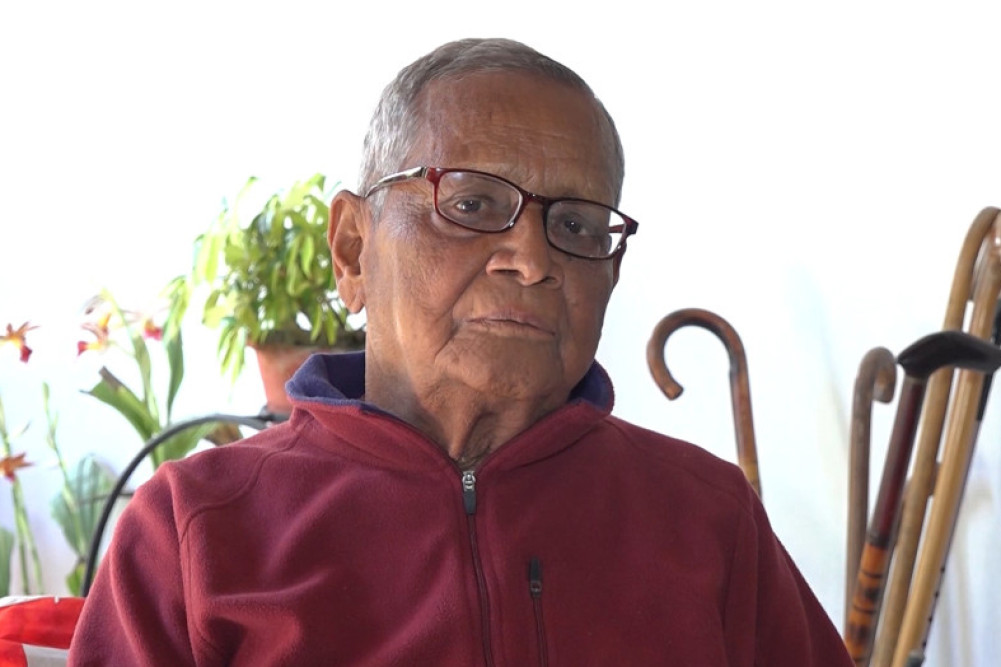
Conversation between Devendra Raj Pandey and Kishor Dahal on 5 Ashoj 2080:We are conscious citizens. We are aware of our rights. We have political awareness. We want freedom. For that, there is no alternative to a democratic system. Therefore, we must work to strengthen the democratic system itself.
We use Google Cloud Translation Services. Google requires we provide the following disclaimer relating to use of this service:
This service may contain translations powered by Google. Google disclaims all warranties related to the translations, expressed or implied, including any warranties of accuracy, reliability, and any implied warranties of merchantability, fitness for a particular purpose, and noninfringement.
In 2079, even as the government was functioning following the elections to the House of Representatives and Provincial Assemblies, there was a sense of suffocation among citizens. The parties had become arbitrary, and the citizens, disillusioned. In a situation where the country seemed to be seeking a movement, we had several conversations with Devendra Raj Pandey, a leader of the citizens’ movement. The plan was to record his interviews on various topics and, if possible, publish them as a book. However, for various reasons, significant progress could not be made in that direction. Pandey passed away last Friday.
The Gen-Z movement on 23 and 24 Bhadra brought about a sweeping change in the situation. Many topics from our conversations have become irrelevant. As a result, many questions and answers from even a single interview have been omitted here. Nevertheless, the possibility of a street movement arising at any time over political issues remains alive in a democracy. This interview may help to clarify the distance between public dissatisfaction and protest. Presented here, is an edited excerpt from a conversation between Devendra Raj Pandey and Kishor Dahal on 5 Ashoj 2080:
You have experience working in the Panchayat-era administration, serving as a minister, and leading the citizens’ movement. Do you feel the country is running properly at this time? What problems do you notice most?
Nepal’s leaders, political officeholders, civil servants, teachers, to some extent upper-level students, and somewhat 'vocal' citizens all belong to the same class. No matter how much conflict appears on the surface, because they are of the same class, their interests are the same. They work, directly or indirectly, for the same interests. In such a situation, the question arises—what about the people’s class? Who, among those we call the people, looks after their rights and interests? No one does.
The people can also be classified. There are the cunning ones, those involved in parties and benefiting from them. I am not referring to them. They may number a few hundred thousand. The rest concerns millions. Our brothers and sisters have gone abroad. Will they stay there or return? There is a vacuum regarding who will care about them. This is a frustrating issue.
Leaders are aware of this situation. But is it a 'defeatist mentality' that prevails? 'Nothing can be done by me, this is just how it is now' —is that what they think? They too have heard the daily news of Nepal being drained into the Gulf. But they make no effort to address it. Is there such a state? There are various groups and communities within the state, and there is conflict among them. It is the responsibility of the state to manage them through policy-making, administrative systems, and the culture of the state.
There is no mechanism to do such work. We made a constitution, but I do not see it accomplishing anything. There is neither leadership, nor values, norms, and systems. And it seems no one has the answer. In such a situation, everyone raises their own issues from their own sectors. Then, trying to coordinate and say, “This is the way forward,” or to understand it, becomes difficult.
Politics is in its own place. There is a National Planning Commission. They say they make plans. What kind of people are there, I do not know. In our time, there were experts. Now I hear there are politicians. Shouldn’t something come out of there? I see nothing anywhere. I do not know what it even does.
Similarly, all civil servants are of the same class. Because there is no distinction among them. There is no conflict either. But there should be conflict. In the Panchayat era, there was conflict. There was conflict between those who wanted to do good and those who wanted to benefit from the status quo. Nowadays, you do not even hear of conflict. We have experienced all kinds of chief secretaries. Now, people race to become chief secretary, they curry favor with the parties. How can such people work independently and fearlessly? This is why I say the bureaucracy has deteriorated more than the politicians.
The chief secretary also sits in the Council of Ministers, as cabinet secretary. His job is not just to record the decisions of the Council of Ministers. What he says may not be implemented, but he can express dissent. He can say that something does not align with the law, policy, rules, history, and culture. Is there anyone who says such things now? The country is diseased, and even the physician supposed to cure it is sick—this is the situation. Politics, administration, or the state structure—all have become diseased.
There is no need to even mention the courts. The 2047 constitution had some fundamental provisions. The most important was the Constitutional Council. The Council, including the Prime Minister, the leader of the opposition, and the Chief Justice, was to recommend appointments. Because, it was believed that this would make it 'neutral'. The person recommended would be of the country, not of any particular party, a national figure. But now, there is power-sharing. The Constitutional Council has been reduced to this.
The 2047 constitution retained the Commission for the Investigation of Abuse of Authority (CIAA). The CIAA existed even during the Panchayat era. At that time, I was also in the cabinet. I was not satisfied with the continuation of the CIAA in the 2047 constitution. But I could not oppose it either. My dissatisfaction was because it was a 'fly-swatting' institution. Since such an institution existed during the Panchayat, I felt it was not appropriate to continue it and work in the same way. Rather, the parliament should have been strengthened, and the executive should have worked under parliamentary oversight. But those were my personal concerns. The CIAA was retained. What has become of the CIAA now? People there have taken bribes, people there have become politicians.
At that time, there was an attempt to do some good. But the situation has deteriorated everywhere. At first, I was surprised by this. But not anymore.
Problems are visible everywhere—in the public transportation system, education system, health system, public service delivery, and the bureaucracy. Inflation has risen to the point where incomes cannot keep up. Yet, why have citizens not been able to effectively raise their voices or protest?
It seems Maitighar Mandala is never empty. Some people come there because of their own personal problems. Others come for collective issues, like the victims of loan sharks. But political issues need to be raised, properly 'articulated' and managed.
I was involved in the 2046 movement. I was also involved in 2062/63. Regarding 2047, we did not rise up to abolish the monarchy. We said we wanted a multiparty system, and that the Panchayat system had to go. At that time, we worked together with the parties. In 2062/63, we aimed to change the structure, form, and essence of the state. It was difficult then too, but we took risks. We did many things. In one sense, it was easier. Now, those who join movements over political issues do not know what to abolish, nor what to bring in. They cannot say, “Let’s abolish the constitution.” If they do, what will they bring in? There is nothing. In fact, it is easier for royalists now, but not for democratic citizens. For royalists, it is easy—they just say the current system does not work, and that they want a king.
On the other hand, the kind of methods and working styles that exist make it difficult to unite. What does anyone understand, what objectives might they have? Again, because of the constitution, its contents, and whether or not it has been implemented, people have different views. On issues like federalism, ethnicity, and proportional representation, there is no single view. Without a single view, unity is not possible. Instead, even if it is small, there should be a mindset that we will keep working. For example, we should say we will not abandon federalism, but we will correct its distortions.
There are many problems. Don’t you sometimes feel that if you had the energy, you would take to the streets and show the power of the citizens?
One day I wrote on Twitter- I will take to the streets and throw them out. My friends were astonished to see that. It was not fake, it came from within.
Do you get such impulses repeatedly?
I do. But perhaps because I am a conscientious citizen. Then the thought also comes—what next, who to bring in? Actually, it is not about bringing someone in. It is about whom to 'support'. The system should remain as it is. Some amendments to the constitution are necessary. But the rest should remain as it is. Who will run it? I do not have the answer. Not just me, those who support new parties probably feel the same.
If you had to take to the streets now, what would your method, destination, and guidance be?
The destination is to strengthen the current system. The distortions in it must be addressed. The elements who thrive on those distortions must be defeated. We are conscientious citizens. We are aware of our rights. We have political consciousness. We want freedom. For that, there is no alternative to a democratic system. Therefore, we must work to strengthen the democratic system. We should not waver on that. That is, the system is this. We must improve it. There is no alternative to this system. It cannot be otherwise. Those who say they want a king are seeking to become subjects. In other words, saying “we want a king” means it was better when we were subjects, isn’t that what they are saying about today’s chaos? Can that ever happen?
Guidance is also an issue. Now, things have deteriorated greatly. In 2062/63, Gyanendra actually helped us. Because, he kept making things worse. That made it easier for us. The day King Birendra’s family was killed, many people began to feel that the monarchy was doomed. Similarly, even when all the foreigners went to Gyanendra and tried to persuade him until the last minute, he did not listen. That also made things easier for us. Now, it is not like that.
First, things have greatly deteriorated. Second, it is our own people who have ruined things. Back then, you could blame Gyanendra. Now, it is our own people who have ruined things. The forces we have supported and assisted have ruined things. And now, those forces are not even listening to our voices.
So how do we move forward? Time will come. It takes time. It does not happen overnight. After all, the best system developed in the course of human civilization is democracy. There have been attacks on it from time to time. Nevertheless, competitive politics, political freedom, and civil rights are the traditional pillars of democracy. On top of that, equality, justice, and inclusion must be added. Guidance should be to promote these.
The issue of method is also clear. You cannot form an organization. You cannot say so-and-so is the leader of the organization. It is collective. Even if someone plays a leading role, the main concept is collective, all citizens are equal. But there must be 'recruitment' of citizens in the movement. How to do that? You cannot specify that these and these qualifications are required. But you can include issues like democratic awareness and republican aspirations. Such people should be called in a way that inspires them. Not as big people, but all of us together, saying, “We need you.” If you call in that way, citizens will come. In this process, some bad elements may also come. You must adopt a method of leaving them aside.
On 10 Saun 2062, we never thought so many people would come. Because we were just eight or ten people sitting in a room making plans. But they came. Because, our call struck the right chord. Such a method must be developed. Now, there is not even a call to citizens. There is no clear method. It is scattered.
In 2046, it was said that a multiparty system should be introduced. In 2062/63, it was about overthrowing Gyanendra’s autocracy and establishing peace, democracy, and a republic. That is, the objective was clear. So it was easier. Now, distortions are seen everywhere. There is nothing big to overthrow as there was then. Therefore, it is difficult to clarify what to bring and what to throw out. How difficult is it to raise a movement in such a situation?
Democracy itself is under attack. That must be protected. That is the issue. Fragmented issues may also be important. Women’s rights, and violence against women are also important issues. But can those issues be addressed in the absence of democracy? No, they cannot. Therefore, democracy is the main issue. Rather, it should be made a bit more concrete. The issue to convince the people is not to become subjects by saying we need a king.
That said, the leaders who have been influential since[2062/63] have ruined things. Not only have they ruined things, they have stolen and lied as well. They have also caused suffering. All this is true. But as I or someone else said long ago- 'they are thieves, but they are our thieves.' That is the situation.
What is your experience in motivating people to join a movement?
The movement started on 7 Falgun 2046. I did not go to the streets that day. I stayed at home, and monitored everything. In the evening, I would call in to BBC and Voice of America, whatever there was, and report. That was my contribution. It took me time to become a supporter of multiparty democracy. I did not go around saying I want a king today, and not tomorrow. I was immersed in that system. I must have made many mistakes. A conscientious person considers this side. At that time, I supported the leaders from my room. If they asked me to write something, I would write.
In 2062/63, however, I did go to the streets. Still, I did not go at the very beginning. Because we were there to support the parties. The idea was to follow them. But because of their incompetence, we had to move ahead ourselves.
Should those joining a movement express some minimum pre-commitment to certain issues?
Nowadays, I do not find the commitments of many who join movements to be clear. In the chaos, anyone can join. Anyone can join in the fight against corruption. Royalists come, and republicans come. But that is not enough/it does not work. That does not mean it is useless. That is also needed. But the foundation on which the movement stands must be clear. Not just “against corruption.” Because, when King Mahendra overthrew BP, he also cited corruption.
If all sides come together and raise a big voice on an issue, what is the harm? For example, if all kinds of people stand together against corruption, wouldn’t that be good?
If everyone comes, there can be infiltration. In such a movement, those who want to overthrow the system also come. We are fighting against corruption to protect the system. But those who want to use corruption as a pretext to overthrow the system also get mixed in.
Is it necessary to present your issues to the people through a manifesto before calling for a movement?
Absolutely. Such a document must be in language the general public can understand. I remember- when we called for the citizens’ movement and took to the streets on 10 Saun 2062. But on 9 or 10 Saun, I had an article in Kantipur. Through that, I explained why our movement was important and why citizen participation was needed.
The main medium for citizens to express dissatisfaction or anger has become social media. You are also active on social media. Are social media platforms sufficient for citizens to play their role?
Technology is just technology. The main issue is who uses it, for what purpose, and how. There may be many good aspects of technology. But, there is also a tendency to misuse technology to attack the system itself. I think, social media platforms may have given citizens a place to air their grievances. I also have nothing but complaints on social media. But no one even bothers to listen. Therefore, technology is not without value. But it is not sufficient. What is sufficient is the human heart and mind.
When there was no social media, people had to come to the streets to express dissatisfaction to a large extent. Now, some people think their civic duty is done after sending a tweet. Isn’t social media decentralizing citizens’ collective protest?
To some extent, what you say is true. But those who are seriouslycommitted to change through the citizens’ movement, they will not be satisfied with social media. They must be proactive.
You have ample experience leading street protests. What is your conclusion about the power of the street in expressing citizens’ dissatisfaction and making the state responsible and accountable?
You mentioned social media earlier. The street is just its broader form. On the street, you see both supporters and opponents. In that sense, it is important. But given the current state of society, the 'division' that exists, there is also the possibility of infiltration and violence. We must avoid that. But the street is important.