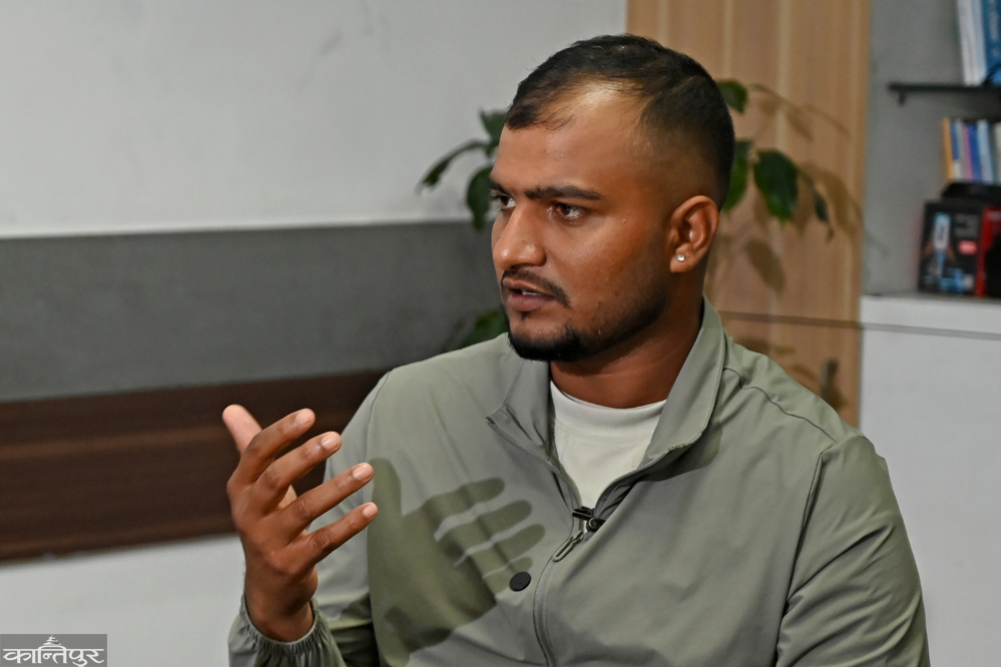
In an interview with Kantipur, Kushwaha, coordinator of the Farmers' Workers' Movement against Meter Bills, Nepal, says, ”If the agreement made with the government is not implemented honestly, the victims of meter bills will become even more victims.”
We use Google Cloud Translation Services. Google requires we provide the following disclaimer relating to use of this service:
This service may contain translations powered by Google. Google disclaims all warranties related to the translations, expressed or implied, including any warranties of accuracy, reliability, and any implied warranties of merchantability, fitness for a particular purpose, and noninfringement.
Against the backdrop of the failure to implement the previous agreements, the metered rate victims who walked the Janakpur-Kathmandu Justice Walk have reached a nine-point agreement with the government. This time, the agreement is somewhat detailed, and the implementation time has also been specified. However, the metered rate victims are concerned about the implementation issue. The dimensions of the metered rate problem, the reasons for the failure to implement the previous agreements and the implementation of the current agreement were discussed with the Nepal coordinator of the Farmers and Workers' Movement against Metered Rate, Awadhesh Kushwaha . The following is a conversation with Janakraj Sapkota for Kantipur: What is the main achievement of the 9-point agreement between the metered rate victims and the government? How to understand it?
This agreement is somewhat different from the one made with the previous government. The government has also tried to look at it differently. The agreement states that some work will be done within a specific time frame. But many issues depend on how the government implements this agreement. Because the meter-rate farmers have been in continuous agitation for the past four years. There have been some achievements in that process. There were four written agreements in the past. But they could not be implemented in the way they should have been. And the victims suffered even more. Due to incidents like auctioning of houses and land and issuing arrest warrants one after another, there was a need to protest again. This time, we had walked on a justice walk from Tirhutiagachhi in Dhanusha to Kathmandu to hold a final protest. After reaching Nijgadh, Home Minister Sudhan Gurung himself came for talks. There, we had formal and informal talks and an agreement was reached. Based on that agreement, we came to Kathmandu. After further talks with government representatives at the Prime Minister's Office, a 9-point agreement was reached. There is a mixture of hope and disappointment. The reason for the disappointment is that, like in the past, if this agreement is not implemented, the problem will repeat itself. Hope is that there is a new government and it has committed to doing something. Therefore, our agreement should be implemented honestly and completely.
What is the difference between the previous agreements with the government and the agreement reached this time?
The current agreement aims to eradicate the meter badge abuse. It is expected to be announced by the Council of Ministers in a few days. In the past, a commission and a task force were formed to solve the meter badge problem, but the agreement was not fully implemented. This time, issues such as making a special act and establishing a tribunal to look into the meter badge issue have been added.
You had also seen the previous agreement as an achievement. But the achievement you sought was not achieved from it. Where was the problem, in the agreement or in the government's style? Or in something else?
In the past, the agreements made by the government were not implemented as they should have been. The government also failed to implement them honestly. After that, various new problems were added. Meter billers went to court in droves and arrest warrants were issued against meter bill victims. Many people's houses were auctioned. Many meter bill victims were forced to flee their homes for fear of being arrested. That is why this problem has become even more complicated now. If the new agreement is not implemented honestly, meter bill victims will become even more victims.
It is heard that a large number of arrest warrants have been issued in the names of meter bill victims from some districts. Can you tell us something about this?
 Hundreds of arrest warrants have been issued by courts in some districts. For example, victims have said that 15-16 hundred arrest warrants have been issued in Dhanusha alone. The practice of meter badges was used by unfairly interpreting the issue of transactions and the situation that has led to a large number of victims leaving their homes is unfortunate. Apart from Dhanusha, we have only 5 to 7 thousand victims, who are running away due to fear of arrest warrants.
How big a problem is the meter badge problem for Nepali society? How many Nepalis do you estimate are victims of this problem?
Earlier, 70 thousand victims have filed applications in the commissions and task forces formed by the government. Apart from this, a large number of victims have also reached the district police. But the police have not made public the integrated data on how many such complaints have been filed in police offices across the country. There are also a large number of victims who have not come into contact with the government. Looking at all this, the number of meter interest victims across the country is around 4-5 lakhs. This problem is most prevalent in eight districts of Madhesh Province. Apart from that, it has also spread to other provinces including Lumbini, Kochi, and Sudurpaschit. In rural areas, there is a trend of fake Tamsuk, blind people, and in small and big cities, before paying the interest, a blank check is signed by the interest taker and the meter interest taker puts his own favorable amount in it and registers a case of check bounce.
It is not possible to understand meter interest in a single style. What are the problems and trends in it?
The problems of meter interest vary from place to place. The most complicated problem is in Madhesh Province. Where we have heard of cases where a moneylender made a Tamsuk of three to four lakhs when taking one lakh rupees as interest. And we have also heard that some people initially take the property and then grab the property if they do not pay the amount on time. There are many issues like getting a blank check signed when giving money on interest, taking three to four times more interest than the amount, making a Kapali Tamsuk more than the amount. In many cases, it is seen that a single moneylender has given money on interest to more than three or four hundred people. This is happening in the style of an institutional crime. Especially Dalits and people from weak economic status have fallen into the trap of meter interest. Some people ask why they had to take a loan from a moneylender? I also hear them saying that there are banks and cooperatives. But the problem in the village is different. We should also understand why people are forced to take money on meter interest. That alone explains the depth of this problem.
For example, in many places in our Susta rural municipality, there is a border problem with India. Again, banks do not agree to give loans by keeping land in the villages near the border with India. Banks there do not give other types of loans either. Due to this situation, some are forced to take loans from local people. Illiterate and poor people do not even have access to banks and cooperatives. Due to lack of employment within the country, people are forced to go for foreign employment. Even for foreign employment, the rule of 'free visa, free ticket' as promised by the government is not in practice. You have to pay a high fee. It costs at least three to four lakhs. For which, local people fall into the trap of meter interest lenders. There is also a bad practice of dowry in Madhesh. The compulsion to spend a lot of money on dowry for a daughter's marriage is also encouraging meter interest. Sukum dwellers and landless people are even more economically weak and are forced to take refuge in meter interest for social behavior. To understand how weak the financial access of citizens is, it is enough to look at the metered rate victims. That is why it is necessary to understand such social problems.
Some of the metered rate victims are in agitation. Some are running away for fear of being arrested. Some may even be in jail. Can you explain this problem?
The problem of metered rate is quite complicated. As for the situation, a single moneylender in Sunsari has issued arrest warrants against 70/80 people. The arrest warrants have been issued in the name of those people who live on undisclosed land. Some are landless. They have to support their families on daily wages. They have no way to get a loan and are trapped in fake Tamsuk. One example is Sunita Sah of Dhanusha. She took a loan of 1.5 lakh. The paper was drawn up, worth four lakhs. The creditor registered a case with interest on it. The court issued an arrest warrant. She was arrested. She is now in jail.
How many people are currently in jail due to the metered interest problem? Do you have any data on this?
We do not have accurate data. But about 4/5 hundred victims who have come in contact with us are in jail. Most of them are from Madhesh Province.
You have staged various protests since 2079 BS – in the district, village or capital. What are the achievements of such protests?
In 2079 BS, for the first time, victims of Nawalparasi and West Terai came to Kathmandu to protest for justice. In 2080 BS, there were two walking justice marches from Bardibas in Mahottari to Kathmandu and from Mechi Mahakali to Kathmandu. Our movement started the debate that this is also a problem. Awareness has developed that metered rate is an illegal business and that it is not a good practice. Some victims have received relief, although in small numbers. Some have had their land confiscated returned. The number of people who have to hide and run away to India due to fear of being evicted and arrested has decreased somewhat. But this problem has not been completely eradicated. Even now, tens of thousands of victims have not been able to get justice. The work of investigating the financial resources of those who run the metered rate business, how one person was able to give money to hundreds of people at interest and what kind of work was done on it remains to be done. The problem has become more frequent since the previous agreements were not fully implemented. We hope that it will end now.
The previous four agreements could not be fully implemented. How confident are you that the current agreement will be fully implemented?
Looking at history, the state has shown hope and ultimately disappointed. That is why we are not yet in a position to be confident. Now our demand is that the agreement be implemented fully and honestly. That is why we will be confident only after the agreement is implemented. The consistency with which the government negotiated and reached the agreement has made us hopeful.
How do you understand the implementation phase of this agreement?
 It has been said that the Council of Ministers will announce the abolition of the meter badge system. The first work should start from here. Second, it has been said that the work of making a special act and forming a tribunal to look into meter badge cases will be completed within three months. Preparations for this have to be started. Now, there is a matter of forming a team in the Prime Minister's Office to implement all this work. There has also been a matter of forming operational committees in each district and monitoring. If all the processes continue, something will be resolved. But how this work will be done remains to be seen.
If the implementation of the current agreement does not go as planned or does not work as expected, what will be the path you will take?
We have been agitating for justice since the beginning. Our agitation has been going on from house to house, from town to ward to district for four years. In the past, we had also surrounded the courts and district administration for justice. Therefore, if the problem is not resolved even now, we do not see any other way except agitation.